

12 Top Legal AI Companies to Know in 2026
Choosing the right legal technology vendor is not simple anymore. Dozens of platforms claim to draft contracts, research case law, or prepare litigation strategy, and picking among the top legal ai companies means separating genuine capability from marketing copy. If you are an independent lawyer, a firm partner, or an in-house counsel comparing options for 2026, you need a clear evaluation framework, not another vague roundup.
This article gives you that answer directly. Below, you will find 12 companies building real products for contract lifecycle management, litigation preparation, legal research, and legal education, each assessed on what they actually do rather than what they promise in a press release.
We cover platforms serving Indian law firms alongside those built for US and UK practice, so you can judge fit against your own jurisdiction and workflow, much like our legal AI software comparison for Indian firms. Along the way, we reference benchmark performance on legal reasoning tasks, including what benchmark studies show about AI and lawyers in legal research and how tools like LeXi AI measure accuracy on statutory interpretation and case analysis, so you can compare vendors on measurable results rather than assumptions.
1. LeXi AI
What it does

LeXi AI is a legal intelligence platform built specifically for Indian law, with additional coverage for US and UK practice. It brings contract lifecycle management, litigation preparation, legal research, and legal education into one connected system instead of forcing you to stitch together separate tools for drafting, case law search, and document review. The platform is designed around the reality that most Indian lawyers juggle contracts, court filings, and research in the same week, often on the same matter.
Unlike general-purpose AI models retrofitted for legal work, LeXi AI trains its reasoning on Indian statutes, case law, and commercial contract patterns. On the AIBE 20 legal reasoning dataset, LeXi AI scored 98.95 percent accuracy on statutory interpretation and case analysis tasks, ahead of GPT 5.5, Gemini 3.1 Pro, Deepseek v3.2, and Claude Opus 4.8. That gap matters because a legal AI company competing on general benchmarks is not the same as one competing on Indian commercial law specifically.
A legal AI tool is only as useful as its accuracy on the law you actually practice, not the law it was trained to sound fluent in.
Key features
LeXi AI organizes its capability into four connected modules rather than one generic chatbot:
- LeXi LiTT: AI-assisted drafting, case strategy building, and courtroom preparation at scale
- LeXi Desk: contract drafting, clause risk analysis, clause generation, translation, and document summarization
- LeXi Agent: legal research, precedent analysis, and drafting acceleration with verified sources
- LeXi Academy: AI-guided learning for law students covering research, drafting, and case understanding
Beyond these modules, the platform offers instant judgment search across verified databases, indemnity and liability risk flagging in contracts, summarization of case files running 400 pages or more, enterprise APIs for firms building custom workflows, and mobile access so you stay connected to a matter outside the office.
Who it is for
Firms and chambers handling high litigation volume benefit most from LeXi LiTT, while corporate legal teams managing vendor and employment contracts lean on LeXi Desk for clause risk analysis. Independent lawyers who need fast, verified research without a research team get direct value from LeXi Agent and its AI-assisted legal research. Law students preparing for practice, meanwhile, use LeXi Academy to build drafting and research skills before they ever touch a live file, which sets LeXi AI apart from tools built purely for practicing lawyers.
Pricing
LeXi AI structures pricing around practice size and module use rather than a single flat fee, since a solo litigator and a 200-lawyer firm need very different levels of access. Enterprises building custom systems on top of the API get separate commercial terms. You can review current plans and module-based rates and request a demo directly on the LeXi AI pricing page.
2. Harvey AI
What it does
Harvey AI is a legal AI platform built with OpenAI and backed by major law firm partnerships, designed for large corporate practices handling complex transactional and litigation work. It positions itself as a general-purpose legal assistant that plugs into a firm's existing document management and research workflow rather than replacing it outright. Harvey markets heavily toward Big Law firms in the US and UK, with case studies built around firms like Allen & Overy and PwC.
A tool built for the top 100 global firms will not automatically fit a 15-lawyer chamber with different documents, budgets, and matter volume.
Key features
Harvey's core strength lies in document analysis, drafting assistance, and due diligence support across large datasets of contracts and filings. It offers:
- Contract analysis and drafting support across multiple document types
- Due diligence workflows for M&A and transactional teams
- Custom model fine-tuning for individual firm knowledge bases
- Integration with firm document management systems
Most of these features assume access to a firm's internal precedent library, which smaller practices often lack.
Who it is for
Harvey suits large international firms with dedicated innovation teams and budgets to manage a custom deployment. Corporate legal departments at multinational enterprises also use it for due diligence acceleration on high-volume transactions. Independent lawyers and small Indian firms will find limited direct relevance, since Harvey's tooling and pricing assume enterprise scale rather than solo or small-team practice.
Pricing
Harvey does not publish public pricing. Access requires a direct sales conversation, and reports from firms that have adopted it suggest enterprise-level contracts running into significant annual commitments, well beyond what most independent practitioners or mid-sized Indian firms would consider for a single legal AI tool.
3. Legora
What it does

Legora is a European legal AI platform, built in Sweden, that positions itself as a collaborative AI workspace for lawyers rather than a single-purpose tool. It lets teams work inside shared AI-assisted workflows for contract review, due diligence, and research memos, with multiple lawyers editing and querying the same matter simultaneously. The platform has gained traction with large firms in the UK and Europe, and it has started expanding into the US market through partnerships with firms handling cross-border transactional work.
A workspace built for team collaboration solves a different problem than a tool built for solo drafting speed.
Key features
Legora structures its offering around a few core workflows rather than a broad feature list:
- Collaborative document review with multiple lawyers working on one AI session
- Contract analysis and clause comparison across large document sets
- Research assistance drawing on uploaded firm precedents and public sources
- Workflow templates for due diligence and transactional review
These features suit firms that already run structured deal teams, since the value comes from shared context across a matter rather than individual productivity gains.
Who it is for
Mid-size and large firms running multi-lawyer deal teams get the most from Legora, particularly in transactional practice areas like M&A and finance. Corporate legal departments handling recurring due diligence cycles also find the collaborative structure useful. Solo practitioners and small Indian firms working mostly independent matters will likely find the collaboration-first design adds complexity without matching benefit.
Pricing
Legora follows an enterprise sales model without published rates, requiring a demo and custom quote based on firm size and matter volume. Reports from adopting firms suggest contract-based pricing tied to seat count, similar to other Big Law focused platforms, which puts it out of reach for most solo and small-firm budgets in India.
4. Spellbook
What it does
Spellbook is a contract drafting add-in that works directly inside Microsoft Word, built on GPT models and aimed at transactional lawyers who draft and negotiate agreements all day. It does not ask you to leave your existing tools. Instead, it layers AI suggestions, clause redlines, and risk flags onto the document you already have open. That approach has made it popular with corporate and transactional lawyers in the US who want AI help without learning a new interface.
A tool that lives inside Word removes the adoption barrier that kills most legal AI rollouts.
Key features
Spellbook focuses narrowly on drafting and negotiation rather than research or litigation. Its core capabilities include:
- Clause and provision suggestions based on the document type
- Redline generation against a counterparty's draft
- Risk flagging for missing or unfavorable terms
- Playbook creation so a firm can encode its own negotiation positions
This narrow focus means Spellbook does not attempt case law research, litigation support, or legal education tools, unlike broader platforms in this list.
Who it is for
Transactional lawyers who spend most of their week negotiating NDAs, master service agreements, or vendor contracts get the clearest benefit from Spellbook. Corporate legal teams already standardized on Word find it easy to roll out since there is no separate platform to learn. Litigators and researchers, and firms whose primary need is Indian case law or courtroom preparation, will find Spellbook offers little outside contract drafting.
Pricing
Spellbook publishes tiered pricing on its website, starting with individual plans priced per user per month, and moving to team and enterprise tiers with volume discounts. Enterprise pricing requires a sales conversation and typically adds custom playbook configuration and dedicated support, which raises the effective cost for firms wanting deeper customization.
5. SpotDraft
What it does
SpotDraft is a contract lifecycle management platform built for in-house legal and business teams that need to draft, negotiate, sign, and track agreements without hopping between five different tools. It combines a contract repository, an approval workflow engine, and AI-assisted review into one system, targeting companies that generate high contract volume, like SaaS businesses and mid-size enterprises. The platform has built a strong base among US startups and scale-ups, with growing adoption among Indian companies running lean legal teams.
A contract platform earns its keep only when business teams outside legal can use it without calling legal for every clause question.
Key features
SpotDraft centers its product around contract visibility and speed rather than deep legal research. Core capabilities include:
- AI-powered contract review flagging risky or nonstandard clauses
- Centralized repository with searchable metadata across all agreements
- Approval workflows that route contracts to the right stakeholder automatically
- E-signature integration and renewal or expiry tracking
These features suit teams managing hundreds of vendor and customer contracts rather than firms handling litigation or courtroom drafting.
Who it is for
Corporate legal teams and startup general counsel offices get the most value here, especially those without a large legal ops staff to manage contracts manually. Businesses running high-volume sales agreements, like SaaS renewals or vendor onboarding, benefit from the automated tracking. Law firms and litigators, along with anyone needing Indian case law research or courtroom preparation, will find SpotDraft outside its intended scope entirely.
Pricing
SpotDraft offers tiered plans starting with a Starter package for smaller teams, moving up to Growth and Enterprise tiers priced on contract volume and user count. Published pricing exists for lower tiers, but enterprise deployments with custom integrations require a direct sales quote, similar to most legal ai companies targeting corporate buyers rather than solo practitioners.
6. Luminance
What it does

Luminance is a UK-founded legal AI platform built around pattern recognition technology rather than pure large language model chat. It reads and analyzes contracts at scale, flagging anomalies, missing clauses, and deviations from a firm's standard positions across thousands of documents at once. The platform grew out of due diligence work and still shows that heritage, with strengths in bulk document review that many chat-first tools cannot match.
A platform built to read ten thousand contracts overnight solves a different problem than one built to draft a single agreement well.
Key features
Luminance splits its offering across pre- and post-signature contract work rather than treating drafting as a single step. Core capabilities include:
- Bulk contract analysis for due diligence, flagging risk and anomalies across large document sets
- Post-signature contract management with obligation tracking and renewal alerts
- AI-assisted drafting and negotiation support inside familiar document formats
- Custom risk models trained on a firm's own historical contract data
Firms running frequent M&A due diligence or portfolio reviews get the clearest return from these bulk-analysis tools among the top legal ai companies covered here.
Who it is for
Corporate legal departments managing large contract portfolios, along with firms running M&A due diligence at volume, represent Luminance's core market. Enterprises needing contract lifecycle management across thousands of legacy agreements also find real value in the bulk-review capability. Independent lawyers and small firms focused on litigation, Indian case law research, or courtroom preparation will find Luminance built for an entirely different workflow.
Pricing
Luminance does not publish standard pricing and instead sells through direct enterprise contracts negotiated per deployment. Quotes typically factor in document volume, number of users, and whether the firm wants custom risk model training on its own contract history, which pushes total cost well above tools priced for individual practitioners.
7. Ironclad
What it does
Ironclad is a contract lifecycle management platform built for enterprise legal and procurement teams that need a single system for every stage of a contract, from intake to signature to renewal, which is how CLM works in practice. It positions itself less as a drafting assistant and more as the operational backbone that legal, sales, and procurement teams use to move agreements through approval without email chains. The platform has built deep integrations with Salesforce and other business systems, which is why it shows up so often in enterprise procurement stacks rather than law firm toolkits.
A contract system earns adoption when sales and procurement use it without ever opening a legal ticket.
Key features
Ironclad organizes its product around workflow automation rather than legal reasoning depth. Core capabilities include:
- Configurable approval workflows connecting legal, sales, and finance teams
- AI-assisted clause analysis and contract data extraction
- Native integrations with Salesforce, Slack, and major e-signature tools
- Searchable repository with obligation and renewal tracking across every executed agreement
These features suit organizations managing high contract volume across departments rather than firms needing courtroom preparation or statutory interpretation support.
Who it is for
Enterprise legal departments and procurement teams running dozens of contract types across multiple business units get the strongest return here. Companies already standardized on Salesforce find the integration reduces friction significantly. Law firms, litigators, and anyone comparing top legal ai companies for Indian case research or drafting acceleration will find Ironclad addresses a different problem entirely, since it assumes an in-house buyer rather than a practicing advocate.
Pricing
Ironclad does not publish standard rates and sells through direct enterprise contracts scaled to contract volume, user count, and integration complexity, so it helps to know what CLM software actually costs before the call. Expect a sales cycle involving procurement and IT before a quote arrives, which suits large organizations but adds friction for smaller legal teams wanting quick deployment.
8. CoCounsel by Casetext and Thomson Reuters
What it does
CoCounsel started as Casetext's AI legal assistant before Thomson Reuters acquired the company and folded it into its research ecosystem alongside Westlaw. It functions as a task-based AI assistant rather than a chat window, meaning you assign it a specific job, like reviewing a deposition transcript or summarizing a contract, and it returns structured output built for that task. The integration with Westlaw gives it access to a research database that most standalone legal AI tools cannot match in the US market.
An AI assistant built around discrete legal tasks produces more usable output than one built around open-ended chat.
Key features
CoCounsel organizes its capability around named skills rather than a single generic prompt box. Core capabilities include:
- Document review and summarization across depositions, contracts, and discovery files
- Legal research memos drawing on Westlaw's case law database
- Deposition preparation and timeline building from case documents
- Contract analysis flagging clauses against a set playbook
This task-based structure suits litigators who want a defined deliverable rather than an open conversation with a model.
Who it is for
US litigation teams already subscribed to Westlaw get the clearest value, since CoCounsel builds directly on that research infrastructure. Mid-size and large firms handling discovery-heavy litigation benefit from the deposition and document review skills. Indian firms and independent lawyers researching Indian statutes and case law will find limited relevance here, since CoCounsel's research depth is built around US federal and state law rather than Indian commercial law.
Pricing
Thomson Reuters bundles CoCounsel access into Westlaw subscription tiers or sells it as an add-on, with pricing quoted directly through a sales team rather than published online. Costs scale with firm size and existing Westlaw commitments, which makes standalone adoption difficult for firms not already inside that ecosystem.
9. LexisNexis Lexis+ with Protégé
What it does
LexisNexis built Protégé as a generative AI layer on top of Lexis+, its long-standing research and citation platform used widely across the US and increasingly in international markets. Protégé answers legal questions, drafts research memos, and summarizes case law while citing directly back to sources inside the Lexis+ database, which gives it an edge over general AI tools that cannot verify their own citations. This positions Lexis+ with Protégé as one of the more established legal ai companies in this list, backed by decades of legal publishing infrastructure rather than a startup research budget.
A research assistant that cites its own source database beats one that generates confident-sounding but unverifiable case references.
Key features
Protégé builds its assistant functions directly into the existing Lexis+ research workflow rather than launching a separate product. Core capabilities include:
- Natural language legal research with citations linked to primary sources
- Document summarization for case law, statutes, and briefs
- Drafting assistance for memos and research summaries
- Personalized workflows that learn a user's practice area over repeated queries
These features work best for lawyers who already rely on Lexis+ for daily research rather than those starting fresh.
Who it is for
Litigators and researchers already subscribed to Lexis+ get the most direct benefit, since Protégé sits inside a tool they already use daily. Law firms handling US federal and state litigation, where Lexis+ coverage runs deep, find real time savings on research memos. Indian lawyers and firms focused on Indian statutes and precedent will find the underlying database thin for local law, since Lexis+ coverage in India does not match its US depth.
Pricing
LexisNexis bundles Protégé into existing Lexis+ subscription tiers or offers it as a paid add-on, with exact rates disclosed only through a sales conversation. Cost depends on firm size, jurisdiction coverage, and existing subscription level, which makes the total price hard to compare against flat-rate legal AI tools.
10. Kira Systems
What it does

Kira Systems is a contract analysis platform built for due diligence, now operating under Litera after its acquisition. It uses machine learning models trained to identify and extract specific clauses, like change of control provisions or assignment restrictions, across hundreds of contracts at once. Kira built its reputation in M&A due diligence rooms, where lawyers used to spend weeks reading agreements manually before the software cut that time down significantly.
A tool trained to spot one clause type across a thousand documents saves more hours than a chatbot answering questions one at a time.
Key features
Kira organizes its product around clause-level extraction rather than open-ended drafting or research. Core capabilities include:
- Pre-built machine learning models for common due diligence clause types
- Custom model training on a firm's own document sets
- Provision comparison across large contract batches
- Reporting tools that summarize findings for deal teams
These features suit structured due diligence work far more than day-to-day drafting or courtroom preparation.
Who it is for
Corporate law firms running frequent M&A due diligence get the clearest return from Kira, since the pricing and setup assume repeated bulk-review projects. Enterprises managing large contract lifecycle portfolios during acquisitions also find the extraction accuracy useful for legacy document review. Litigators, independent lawyers, and firms comparing top legal ai companies for Indian statutory research or drafting will find Kira built for a narrower, transactional purpose entirely.
Pricing
Kira does not publish standard rates and sells through Litera's enterprise sales team, with quotes built around document volume, custom model training needs, and user count. Firms should expect a multi-week evaluation process before pricing, since deployment typically involves testing extraction accuracy against a firm's own sample contracts first.
11. Clio Duo
What it does
Clio Duo is the AI assistant built into Clio, the practice management platform used widely by small and mid-size firms across the US, UK, and Canada. Rather than functioning as a standalone research or drafting tool, Duo works inside the same system where a firm already tracks matters, time entries, billing, and documents. It answers questions about a specific matter by pulling directly from that firm's own case data, which sets it apart from general-purpose assistants that have no visibility into your files.
An AI assistant that already knows your matter history saves more time than one you have to brief from scratch every session.
Key features
Duo builds its functions around practice management data rather than open legal research. Core capabilities include:
- Matter summaries pulled from existing case notes, documents, and communications
- Natural language search across a firm's own Clio records
- Drafting assistance for client communications and basic documents
- Task and deadline suggestions based on matter activity
These features work only as well as the data already sitting inside Clio, so firms with thin or disorganized records get less value from the assistant.
Who it is for
Small and mid-size firms already running their practice on Clio get the clearest benefit, since Duo adds AI capability without requiring a new platform migration. Solo practitioners managing client communication and scheduling alongside casework find the matter-summary feature genuinely useful day to day. Firms outside the Clio ecosystem, along with Indian lawyers needing statutory research or courtroom drafting support, will find Duo tied too closely to a practice management tool built primarily for Western jurisdictions.
Pricing
Clio bundles Duo into its higher-tier practice management plans rather than selling it as a separate product, with exact availability depending on subscription level and region. Firms should check current plan tiers directly with Clio, since Duo access has expanded gradually since its 2023 launch.
12. Draftwise
What it does
Draftwise is a contract drafting and precedent search platform built for transactional lawyers who spend their days comparing clause language across past deals. It indexes a firm's own historical contracts and lets lawyers search that library the way they would search case law, pulling up how the firm has handled a specific indemnity clause or termination provision before. The company positions itself against manual precedent hunting, the practice of digging through old deal folders to find language a senior partner used two years ago.
A firm's own contract history is often its best precedent bank, if someone builds a way to search it properly.
Key features
Draftwise centers its product on precedent intelligence rather than open-ended drafting or research. Core capabilities include:
- Clause-level search across a firm's own historical contract library
- Drafting suggestions pulled from precedent language rather than generic AI output
- Comparison tools showing how a clause has varied across past deals
- Integration with Word for in-line suggestions while drafting
These features depend heavily on the quality and volume of a firm's existing contract archive, so newer firms with thin document libraries see less benefit early on.
Who it is for
Mid-size and large transactional firms with deep contract archives get the strongest return here, particularly practice groups that repeat similar deal structures across clients. Corporate legal teams negotiating recurring agreement types, like licensing or supply contracts, also find value in the clause comparison tools. Independent lawyers, litigators, and firms comparing top legal ai companies for Indian case research or courtroom preparation will find Draftwise addresses a narrow transactional need rather than a full practice workflow.
Pricing
Draftwise does not publish standard pricing and sells through direct sales conversations, with quotes shaped by firm size, document volume, and number of users. Firms typically go through an evaluation period where Draftwise indexes a sample of contracts before a final quote, adding time to the procurement process compared to platforms with published tiers.
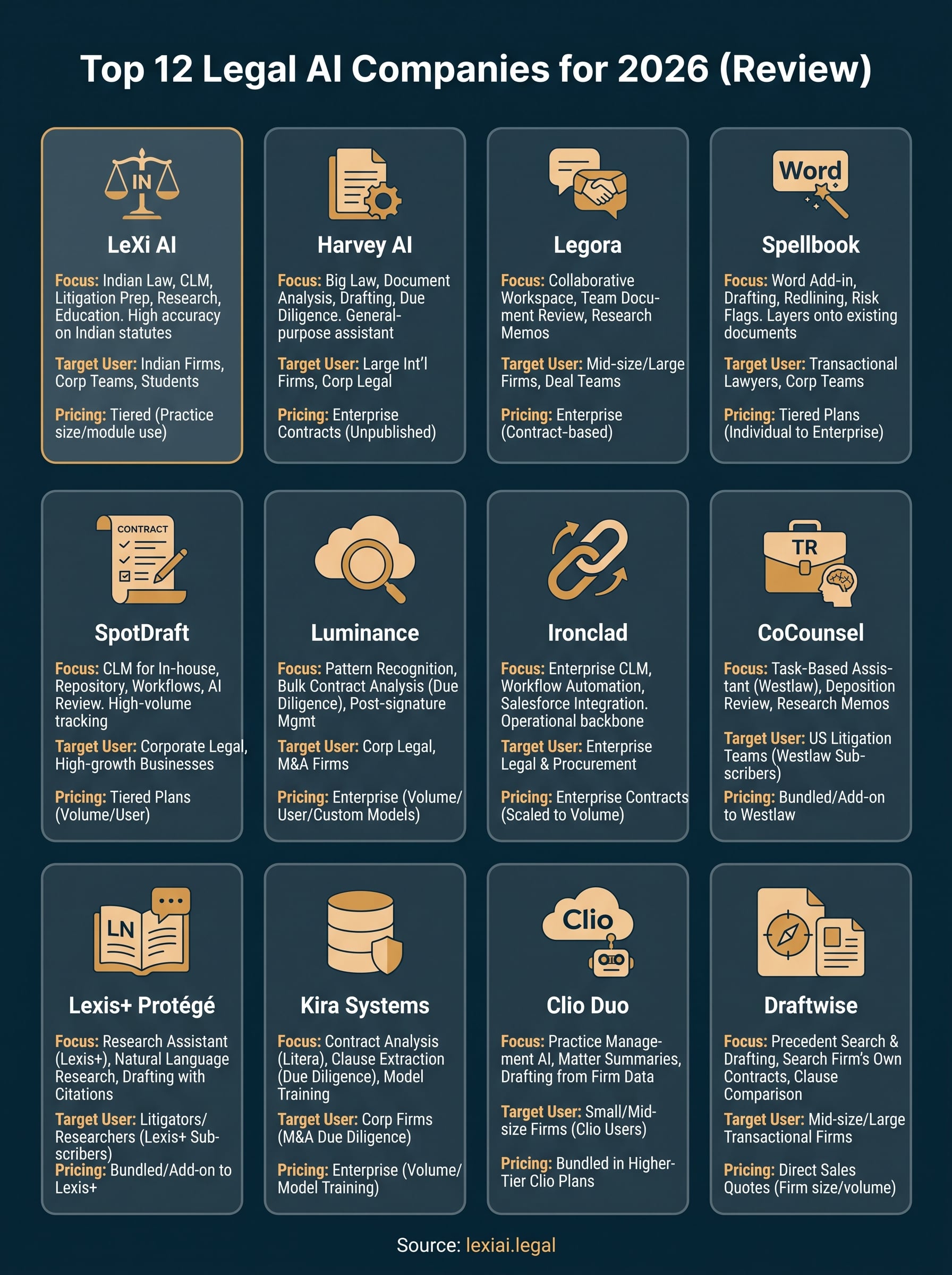
Choosing the right legal AI tool for your practice
Most of these platforms solve one problem well. Harvey and Legora suit Big Law budgets. Spellbook and Draftwise focus narrowly on drafting inside Word. SpotDraft, Ironclad, and Luminance handle contract volume for corporate teams. CoCounsel and Lexis+ Protégé work best if you already pay for Westlaw or LexisNexis. None of them, though, were built around Indian statutes, case law, and commercial contract patterns the way LeXi AI was.
If your practice touches litigation prep, contract review, research, and training junior lawyers in the same week, running four separate subscriptions gets expensive and slow. A connected platform built for Indian legal work removes that friction instead of adding another tool to your stack.
Compare the benchmark accuracy and module depth yourself before committing to a vendor. You can try LeXi AI free and see how it handles your own contracts and case files before you decide.