

Promissory Note Format: Sample and How to Draft One
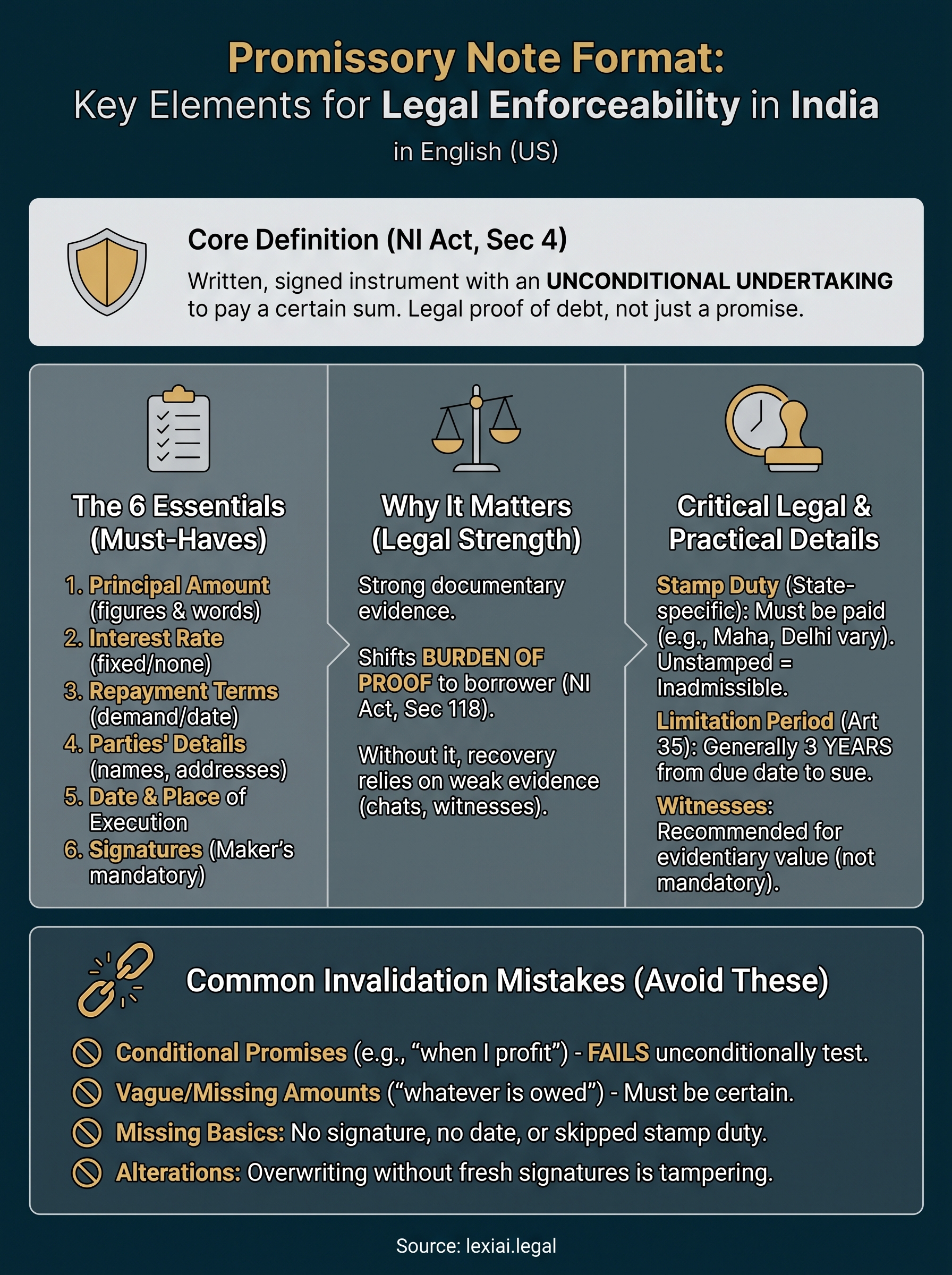
A promissory note format needs six things to hold up: the loan amount, interest rate, repayment schedule, names of borrower and lender, date, and signatures. Miss any of these and you have a document that reads like a promise but does not work as legal proof of a debt. Under Section 4 of the Negotiable Instruments Act, 1881, a promissory note is a written, signed instrument with an unconditional undertaking to pay a certain sum, and Indian courts have repeatedly refused to enforce notes that skip these basics.
If you searched for this format because a friend, relative, or business contact needs money and you want the loan on paper, you are in the right place. This article gives you a sample promissory note you can copy, edit, and use the same day, along with a clause-by-clause breakdown of why each line matters.
We cover the difference between a demand note and an installment note, when you need stamp paper and witnesses, and how courts have treated informal IOUs versus properly drafted notes in recovery suits. Lawyers drafting these for clients, and business teams handling recurring loan documentation, can also use LeXi AI's drafting tools to generate and check notes against these same requirements before signing.
Why a promissory note format matters under Indian law
A promissory note format is not just paperwork, it decides whether you can actually recover your money if the borrower stops paying, usually starting with a legal notice for recovery of money. Courts treat a properly worded note as strong documentary evidence of debt, shifting the burden onto the borrower to prove the money was never owed, under Section 118 of the Negotiable Instruments Act, 1881, which presumes consideration in a validly executed note.
A promissory note that skips the standard format is just a signed piece of paper, not proof of debt.
Enforceability and evidentiary value
Judges across India have thrown out recovery suits where the note lacked a certain sum, a clear repayment date, or a proper signature. In Bhagwan Das v. Rajmal and similar rulings, courts have held that vague or conditional promises fail the test of Section 4, since the Act requires an unconditional undertaking to pay. Without that certainty, your note becomes weak secondary evidence at best under the law of evidence in Indian courts, and the lender ends up relying on witness testimony, bank transfer records, or WhatsApp chats to prove the loan existed at all.
Stamp duty and limitation period requirements
Every state has its own stamp duty rule for promissory notes under the Indian Stamp Act, 1899, and an unstamped or under-stamped note can be inadmissible in court until the deficient duty and penalty are paid.
| State | Typical Stamp Duty on Promissory Notes |
|---|---|
| Maharashtra | 0.1% of loan amount, subject to state notification |
| Karnataka | Fixed nominal duty for smaller amounts |
| Delhi | Ad valorem duty based on the sum secured |
Given this variation, check your state's current stamp act before executing the note, since rates change through amendments. Limitation also matters: under Article 35 of the Limitation Act, 1963, you generally have three years from the due date to sue on a promissory note, so a correctly dated note protects your right to recover the money later. Handled right, the format itself becomes your evidence, not just a record of intent.
Essential clauses every promissory note format must include
Every valid promissory note format needs the same core clauses, regardless of whether the loan is between friends or businesses. Leave one out, and you weaken the document's standing as a negotiable instrument under Section 4 of the Negotiable Instruments Act, 1881.
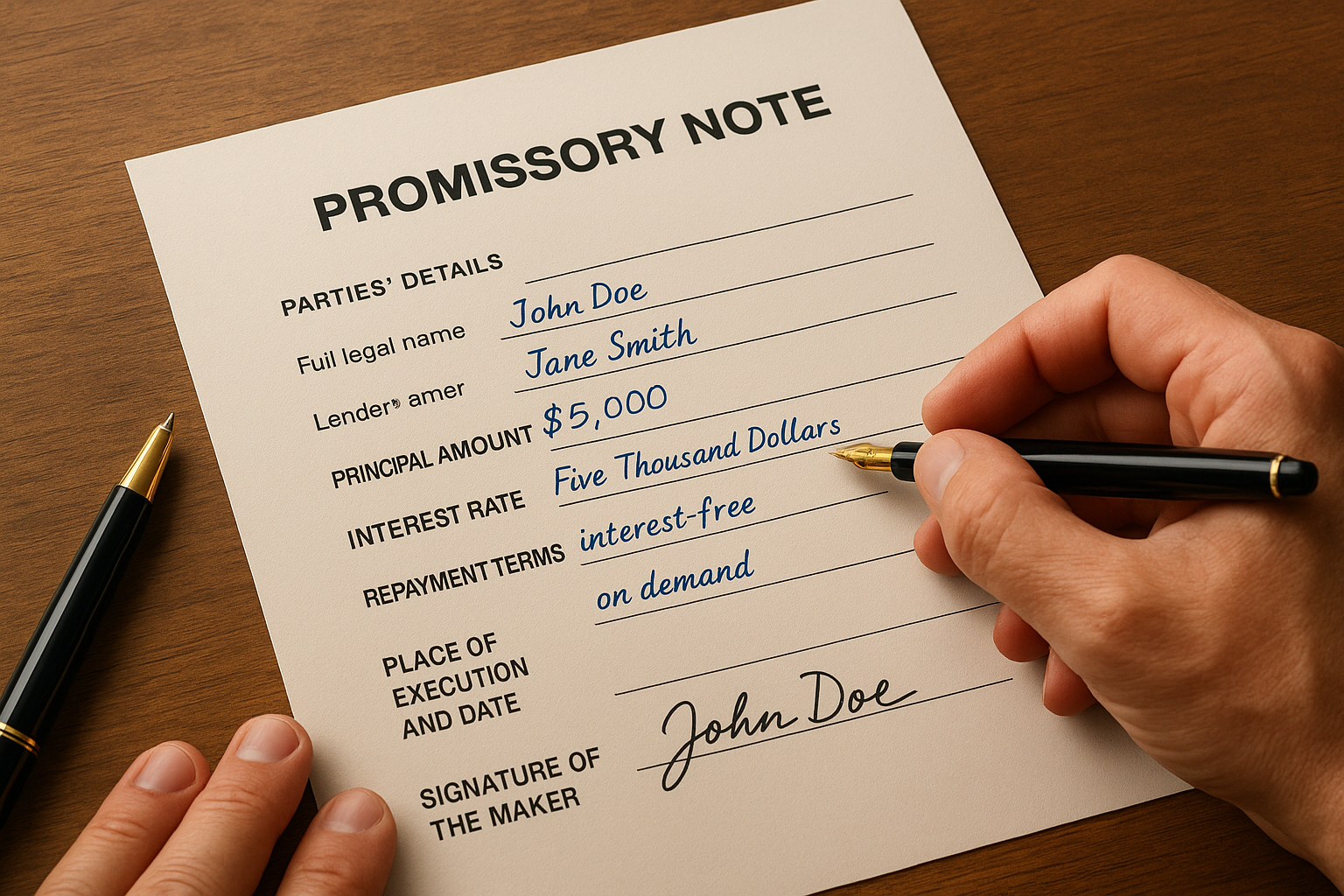
- Parties' details: Full legal names, addresses, and identification of borrower and lender.
- Principal amount: The exact sum lent, written in both figures and words to avoid disputes.
- Interest rate: Stated clearly as simple or compound, with the annual percentage, or marked "interest-free" if that is the intent.
- Repayment terms: Whether it is payable on demand, on a fixed date, or in installments, with due dates specified.
- Place of execution and date: Needed to calculate the limitation period and determine applicable stamp duty.
- Signature of the maker: The person promising to pay must sign, since an unsigned note has no legal force.
- Witness signatures: Not mandatory under the Act, but strongly recommended for evidentiary weight in disputes.
Skip even one clause, and your loan agreement template turns into a weak IOU that a court can easily question.
Beyond these, some lenders add a default clause specifying what happens if a payment is missed, such as accelerated repayment of the full balance, drafted in line with the bare text of the Indian Contract Act, 1872. Notes drafted for business loans often include a jurisdiction clause too, naming the court where disputes will be filed. Templates built for a promissory note sample rarely include this, so add it yourself if the loan involves a substantial amount.
How to draft a promissory note step by step
Start with the basics before you touch the wording, applying the same drafting skills that keep legal documents precise. Gather the loan amount, the repayment date or schedule, and the full legal names of both borrower and lender, since a correct promissory note format depends on having these facts settled before you write a single sentence.
- Decide whether the note is payable on demand or on a fixed date, since this changes the repayment clause entirely.
- Write the principal sum in both figures and words to remove any room for dispute.
- State the interest rate as a fixed annual percentage, or mark the loan interest-free if that is the deal.
- Add the place and date of execution, since both affect stamp duty and the limitation period later.
- Insert a default clause describing what happens if a payment is missed.
- Print two copies, sign both as the maker, and get at least one witness on each copy.
A note signed without a witness still works legally, but it becomes far harder to prove in court if the borrower denies the loan.
Finish by buying the correct stamp paper for your state and pasting or printing the note on it before signing, not after. Once signed, hand the original to the lender and keep the duplicate, since possession of the original often matters in recovery suits. Lawyers handling several such loan agreement drafts a month can run this same sequence through LeXi Desk to check clauses for gaps before the ink dries.
Sample promissory note format for a personal loan
Here is a ready promissory note format you can copy for a straightforward personal loan between two individuals. Fill in the brackets, print it on the correct stamp paper for your state, and sign in front of a witness.
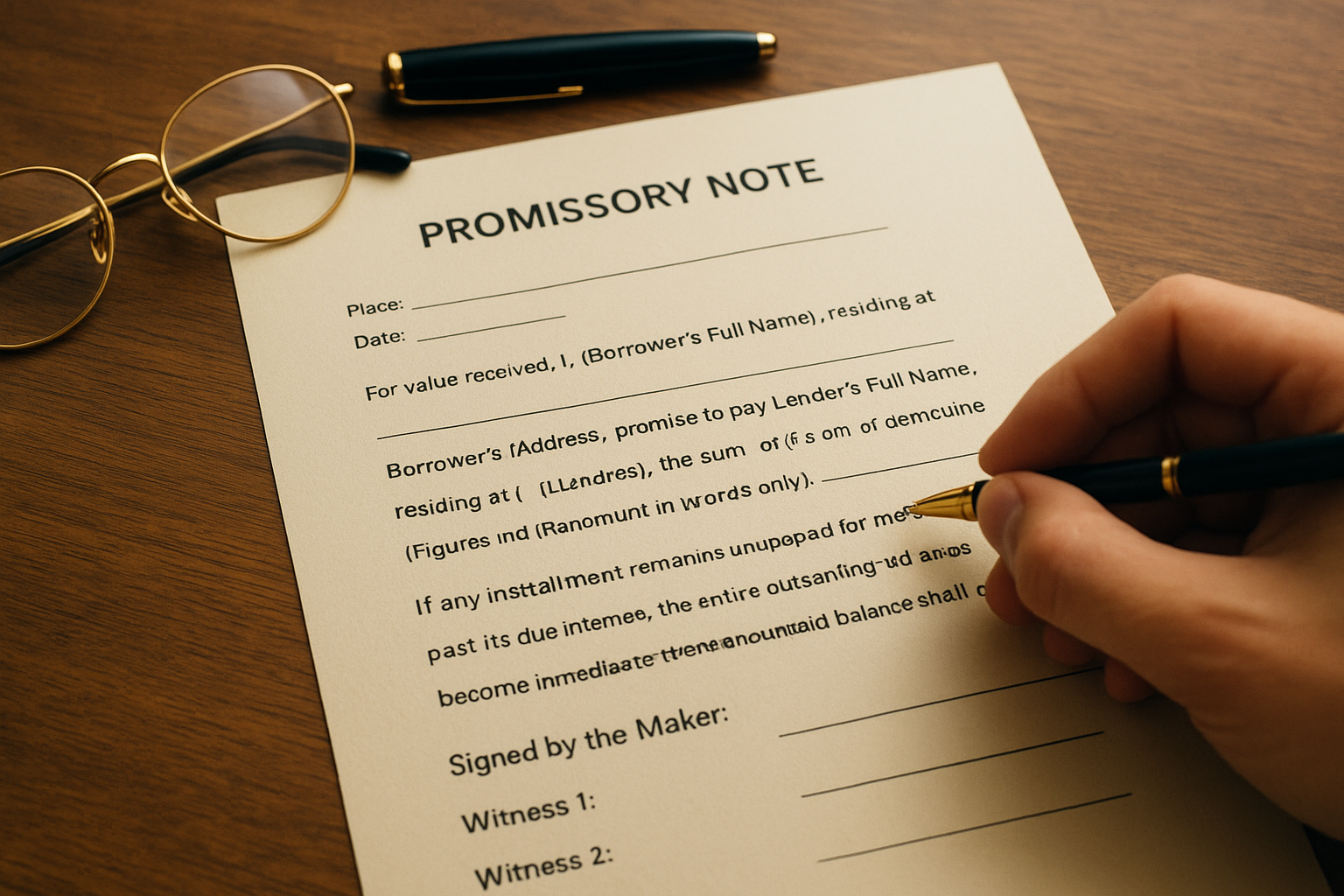
PROMISSORY NOTE

Place: [City, State]
Date: [DD/MM/YYYY]

For value received, I, [Borrower's Full Name], residing at
[Borrower's Address], promise to pay [Lender's Full Name],
residing at [Lender's Address], the sum of Rs. [Amount in
Figures] (Rupees [Amount in Words] only), on or before
[Repayment Date / "on demand"].

Interest shall accrue on the outstanding principal at the
rate of [X]% per annum, [simple/compound], payable
[monthly/at maturity].

If any installment remains unpaid for more than [X] days
past its due date, the entire outstanding balance shall
become immediately due and payable at the option of the
Lender.

Signed by the Maker:
_______________________
[Borrower's Name]

Witness 1: _______________________
Witness 2: _______________________
Notice how the loan agreement template above separates the principal, interest, and default clauses into distinct paragraphs rather than one dense block. Judges reading recovery suits look for exactly this kind of clarity when deciding whether the note meets Section 4 of the Negotiable Instruments Act, 1881.
A note that reads clearly to a stranger will read clearly to a judge too.
Once filled in, this promissory note sample works for salary advances, family loans, or small business credit, provided you adjust the interest and repayment lines to match the actual deal struck between the parties.
Mistakes that make a promissory note invalid
Most disputes over a promissory note format trace back to the same handful of drafting errors, not fraud or bad faith. Courts do not excuse sloppy wording just because both parties meant well, so it pays to know exactly what turns a valid note into a worthless IOU.
Conditional or vague payment promises
Often the problem starts with language that makes repayment contingent on something else, like "I will pay once my business turns a profit." Section 4 of the Negotiable Instruments Act, 1881 demands an unconditional undertaking, so any note tied to an external event fails the test outright. Vague sums, like "whatever is owed," cause the same failure since the amount must be certain and stated in both figures and words.
A conditional promise is not a promissory note, it is a wish written on paper.
Missing signatures, dates, or stamp duty compliance
Beyond wording, several procedural gaps quietly kill enforceability:
- No signature from the maker, leaving the note with no binding force at all
- No execution date, which blocks accurate calculation of the limitation period under Article 35 of the Limitation Act, 1963
- Skipping stamp duty under the applicable state stamp act, making the note inadmissible until penalties are paid
- Alterations or overwriting on the amount without fresh signatures nearby, which courts read as tampering
Noticing these patterns early, before a dispute lands in court or you are left tracking a debt recovery case online, saves you from discovering the flaw only after the borrower stops paying.
Before you sign the note
A correct promissory note format is the difference between recovering your money and losing it to a drawn-out dispute over what was actually promised. Get the six essentials right, principal, interest, repayment terms, party details, date, and signatures, and you have a document that stands up under Section 4 and Section 118 of the Negotiable Instruments Act, 1881, not just a signed page.
Double-check the stamp duty for your state, add a witness even though the Act does not demand one, and keep the wording unconditional throughout. If the loan involves a meaningful sum or a business relationship, get a lawyer to review the draft before either party signs, since a small clause gap now can cost far more later in a recovery suit.
If you draft these notes often, or advise clients who do, see how LeXi AI's legal drafting platform generates and checks your notes against these same requirements before anyone puts pen to paper.