

Police Complaint Format: How to Write One with Sample
You need to file a police complaint and you do not know where to start. A wrong format, a missing detail, or an unclear statement of facts can slow down your FIR registration or weaken your case later in court. Getting the police complaint format right the first time saves you multiple trips to the station.
This guide gives you the exact structure to follow: addressee details, your personal information, a clear statement of facts, the relevant sections if you know them, and a proper closing with signature. You will also find a ready-to-use sample covering a common scenario like theft or a lost document, so you can adapt it to your own situation instead of writing from scratch.
We cover what a written complaint must contain under the Code of Criminal Procedure framework, how it differs from an FIR, and what to do if the police refuse to act on it. If drafting still feels difficult, tools like LeXi AI can help structure the language correctly while you focus on getting the facts right.
When you need to file a police complaint letter
You file a written complaint any time you want the police to act on an incident but you are not physically sitting at the station reporting it verbally. This includes theft, cheating, harassment, cybercrime, a lost passport or Aadhaar card, or a property dispute that has turned threatening. A written police complaint creates a paper trail that a verbal report does not, which matters if the case drags on for months.
Cognizable versus non-cognizable offenses
Under the Bharatiya Nagarik Suraksha Sanhita, 2023, which replaced the CrPC in July 2024, the officer's response depends on whether the offense is cognizable or non-cognizable. Section 173 BNSS (formerly Section 154 CrPC) requires the officer to register an FIR immediately for a cognizable offense. For non-cognizable offenses, the officer records your complaint in a daily diary but cannot investigate without a magistrate's order.
| Offense type | Example | Officer's duty |
|---|---|---|
| Cognizable | Theft, assault, robbery | Register FIR immediately, no permission needed |
| Non-cognizable | Minor scuffle, defamation | Note complaint, needs magistrate's order to investigate |
A complaint letter is your entry point into the system, but only a cognizable offense turns it into an FIR on the spot.
Common situations that call for a complaint letter
Most people only think of a complaint letter to the police after something goes wrong at home or at work. In practice, you need one in several recurring scenarios:
- Theft or burglary at your home, shop, or vehicle
- Loss of important documents like a passport, PAN card, or property papers
- Cheating or fraud, including online payment scams
- Harassment, stalking, or threats from a known or unknown person
- Cybercrime such as hacking, identity theft, or blackmail
- Missing person reports, including runaway minors
Each of these situations needs a slightly different police complaint format, but the core structure stays the same across all of them. Once you know which category your incident falls under, the next step is collecting the details that make your letter hold up during investigation and, later, in court.
Step 1. Gather the incident details and evidence
Before you write a single line, sit down and reconstruct the incident in order. Police officers and, later, courts care about precise timelines, not general impressions. Note the date, time, and exact location of the incident, along with the names of anyone involved, including witnesses who saw what happened. If you skip this step, you end up adding details later in a supplementary statement, which weakens your original complaint.
What details to note down
Write down every fact while it is still fresh, even the small ones that seem irrelevant now.
- Exact date, time, and place of the incident
- Names, descriptions, or vehicle numbers of the people involved
- Sequence of events, in the order they happened
- Names and contact details of any witnesses
- Approximate value of loss, if property or money is involved
- Any prior incidents connected to the same person or dispute
A complaint built on specific facts moves faster through investigation than one built on general accusations.
Collecting supporting evidence
Gather whatever proof exists before you head to the station, since officers ask for it anyway. This includes CCTV footage, medical reports, photographs of damage, screenshots of threatening messages, bank statements for cyber fraud, or copies of lost documents like your passport or PAN card. Keep photocopies ready, since the original written complaint stays with the police station while you retain an acknowledged copy for your own records. Organizing this evidence now also makes Step 2, drafting the actual letter, considerably faster.
Step 2. Follow the correct complaint letter format
Once you have the facts organized, structure them into a format that any station officer recognizes on sight. A police complaint format follows a fixed order: addressee, your details, subject line, body, and signature. Skipping any of these sections makes the officer ask you to rewrite it, which costs you another visit.
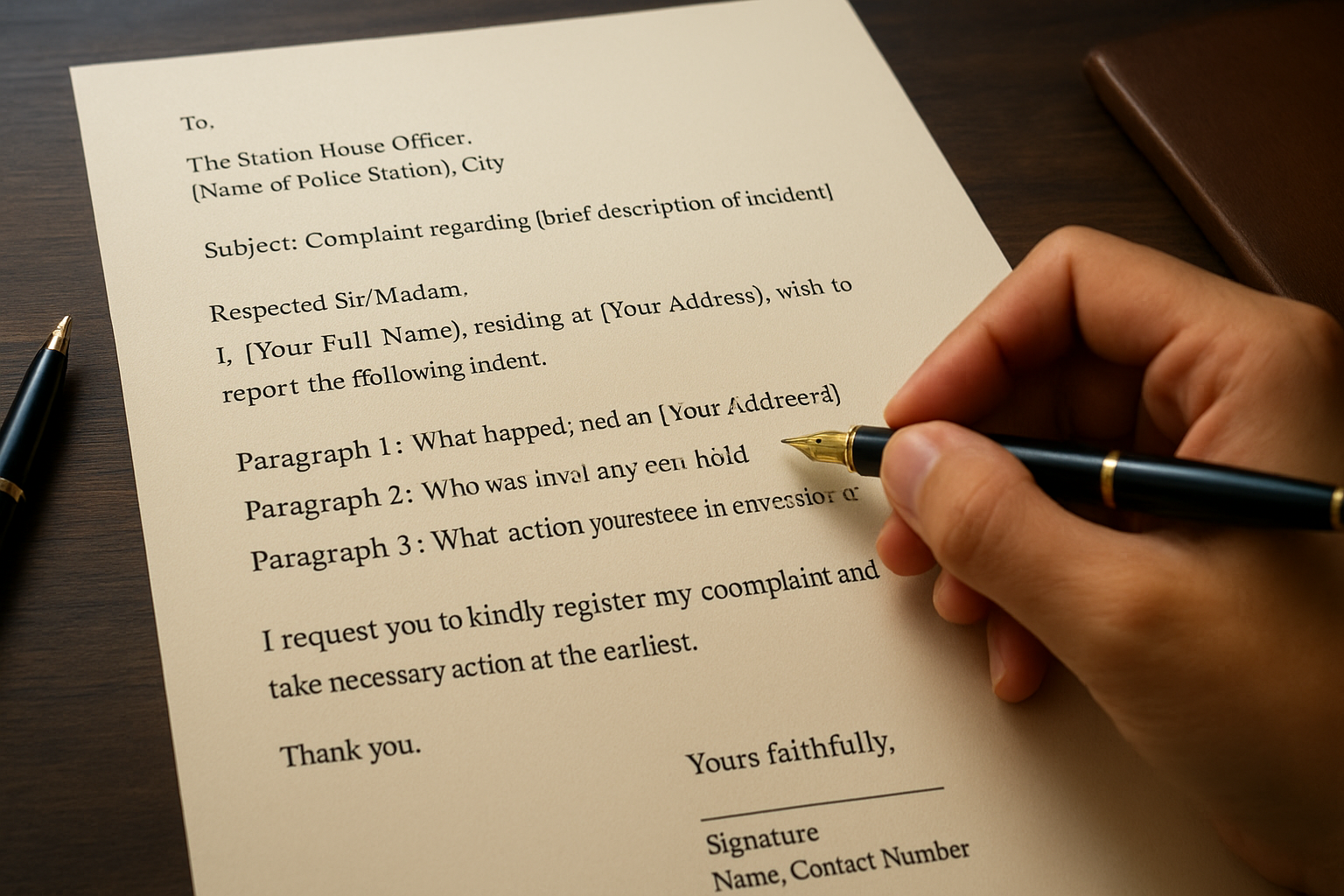
A complaint that follows the standard format gets read and acted on faster than one that reads like a personal letter.
The standard layout to follow
Use this template as your starting structure, then fill in the specifics of your incident.
To,
The Station House Officer,
[Name of Police Station], [City]

Subject: Complaint regarding [brief description of incident]

Respected Sir/Madam,

I, [Your Full Name], residing at [Your Address], wish to report the following incident.

[Paragraph 1: What happened, when, and where]
[Paragraph 2: Who was involved, and any evidence you hold]
[Paragraph 3: What action you request, such as FIR registration or investigation]

I request you to kindly register my complaint and take necessary action at the earliest.

Thank you.

Yours faithfully,
[Signature]
[Name, Contact Number, Date]
Getting the salutation and closing right
Address the letter to the Station House Officer of the police station with jurisdiction over the incident location, not your home address if these differ. Close with "Yours faithfully" followed by your signature, printed name, phone number, and the date, since officers use these to verify identity before registering the FIR.
Step 3. Write, attach proof, and submit the letter
Now you turn your notes and the template into a final draft. Keep the language plain and factual, since a police complaint letter written in emotional or exaggerated language often gets sent back for revision, and the same core drafting skills for precise legal documents apply here as anywhere else. Stick to what happened, when, and who was involved, and avoid speculation about motives unless you have proof to back it.
Writing the final draft cleanly
Type the letter if possible, or write it legibly by hand on plain paper, since illegible complaints slow down data entry at the station. Number your evidence attachments and reference them in the body, for example "Annexure A: screenshot of the threatening message." Make two extra photocopies of the complete letter along with attachments before you leave home, since the station keeps the original and you need a copy for your own file and, sometimes, for a lawyer.
A clean, factual draft with numbered evidence gets processed faster than a long, emotional letter without attachments.
Submitting at the right station
Submit the letter at the police station with jurisdiction over where the incident happened, not necessarily your home station. Hand it to the duty officer or the Station House Officer directly, and ask for a receipt or acknowledgment with a date stamp and diary number.
- Carry your photocopy for the officer to stamp and return
- Ask for the daily diary (DD) entry number if an FIR is not registered immediately
- Note the officer's name and badge number for follow-up, and once an FIR is registered you can check case status by police station on eCourts
If drafting the language correctly feels slow, a tool like LeXi AI can help structure the sentences while you focus on the facts and evidence.
Sample police complaints for common situations
Having the format memorized only gets you halfway there. Seeing a filled-in sample next to the blank template makes the actual drafting faster, since you can copy the sentence structure and swap in your own facts. Below are two versions built on the format from Step 2, one for theft and one for a lost document, since these two account for a large share of complaints filed at any station.
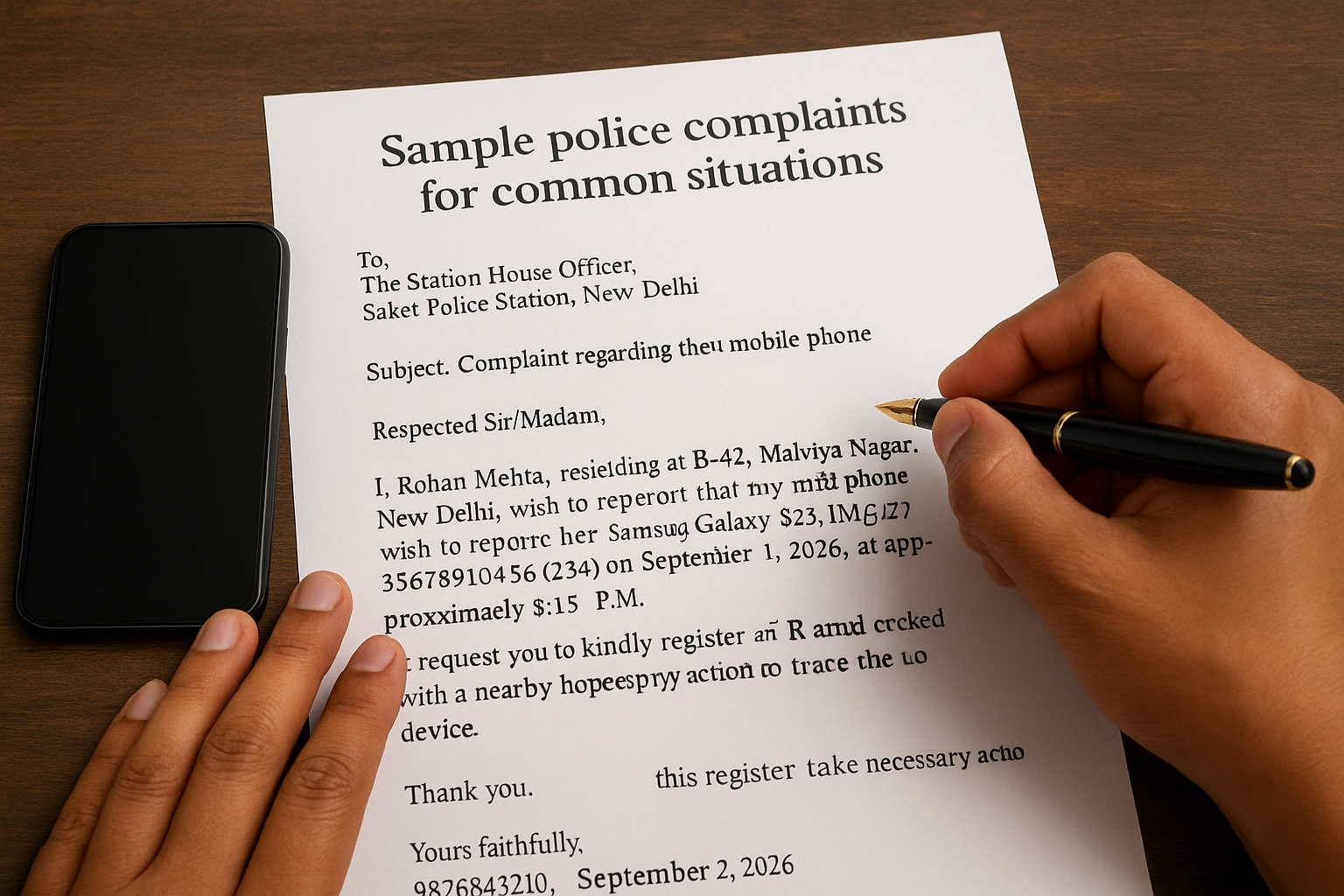
Sample complaint for theft
Adapt this draft for a stolen phone, vehicle, or shop burglary by changing the item and value details.
To,
The Station House Officer,
Saket Police Station, New Delhi

Subject: Complaint regarding theft of mobile phone

Respected Sir/Madam,

I, Rohan Mehta, residing at B-42, Malviya Nagar, New Delhi, wish to report that my mobile phone (Samsung Galaxy S23, IMEI 356789104561234) was stolen from my scooter's front basket near Saket Metro Station on September 1, 2026, at approximately 8:15 PM. I noticed the theft immediately after and checked with a nearby shopkeeper, Mr. Verma, who may have witnessed the incident.

I request you to kindly register an FIR and take necessary action to trace the stolen device.

Thank you.

Yours faithfully,
Rohan Mehta
9876543210, September 2, 2026
Sample complaint for a lost document
A sample letter is a starting point, not a substitute for your own facts. Always replace every bracketed detail with what actually happened.
This version works for a lost passport, PAN card, or property document, where the police report is usually needed for reissuance.
To,
The Station House Officer,
Koramangala Police Station, Bengaluru

Subject: Complaint regarding loss of passport

Respected Sir/Madam,

I, Anjali Rao, residing at 14, 5th Cross, Koramangala, Bengaluru, wish to report that my passport (Passport No. Z1234567) went missing while traveling on the Bengaluru metro on August 30, 2026. I searched thoroughly at home and at my workplace before concluding it was lost.

I request a copy of this complaint for submission to the Regional Passport Office.

Thank you.

Yours faithfully,
Anjali Rao
9123456780, September 2, 2026
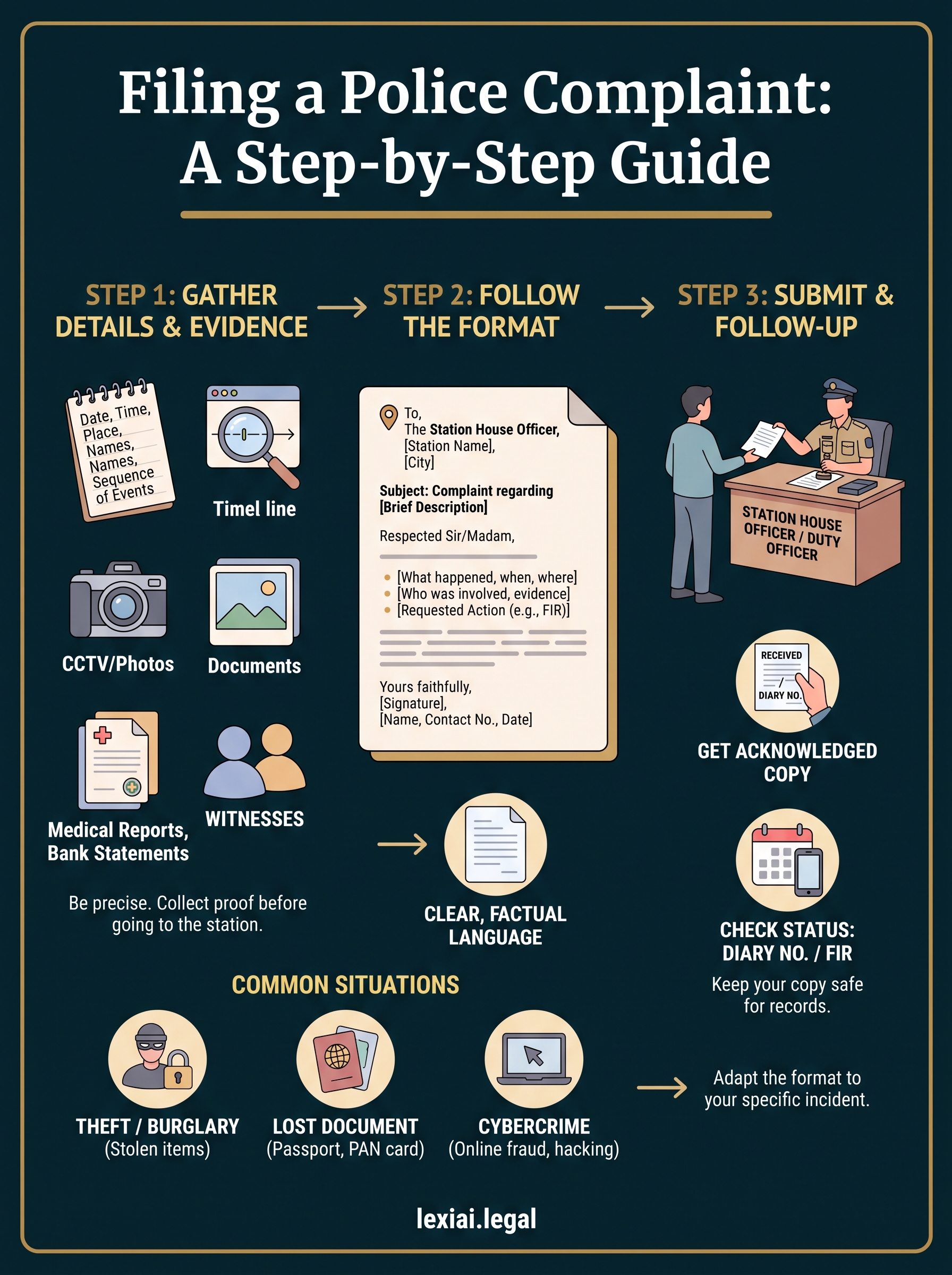
Keeping your complaint on record
Getting the police complaint format right is only half the job. Hold on to your acknowledged copy, the diary number, and the officer's name, since you may need them for insurance claims, passport reissuance, or a follow-up if the case stalls. File your copy somewhere you can find it in a hurry, not buried in a drawer with old papers.
Justice moves faster when your paperwork is clean the first time. A complaint with clear facts, proper attachments, and the right addressee rarely gets sent back for corrections, and that saves you repeat trips to the station.
Keen drafting matters beyond police complaints too, especially if you deal with contracts, notices, or case filings as part of your work. If you want AI-assisted drafting that keeps your legal language precise without the guesswork, see how the LeXi AI platform fits into your practice.