

Mohori Bibee vs Dharmodas Ghose Case Summary: Facts and Judgment
A minor mortgaged his house, took the money, and then argued in court that the entire contract was void because he was underage. That is the core of Mohori Bibee vs Dharmodas Ghose, and the Privy Council agreed with him. This 1903 ruling still decides how Indian courts treat agreements involving minors today.
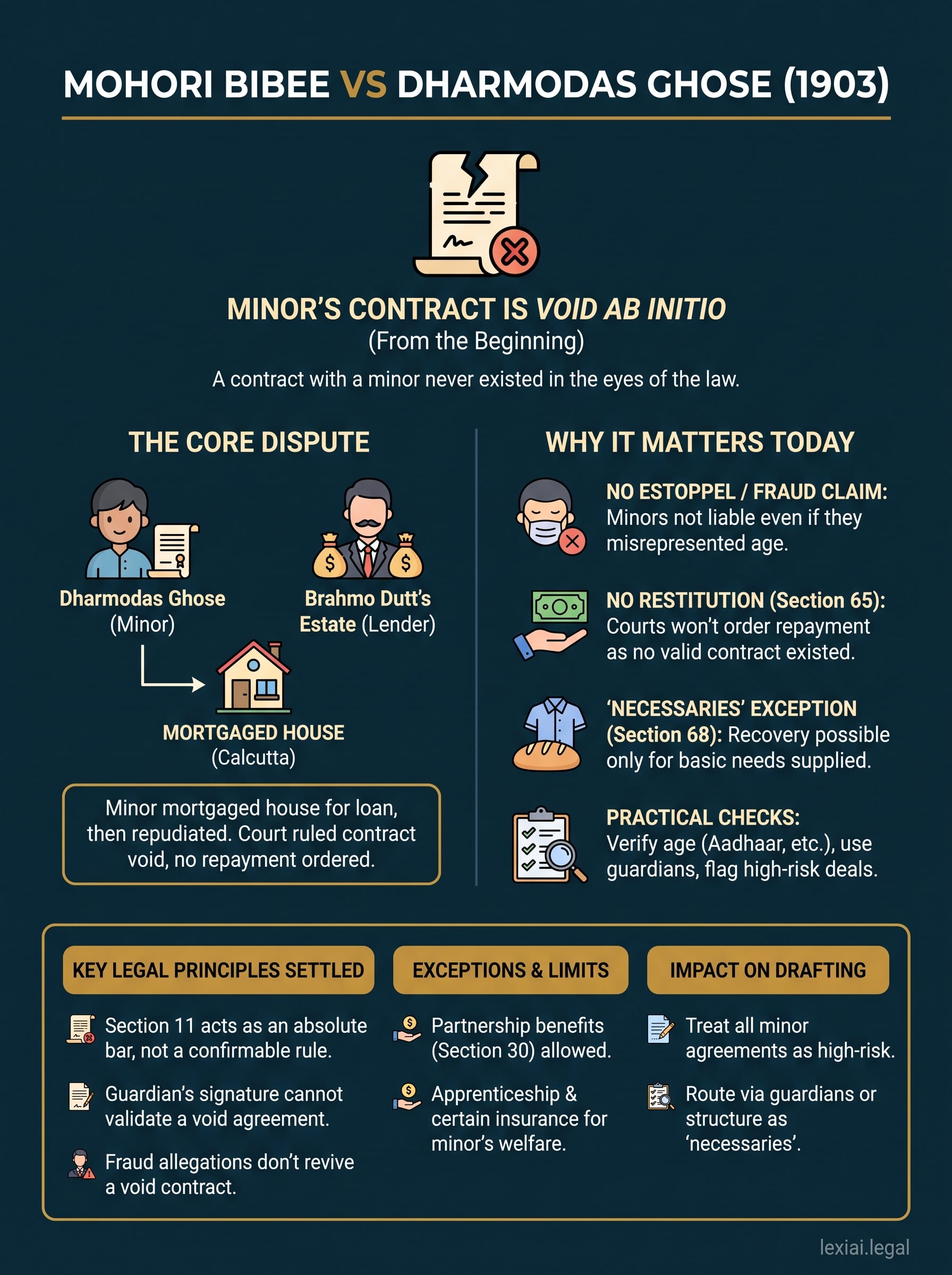
If you are searching for this case, you want the facts and the actual holding, not just a one-line quote about Section 11 of the Indian Contract Act, 1872. The Privy Council held that a contract with a minor is void ab initio, meaning it never existed in the eyes of law, not merely voidable. Dharmodas Ghose kept the mortgage money and still avoided repayment, because the court refused to force restitution under Section 65, which applies only to valid contracts made by competent parties.
This article walks through the background of the dispute, the arguments raised by Brahmo Dutt's estate, and the reasoning the Privy Council used to reach its judgment. You will also see why this precedent still shapes contracts with minors in commercial dealings, drafting practice, and how tools like LeXi AI flag age-related capacity risks in agreements today.
Why the Mohori Bibee ruling still matters today
Dharmodas Ghose, a minor, mortgaged his Calcutta house to secure a loan from moneylender Brahmo Dutt, acting through his attorney Kedar Nath. Dutt's agent knew about the minority, since Dharmodas's mother had already sent written notice warning him not to lend. When Dutt's estate sued to enforce the mortgage after Dharmodas repudiated it, the case moved from the Calcutta High Court to the Privy Council, then India's highest court of appeal.
The facts, at a glance
Before getting into the reasoning, it helps to see the core details in one place.
| Element | Detail |
|---|---|
| Parties | Dharmodas Ghose (minor mortgagor) vs. Brahmo Dutt's estate (represented by Mohori Bibee) |
| Property | House in Calcutta, mortgaged for Rs. 20,000, of which about Rs. 8,000 was actually paid |
| Key statute | Section 11, Indian Contract Act, 1872 (competency to contract) |
| Forum | Privy Council, 1903 |
| Holding | Minor's contract is void ab initio, not voidable |
The reasoning behind a void, not voidable, contract
Dutt's lawyers argued the mortgage was merely voidable, meaning Dharmodas could ratify it on reaching majority, and that fraud on his part (misrepresenting his age) should stop him from denying liability. The Privy Council rejected both arguments. It read Section 11 as an absolute bar on minors entering contracts, not a rule that creates a contract capable of later confirmation. Since no valid contract ever existed, there was nothing to ratify and nothing to enforce.
A contract signed by a minor never becomes a contract in the eyes of the law, no matter how the parties later behave.
Why this still shapes Indian contract law
Relevance here is not academic. Every law firm drafting a contracts with minors clause, every bank structuring a loan with a young borrower, and every corporate legal team reviewing vendor agreements still runs into this exact fact pattern in modified form. Section 68 of the Indian Contract Act, which allows recovery of necessaries supplied to a minor from the minor's property, exists precisely because courts needed a narrow exception after Mohori Bibee closed off restitution under Section 65.
Second, the case fixed the age of majority question for contract purposes at 18 years under the Indian Majority Act, 1875 (now read with the Indian Majority Act, 1875 as amended), settling disputes about when capacity actually begins. Third, it created a durable template that Indian courts use whenever a party's competency is challenged, whether the issue is minority, unsoundness of mind, or disqualification under other statutes referenced in Section 11 itself. Practicing lawyers still cite Mohori Bibee first, then argue variations from there, which is why it belongs in any serious discussion of the mohori bibee vs dharmodas ghose case summary and its lasting footprint on Indian commercial practice.
How to apply the minor's agreement rule in practice
Applying this precedent is not just theory for law students, it changes how you draft and review agreements on a daily basis. Before you let anyone sign a contract, confirm the signatory's age with a reliable document like an Aadhaar card, birth certificate, or school leaving certificate. If there is any doubt about the person's capacity to contract, treat the deal as high risk and route it through additional review, following best practices for managing the contract lifecycle, because a court will not save you later by calling the agreement merely voidable.
Checklist before signing any agreement with a minor
Use this sequence whenever a counterparty's age is uncertain:
- Verify age proof independently, do not rely on a self-declaration in the contract
- If the party is a minor, route the agreement through a natural guardian or a guardian appointed under the Guardians and Wards Act, 1890
- Structure any benefit transfer as a necessaries claim under Section 68 rather than a standard commercial contract
- Document the transaction so that any later dispute can be traced to specific property, not just a personal promise
- Flag the file for legal sign-off before disbursing funds or handing over goods
A signature from a minor gives you paperwork, not a contract, so build your risk checks around age verification first.
What happens if a minor already received the benefit
Often the money or goods have already changed hands by the time someone raises the minority defense, exactly as happened with Dharmodas Ghose. Courts still will not order repayment under Section 65, since that section presumes a valid contract existed in the first place. Recovery is possible only in narrow situations, such as tracing specific property still held by the minor, or claiming under Section 68 if the benefit qualifies as necessaries. Anyone advising a client on the mohori bibee vs dharmodas ghose case summary should stress this point early: prevention through age checks beats litigation after the money is gone.
Key legal principles the case settled beyond minority
Beyond the headline finding on minority, the Privy Council used Mohori Bibee to settle three doctrines that still control disputes involving any incompetent party, not just minors. Courts across India rely on this ruling whenever they need to decide how far equitable relief can stretch when one side to an agreement never had the capacity to contract in the first place.
Estoppel cannot cure incapacity
Dutt's lawyers argued that Dharmodas should be estopped by his own conduct, since he had represented himself as a major to secure the loan. The Privy Council rejected this outright, holding that estoppel under Section 115 of the Indian Evidence Act, 1872, now replaced by the Bharatiya Sakshya Adhiniyam presumes the other party had no independent means of knowing the truth. Since age is a fact any lender can verify, and since the whole purpose of Section 11 is to protect minors regardless of their own statements, allowing estoppel here would have defeated the statute entirely.
Restitution has strict limits
The judgment also drew a hard line around Section 65, which orders restitution only when a contract was valid at formation and later discovered to be void. A minor's agreement fails at formation, so Section 65 never switches on. That single distinction now guides how Indian courts separate ordinary contract disputes from capacity disputes.
Once a court finds no valid contract ever existed, it cannot order restitution as if one had.
Finally, the case confirmed that fraud allegations against a minor cannot revive an otherwise void agreement, closing off a loophole lenders had tried to exploit for decades before 1903. Together these three principles, no estoppel, no restitution under Section 65, and no fraud-based revival, form the analytical checklist lawyers still run through today whenever a mohori bibee vs dharmodas ghose case summary comes up in a capacity dispute involving someone other than a minor, such as a person of unsound mind.
How later courts have applied and distinguished the ruling
Courts did not just cite Mohori Bibee and move on. They spent the following century testing its limits, sometimes extending the rule and sometimes carving out narrow exceptions where rigid application would have hurt the very minors the rule was meant to protect.
Cases that extended the void ab initio rule
In Mir Sarwarjan v. Fakhruddin Mahomed Chowdhury (1912), the Privy Council refused to order specific performance of a contract for the purchase of land entered into on behalf of a minor, reasoning that a void agreement gives no party, guardian included, standing to seek enforcement. Later, in Nawab Sadiq Ali Khan v. Jai Kishori (1928), the same logic barred enforcement even where a guardian had signed for the minor's clear benefit. Both rulings confirm that incapacity to contract cannot be worked around simply by routing the agreement through a third party.
Extending Mohori Bibee, courts have held that even a guardian's signature cannot breathe life into a minor's void agreement.
Where courts drew boundaries
Not every later ruling read Mohori Bibee as absolute. Indian courts have allowed a minor to be admitted to the benefits of a partnership under Section 30 of the Indian Partnership Act, 1932, since that provision grants rights without imposing contractual liability. Similarly, contracts of apprenticeship and certain insurance policies taken out for a minor's benefit have survived challenge, because the minor never bears an enforceable obligation.
- Partnership benefits under Section 30 (Partnership Act, 1932)
- Scholarship and insurance arrangements for a minor's welfare
- Necessaries claims traced to specific property under Section 68
These carve-outs show that judges distinguish between agreements that burden a minor and arrangements that only benefit one, keeping the original mohori bibee vs dharmodas ghose case summary relevant across very different fact patterns.
What this case means for lawyers today
Mohori Bibee vs Dharmodas Ghose still sets the baseline test every time capacity to contract comes into question. The ruling tells you that a minor's agreement is void from the start, that estoppel and fraud claims cannot revive it, and that restitution under Section 65 stays off the table once the deal fails at formation. Whether you are drafting a loan agreement, reviewing a vendor contract, or advising a client on age-related capacity risks, this 1903 judgment remains the first citation you reach for.
Getting this analysis right on every file takes discipline, especially when age proof is unclear or a guardian is involved. LeXi Desk flags capacity issues and clause risks like this automatically during contract review, so you catch them before signing rather than after a dispute lands in court. If you want that kind of check built into your daily drafting work, create your LeXi AI account and see how it handles capacity flags on your own contracts.