

Legal AI Infrastructure: What It Is and Why It Matters
Most law firms in India now use some form of AI tool for drafting or research, but very few have thought about what sits underneath those tools. Legal AI infrastructure is that underlying layer, the data pipelines, verified case law sources, security controls, and workflow connections that determine whether an AI output can actually be trusted in practice. Without it, you get answers that sound confident but cannot survive scrutiny from a senior partner or a judge.
This article answers the question directly: legal AI infrastructure is the combination of data foundations, model accuracy, and governance controls that make AI usable for real legal work, not just demos. It matters because a hallucinated citation in a filing under the Bharatiya Nagarik Suraksha Sanhita, the code that replaced the CrPC, or a missed indemnity clause in a contract, has consequences that a generic AI model was never built to avoid.
We will cover what infrastructure actually includes, how it differs from simply using ChatGPT or Gemini for legal tasks, and what to check before adopting or building a system, whether you are an independent lawyer, a firm, or an enterprise legal team evaluating platform reliability.
Why legal AI infrastructure matters for law firms
Every law firm using AI today is really making a bet on infrastructure, whether the partners realize it or not. When you paste a clause into ChatGPT instead of a purpose-built legal AI tool or ask Gemini to summarize a judgment, you are relying on a general-purpose model that was never trained on verified Indian case law, current statutory amendments, or firm-specific precedent. That gap is invisible until it costs you a filing deadline, a client relationship, or a hearing.

The difference between a chatbot answer and a defensible one
A general AI model predicts the next likely word based on patterns in its training data. It does not check whether a cited judgment actually exists, whether a section number matches the current version of the Bharatiya Nyaya Sanhita that replaced the IPC, or whether a clause you generated conflicts with a stamp duty requirement in your state. Legal AI infrastructure solves this by connecting the model to verified sources, structured legal databases, and validation layers before an answer ever reaches you.
An AI answer that cannot be traced back to a verified source is not legal advice, it is a guess dressed up in confident language.
Where firms actually feel the difference
The practical impact shows up in three places: research accuracy, drafting speed, and audit readiness. A firm without proper infrastructure spends hours re-verifying every citation an AI tool produces, which erases most of the time saved. A firm with verified data pipelines and clause libraries built into the workflow gets usable output on the first pass far more often.
| Factor | Generic AI tool | AI backed by legal infrastructure |
|---|---|---|
| Case law source | Public web data, often outdated | Verified judgment databases with citations |
| Statutory accuracy | Prone to citing repealed sections | Updated against current acts and amendments |
| Contract clause risk | No structured risk flagging | Automated indemnity and liability risk detection |
| Audit trail | None | Logged, traceable outputs for review |
| Data handling | Often unclear retention policy | Defined security and confidentiality controls |
The cost of skipping this layer
Relying purely on a general model without infrastructure creates a specific kind of risk: it works fine most of the time, right up until it does not. Several Indian courts have already flagged fabricated citations submitted by lawyers who used AI without verifying the output, and the reputational damage from that kind of error rarely stays contained to one case. Building or adopting proper infrastructure is not about distrust of AI itself, it is about making sure the AI is checked against something real before it reaches a client file or a court record.
Why this matters more as adoption grows
Startups and enterprises now push AI adoption faster than most firms can build governance around it, and that pace makes infrastructure decisions urgent rather than optional. Firms that treat this layer as an afterthought end up patching problems case by case, while firms that get the foundation right upfront scale their AI use without constantly second-guessing what the tool just told them. Platforms benchmarked on legal reasoning tasks, rather than general knowledge tasks, exist precisely because this distinction has real consequences in practice, and it is worth knowing how reliable legal AI accuracy really is before you lean on it.
How to evaluate legal AI infrastructure before adopting it
Before signing on with any vendor, ask what sits behind the interface, not just what the interface shows you in a demo. A polished chat window tells you nothing about the verification pipeline or the source database feeding it. Push past the sales pitch and ask specific, checkable questions, because that is the only way to know if a tool will hold up when a client or a judge questions its output.
Questions to ask before you sign
Treat this like due diligence on any other vendor contract, not a software trial. A firm running a comparison of legal AI software for Indian firms should get direct answers to each of these before committing budget or workflow time to a platform.
- Which case law database does the model draw from, and how often is it updated against new judgments?
- Does the tool cite sources you can independently verify, or does it just produce prose?
- How does the platform handle statutory amendments, such as changes under the Bharatiya Sakshya Adhiniyam that replaced the Evidence Act?
- What happens to client documents you upload? Ask for the actual data retention and confidentiality policy, not a summary.
- Can the vendor show benchmark results on legal reasoning tasks, rather than general knowledge tests?
- Is there an audit trail for every output, so a partner can trace a claim back to its source?
If a vendor cannot answer where an answer comes from, do not trust the answer itself.
What documentation should actually exist
Demand written proof, not verbal assurance. A serious platform will have documentation on data security certifications, encryption standards, and how it isolates client data from training data used for other users. Reliable legal AI infrastructure also comes with logs you can pull up months later if a filing gets challenged, showing exactly what the AI produced and what source it relied on.
Skip any vendor that treats these questions as an inconvenience. Independent lawyers and small chambers often assume this level of scrutiny is only for large enterprises, but a single fabricated citation in a filing carries the same reputational cost regardless of firm size. Testing a platform against real matters, not sample data, before rolling it out firm-wide remains the fastest way to catch gaps early.
Key components of a reliable legal AI infrastructure stack
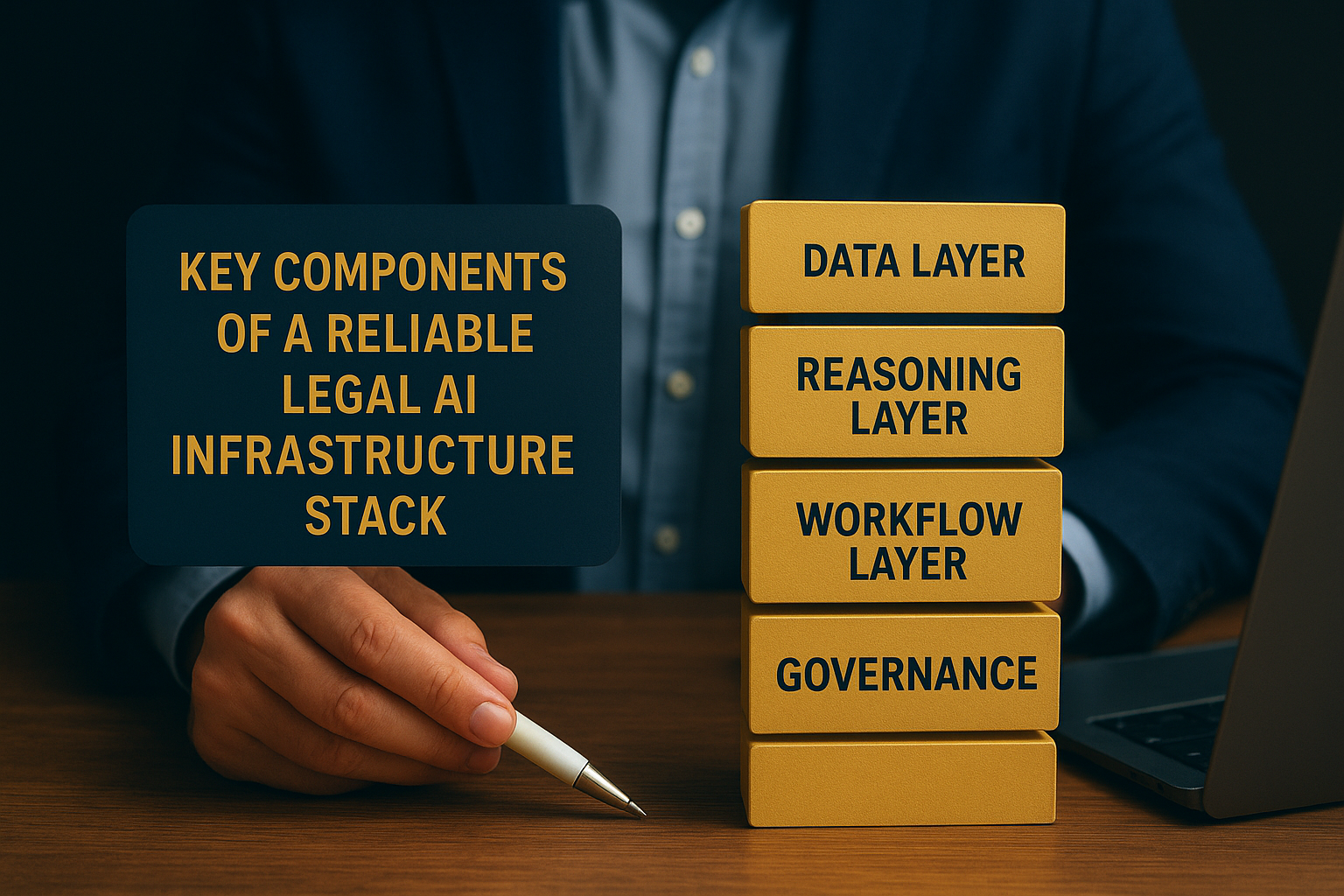
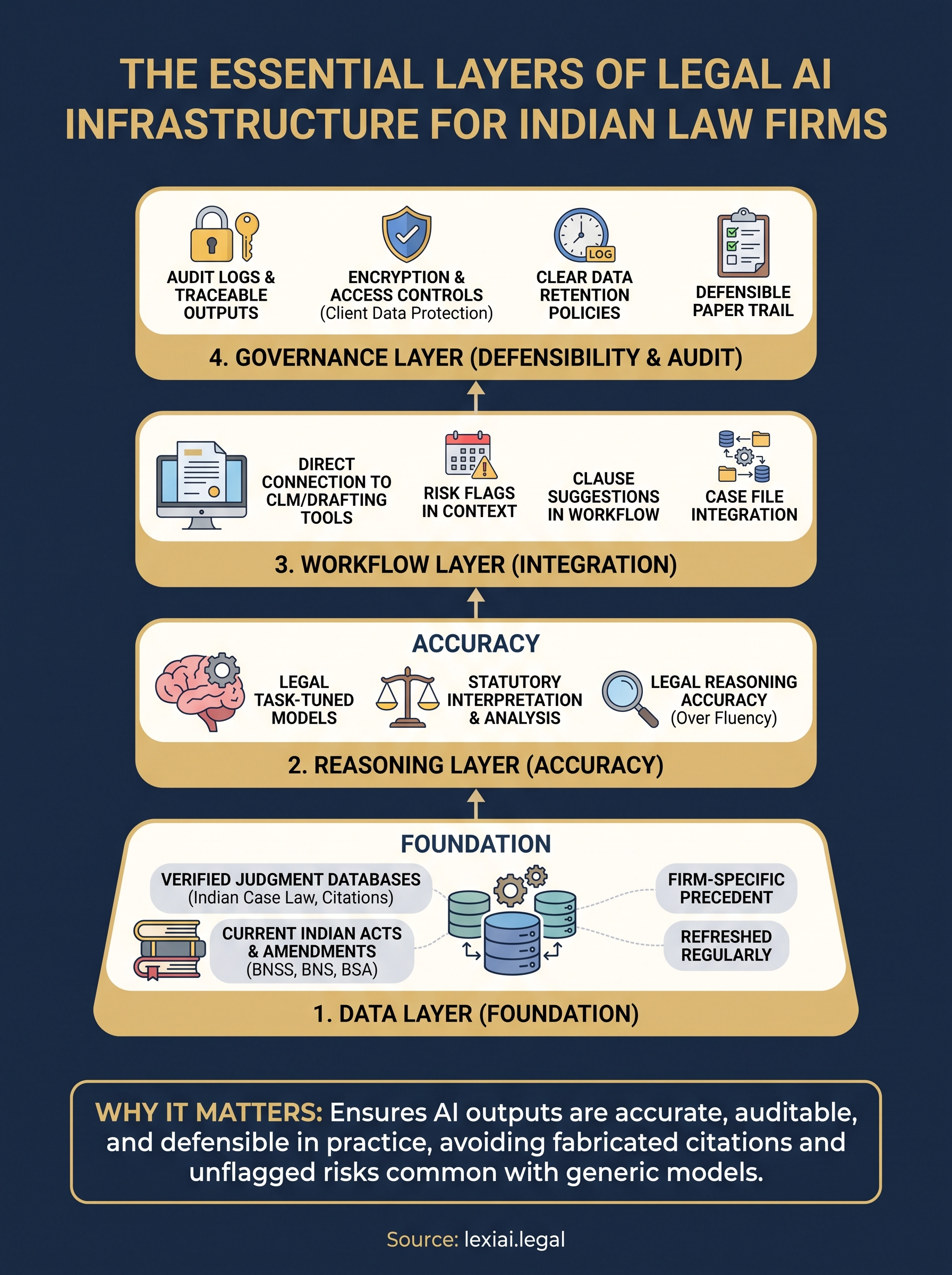
A working stack has four layers, and each one has to hold up on its own before the whole system earns your trust. Skipping any single layer does not just weaken the output, it breaks the chain a partner needs to defend that output later. Understanding these layers helps you evaluate a vendor pitch or plan an in-house build with the same standard.
The data layer
Everything starts with what the model can actually see. A reliable stack pulls from the kind of verified judgment databases behind serious AI legal research tools, current statutory text, and firm-specific precedent, refreshed on a schedule you can check rather than a vague promise of "regular updates." Without this layer, the model is guessing from whatever it absorbed during training, which may be years old and was never checked for legal accuracy in the first place.
The reasoning layer
This is the model itself, but tuned for legal tasks rather than general conversation. Legal reasoning accuracy on statutory interpretation and case analysis matters more here than fluent prose, since a well-written wrong answer is more dangerous than an obviously incomplete one.
A stack that reasons well but reads from stale data will still fail you when it counts.
The workflow layer
Infrastructure only earns its keep when it plugs into how you already work, not a separate app you have to remember to open. Look for tools that connect to your contract lifecycle management process, drafting templates, and case files directly, so risk flags and clause suggestions appear where you are already working.
The governance layer
Every output needs a paper trail. This layer covers:
- Audit logs tied to each generated answer or draft
- Encryption and access controls for uploaded client documents
- Clear separation between one client's data and another's
- A defined retention and deletion policy you can show a client if asked
A stack missing this layer might work fine day to day, but it leaves you unable to explain, months later, exactly how a filing or contract clause was produced.
Common mistakes law firms make with legal AI infrastructure
Even firms that understand the theory behind legal AI infrastructure still stumble on the same few mistakes during rollout. Most of these errors come from treating the technology as a shortcut rather than a system that needs proper setup. Recognizing these patterns before you commit budget saves you from repeating them at a client's expense.
Buying the interface, not the infrastructure
Firms often choose a platform based on how polished the chat window looks, without asking what feeds it. A clean design can hide a thin data foundation that has not been updated in months. Judging a tool by its screen instead of its verified source pipeline is the single most common mistake independent lawyers and small chambers make.
Skipping verification because the output sounds fluent
Confident prose gets mistaken for correct prose more often than firms want to admit. Lawyers under deadline pressure sometimes file drafts straight from an AI tool without checking whether the cited judgment exists or the section number matches the current act.
A fluent answer is not the same as a correct one, and courts do not grade AI output on style.
Leaving governance for later
Many firms roll out an AI tool firm-wide, then only think about data retention policy and client confidentiality in legal AI and access controls after a client asks pointed questions. Retrofitting governance onto an existing rollout is harder and slower than building it in from day one. Waiting until a security review forces the issue means you find gaps under pressure rather than on your own schedule.
Assuming one tool covers every workflow
Teams sometimes deploy a general research tool and expect it to also handle contract risk flagging, drafting, and case summarization equally well. Different legal tasks need different verification layers underneath, and a tool built for research does not automatically carry the same rigor into drafting or clause analysis. Overlooking this distinction is how firms end up trusting an output in one context that was never validated for that specific task.
Getting the foundation right before the tools
The firms that get real value from AI are not the ones with the flashiest chat interface. They are the ones that checked the data layer, the governance layer, and the workflow fit before rolling anything out firm-wide. Legal AI infrastructure is not a feature you bolt on later, it is the reason an output can survive a partner's questions or a judge's scrutiny.
Getting this right upfront costs you a few extra weeks of due diligence. Skipping it costs you a fabricated citation in a filing, or a clause risk nobody flagged until a client noticed. Neither is a trade worth making.
If you are evaluating where to start, look at a platform built on verified Indian case law and benchmarked legal reasoning rather than general knowledge. You can try LeXi AI free and test it against a real matter before deciding anything firm-wide.