

Legal AI Data Privacy: What It Is and How to Protect Client Data
Legal AI data privacy means protecting client information, case files, and privileged communications when you feed them into an AI tool for drafting, research, or contract review. Every time you paste a client's agreement into a chatbot or upload a case file to summarize it, you are moving confidential data outside your firm's direct control. That single act can trigger obligations under the Digital Personal Data Protection Act, 2023, and under the confidentiality duties set out in the Advocates Act and the Bar Council of India Rules.
If you are asking how to actually protect that data, the short answer is this: know where your data goes, use tools built for legal confidentiality rather than general AI models, and get client consent before uploading sensitive files. Data residency, encryption standards, and vendor contracts matter as much as the AI's accuracy.
This article walks through what counts as personal or privileged data in legal AI use, the specific compliance risks Indian lawyers face, and practical steps for vetting tools like the LeXi AI platform that are built around Indian legal workflows and data protection requirements from the start.
Why legal AI data privacy matters for Indian lawyers
Protecting client data when you use AI is not optional paperwork. It sits at the core of your professional obligation as an advocate. Section 126 of the Indian Evidence Act, 1872, now replaced by the Bharatiya Sakshya Adhiniyam, makes any communication between you and your client privileged, and that privilege does not disappear just because you typed the details into a chatbot instead of a notebook. The Bar Council of India Rules on professional standards reinforce this by requiring advocates to guard client secrets throughout the engagement, not just during the hearing. Once you understand that legal AI data privacy is really an extension of your existing confidentiality duty, the stakes become much clearer.
What happens when client data leaves your firm's control
Every upload to a general-purpose AI tool is a data transfer event, whether you think of it that way or not. When you paste a merger agreement into a public chatbot to summarize it, that text often gets stored on servers outside India, sometimes used to improve the underlying model, and rarely deleted on a schedule you control. Cross-border data transfer of this kind can conflict with client contracts that specify data localization, and it almost always conflicts with the spirit of confidentiality obligations under the Advocates Act, 1961. Litigation files are worse. A 400-page case file often contains witness statements, medical records, and financial disclosures, all of which qualify as sensitive personal data under Indian law, not just routine business documents.
Confidentiality does not pause the moment you open an AI tool, it travels with the data.
The compliance exposure under the DPDP Act, 2023
The Digital Personal Data Protection Act, 2023 changes the calculation for law firms that process personal data digitally. If your firm collects, stores, or transmits a client's personal data through an AI platform, you are functioning as a data fiduciary under Section 2(i) of the Act, and the AI vendor may be your data processor under the contract you sign with them. That relationship carries real duties: you need a lawful basis for processing, you need to secure the data against breach, and you need to notify the Data Protection Board of India if something goes wrong. Firms that treat AI adoption as a purely operational decision, made by whoever is fastest with a credit card, tend to skip this analysis entirely. That is how a firm ends up with client financial records sitting inside a vendor's training pipeline without anyone signing off on it.
Reputational and business risk beyond regulation
Regulatory penalties are only part of the picture. A single leaked draft settlement agreement, or a client discovering their dispute details were used to train a public model, can end a client relationship overnight and damage referrals for years. Corporate legal teams and enterprise clients increasingly ask outside counsel direct questions about which AI tools for lawyers in India touch their contracts and how that data is secured, before they sign an engagement letter. Independent lawyers face a quieter version of the same risk: a client who finds out their custody dispute was processed through an unvetted consumer chatbot is unlikely to refer you to anyone else.
A quick view of where the risk concentrates
The table below breaks down where legal AI data privacy risk typically shows up in day-to-day practice, so you can see which workflows deserve the most scrutiny before you automate them.
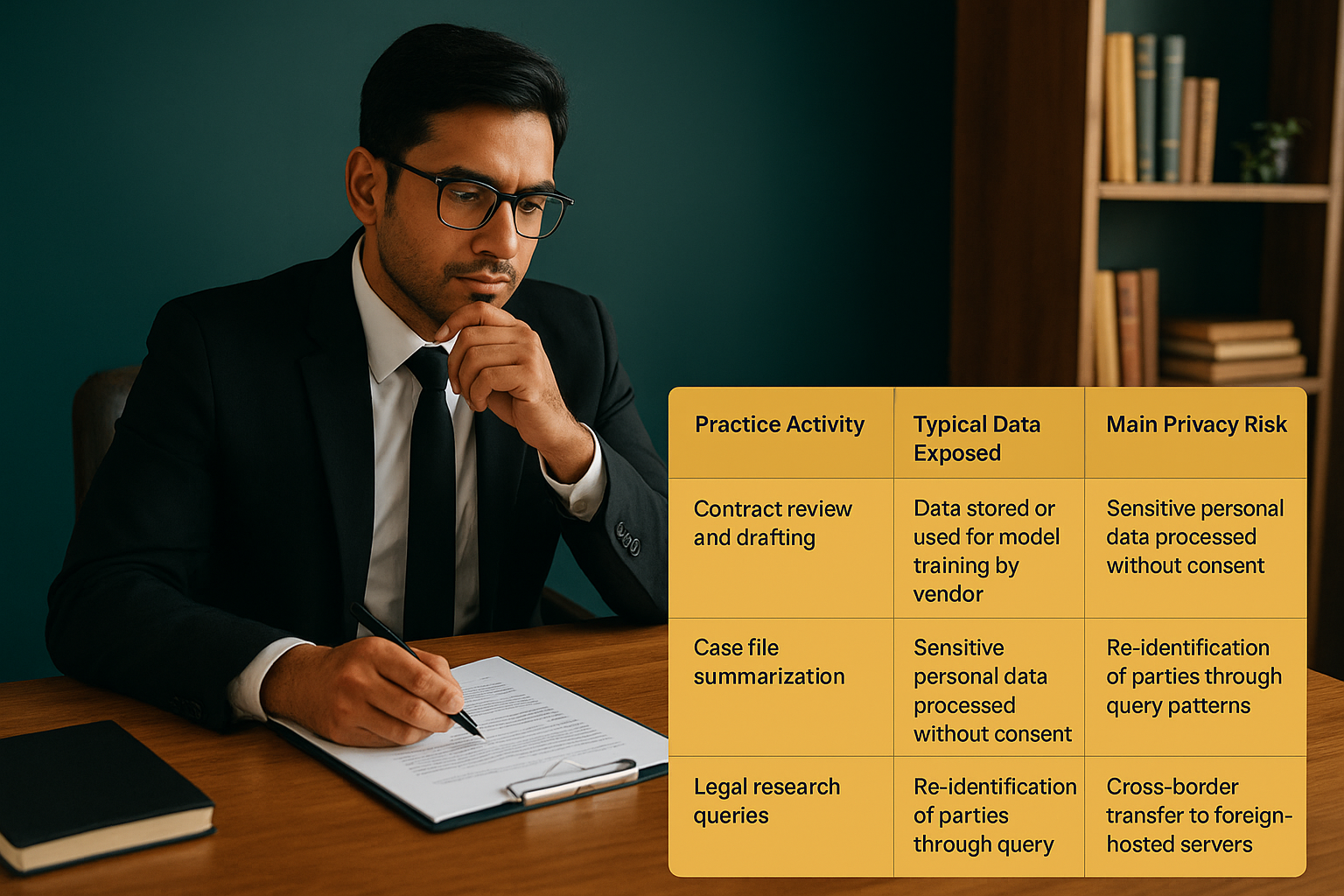
| Practice Activity | Typical Data Exposed | Main Privacy Risk |
|---|---|---|
| Contract review and drafting | Commercial terms, indemnity clauses, party details | Data stored or used for model training by vendor |
| Case file summarization | Witness statements, medical or financial records | Sensitive personal data processed without consent |
| Legal research queries | Case facts embedded in search prompts | Re-identification of parties through query patterns |
| Court filing translation | Full pleadings and annexures | Cross-border transfer to foreign-hosted servers |
Each row represents a point where a well-meaning shortcut, like pasting a clause into a free AI tool to save ten minutes, can turn into a confidentiality breach. Understanding this map is the first step toward building a workflow, covered next, that lets you use AI without gambling with client trust.
How to protect client data when using legal AI tools
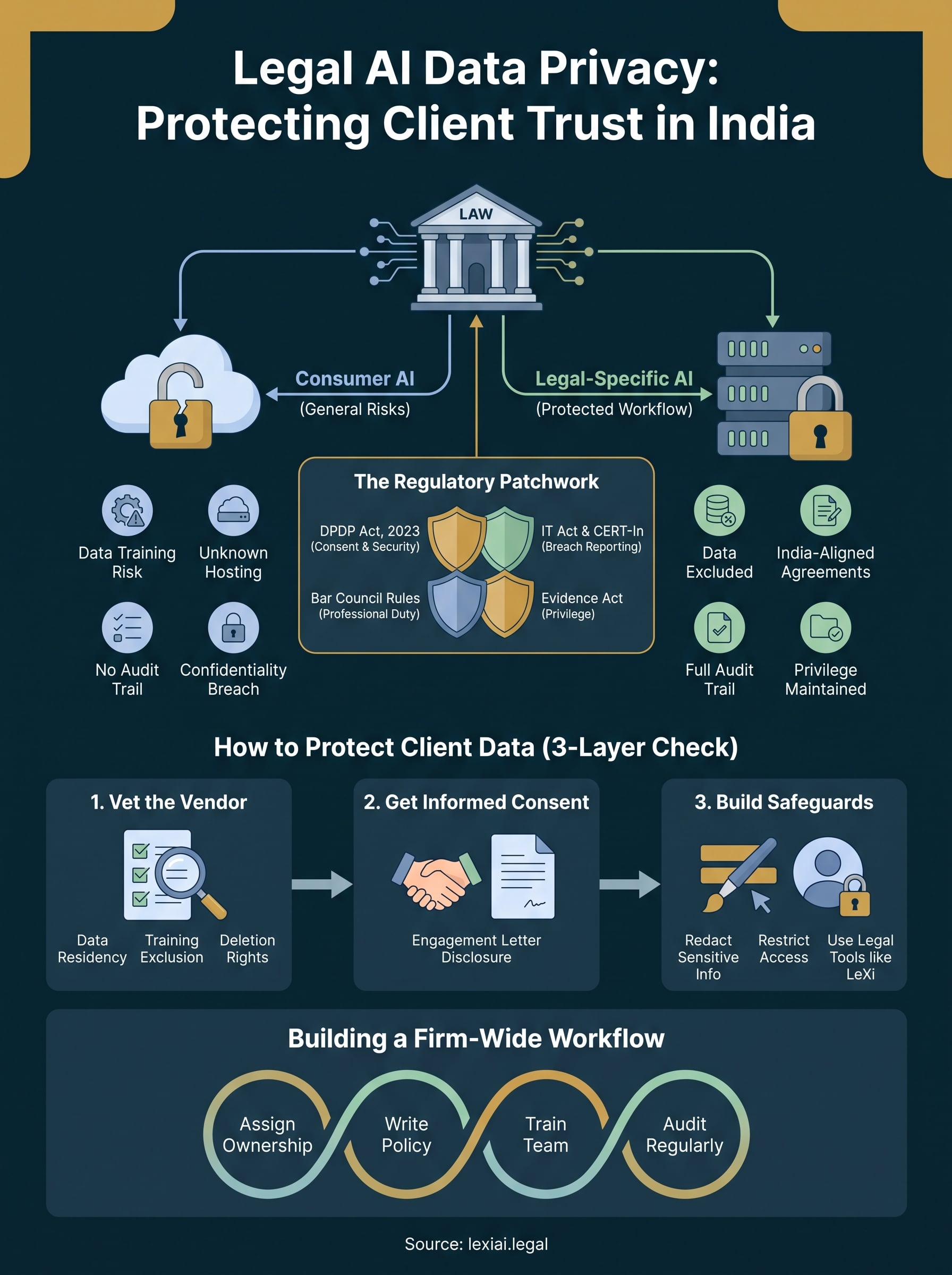
Protecting client data starts long before you type a single prompt. It begins with a decision about which tool touches your files, what you tell your client, and what technical controls sit between the AI vendor and your case documents. Think of it as a three-layer check: vendor due diligence, client consent, and internal safeguards. Skip any one layer and the other two cannot fully cover for it.
Vet the vendor before you upload anything
Before you feed a single contract into any AI platform, ask the vendor where the data lives, how long it is retained, and whether it is used to train the underlying model. A legal AI vendor built for law firms should give you a straight answer to all three questions, usually in a data processing agreement rather than a marketing page. Look for tools that offer India-based data hosting or at least contractual guarantees against cross-border transfer for privileged material.
If a vendor cannot tell you where your client's data sits tonight, do not upload the file.
Use this quick checklist before onboarding any AI tool for client work:
- Does the vendor sign a data processing agreement under the DPDP Act, 2023?
- Is client data excluded from model training by default, or does that require an opt-out?
- Can you request deletion of a specific client's data on demand?
- Does the vendor publish encryption standards for data at rest and in transit?
- Is there a named point of contact for a breach notification, not just a support ticket queue?
Get informed consent from clients
Consent is not a formality you add after the fact. Tell clients, in the engagement letter or a short written notice, that you use AI tools for drafting, research, or summarization, and name the categories of data involved. Sensitive matters, like matrimonial disputes or medical negligence claims, deserve a specific conversation rather than a boilerplate clause buried in page twelve of the retainer. Clients generally do not object to AI use once they understand it, but they object strongly to finding out about it later.
Build technical safeguards into your workflow
Safeguards work best when they are boring and consistent, not clever. Set a firm policy that no case file leaves your systems without redaction of names, addresses, and identifying numbers where the AI does not need them for the task. Restrict access so that only the assigned team can query a matter through the AI tool, mirroring the access controls you already apply to physical case files. Platforms like LeXi Desk are built to keep contract data inside a controlled environment rather than a shared consumer chatbot, which reduces the manual redaction burden significantly. Review your vendor's security posture at least once a year, the same way you would review your malpractice insurance, because both protect you when something goes wrong.
India's regulatory framework for AI data privacy
India does not have a single law that says "AI must do this," so anyone using AI for legal work in India has to work with the statutes that already exist. Instead, legal AI data privacy obligations come from a patchwork of statutes that were not written with AI in mind but apply to it anyway. Knowing which law governs which part of your workflow saves you from assuming one compliance step covers everything.
The DPDP Act, 2023 and its draft rules
The Digital Personal Data Protection Act, 2023 remains the anchor law, and the draft DPDP Rules released for public consultation add operational detail that firms cannot ignore. The rules specify how consent notices must be worded, what counts as a "significant data fiduciary" subject to stricter audit duties, and the timeline for reporting a breach to the Data Protection Board of India. A firm running case files through an AI platform at scale, across multiple clients, could plausibly cross the threshold for significant data fiduciary status, which brings mandatory data protection impact assessments. Read the rules alongside your vendor contract, not instead of it.
The Information Technology Act and CERT-In reporting
Before the DPDP Act, the Information Technology Act, 2000 and its 2011 Sensitive Personal Data or Information Rules already required reasonable security practices for anything classifiable as sensitive personal data, a category that includes medical records, financial information, and biometric data. Case files routed through AI tools frequently contain exactly this kind of data. On top of that, CERT-In's 2022 directions require reporting certain cyber incidents within six hours of detection, a timeline that assumes you already know which vendor holds your data and how to reach them.
A firm that cannot name its AI vendor's breach contact within six hours has already failed the CERT-In clock.
Bar Council rules and professional conduct
Separate from data protection statutes, the Bar Council of India Rules under the Advocates Act, 1961 impose a professional duty of confidentiality that predates any AI regulation and does not soften because a chatbot, not a junior associate, handled the draft. Disciplinary committees have historically treated confidentiality breaches as misconduct regardless of the tool involved, and there is no reason to expect AI to be treated as an exception.
Where the frameworks overlap
The table below shows how these frameworks stack for a typical AI-assisted task.
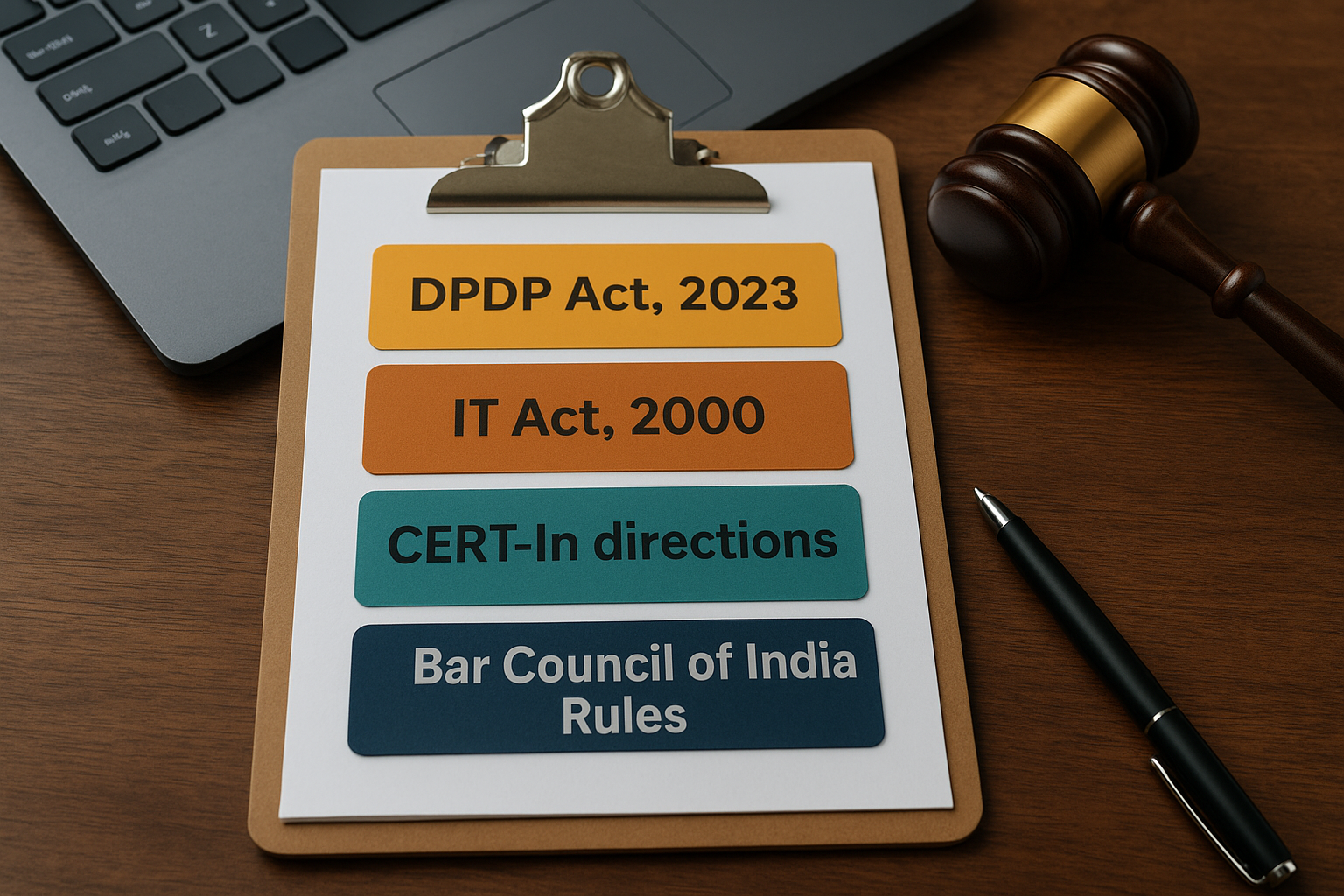
| Law or Rule | What It Requires | Applies When |
|---|---|---|
| DPDP Act, 2023 | Lawful basis, consent, breach notification | Any personal data processed via AI |
| IT Act, 2000 (SPDI Rules) | Reasonable security practices | Sensitive personal data (medical, financial) |
| CERT-In directions | Incident reporting within 6 hours | Confirmed cyber incident or breach |
| Bar Council of India Rules | Confidentiality of client communications | All client matters, regardless of tool used |
Treat these as layers, not alternatives. A tool that satisfies the DPDP Act on paper can still put you in breach of your Bar Council duties if you never told the client it was in use.
Consumer AI versus legal-specific AI for privacy
Not every AI tool treats client data the same way, and the gap between a free chatbot and a legal-specific AI platform is wider than most lawyers assume. Consumer tools are built to answer general questions for millions of users, which means their default settings favor broad data collection and model improvement over confidentiality. Legal-specific platforms are built around the opposite assumption, that every file is potentially privileged and needs to be treated that way from the first upload.
Why consumer chatbots fail the confidentiality test
General-purpose AI tools were not designed with Section 126 privilege or the Bar Council's confidentiality rules in mind, because their makers were not building for lawyers, which is the heart of the ChatGPT versus purpose-built legal AI question. Many consumer AI services retain your prompts to improve future model versions unless you manually change a setting, and that setting often resets after an update. Uploading a client's settlement draft into one of these tools means you have no contractual guarantee about where the text is stored, who can access it internally at the vendor, or whether it gets used to train a model that a competitor's lawyer might query next month.
A tool built for general chat is not built to keep a privileged document privileged.
Questions of jurisdiction compound the problem. Most consumer AI vendors host data on servers outside India, and their terms of service rarely mention the DPDP Act, 2023 or CERT-In reporting timelines at all, because those obligations were not written with a global consumer product in mind.
What legal-specific platforms do differently
Platforms built specifically for legal work, including tools like LeXi Desk and LeXi Agent, start from the assumption that every document is confidential by default. That design choice shows up in concrete features: data processing agreements that reference Indian data protection law by name, exclusion of client matters from model training unless a firm explicitly opts in for its own internal use, and audit trails that let you show a client exactly who accessed their file and when. Vendors serious about legal work also tend to publish their encryption standards and retention policies openly, rather than burying them in a generic terms page written for a different product entirely.
A side-by-side comparison
The table below sets out the practical differences that matter most when you are deciding what to trust with a client file, and a fuller comparison of legal AI software for Indian firms goes deeper on individual vendors.
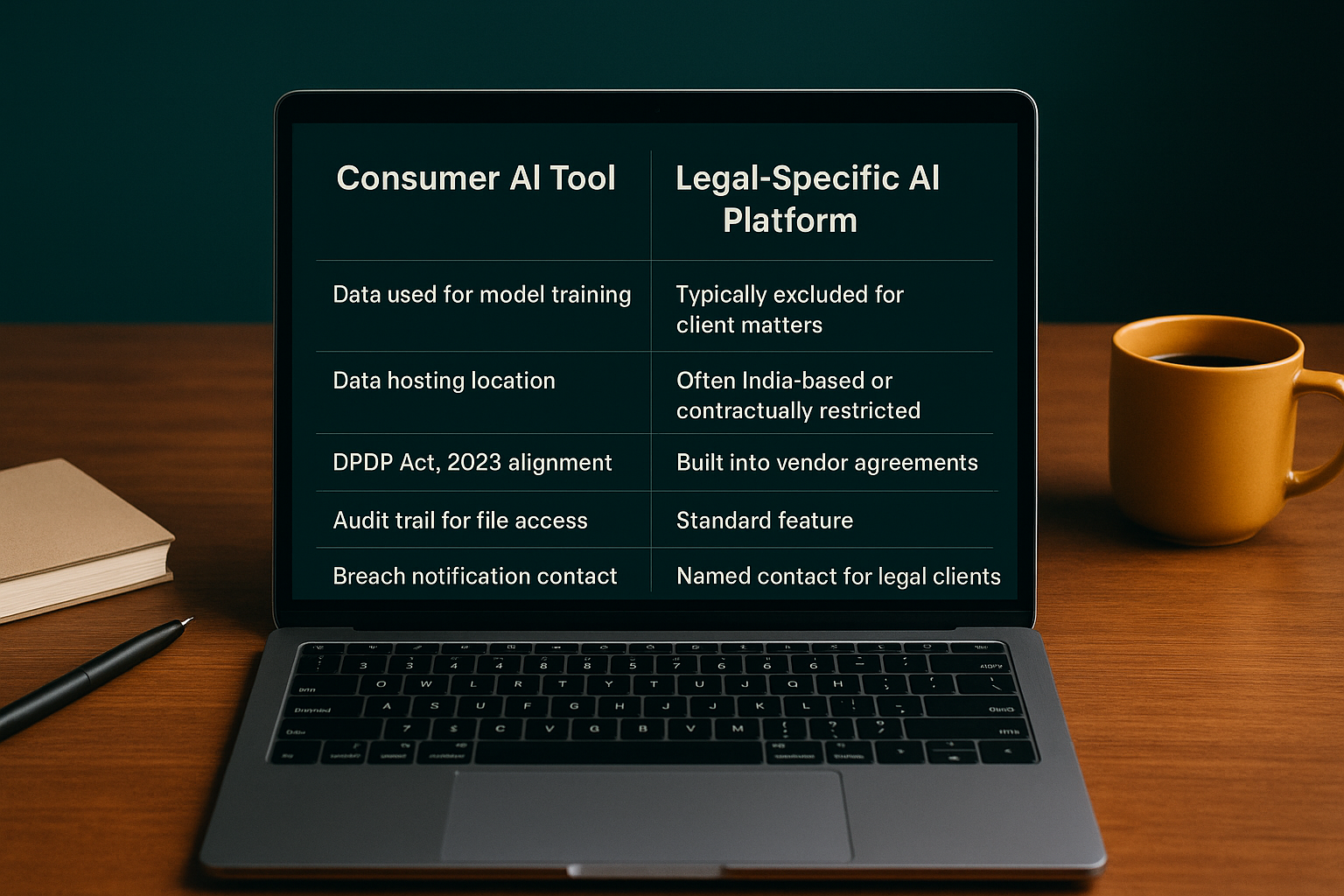
| Factor | Consumer AI Tool | Legal-Specific AI Platform |
|---|---|---|
| Data used for model training | Often yes, by default | Typically excluded for client matters |
| Data hosting location | Usually undisclosed or foreign | Often India-based or contractually restricted |
| DPDP Act, 2023 alignment | Rarely referenced | Built into vendor agreements |
| Audit trail for file access | Not available | Standard feature |
| Breach notification contact | Generic support | Named contact for legal clients |
Selecting between these two categories is not really a question of how reliable legal AI is, since consumer models can draft a passable clause too. It is a client trust question, and the table above shows why the answer, for privileged material, almost always points toward a platform built for legal work rather than one built for everyone.
Building a firm-wide AI data privacy workflow
A policy that lives only in your head protects nobody once your firm has more than one associate touching AI tools. Firm-wide AI data privacy needs a written workflow that survives staff turnover, client audits, and the ordinary chaos of a busy litigation practice. Treat it the same way you treat conflict checks: a fixed step in the process, not a judgment call left to whoever is drafting at midnight.
Assign clear ownership
Someone at the firm needs to own AI data privacy the way a partner owns billing or a senior associate owns docket management. Give that person authority to approve new AI tools, review vendor contracts, and field client questions about how their data is handled. Without a named owner, decisions about which chatbot to use for a quick research query end up made by whichever junior lawyer is under deadline pressure that day, and that is exactly how sensitive files end up in unvetted tools.
Put the policy in writing
Every firm using AI for client work benefits from a short, plain-language policy that every lawyer and paralegal signs off on. It does not need to run twenty pages. It needs to answer the questions your team actually asks in practice.
Firm AI Use Policy, short form:
1. Approved tools list: [name approved platforms, e.g. LeXi Desk, LeXi Agent]
2. Prohibited data: no client names, case numbers, or medical/financial
 details in unapproved consumer AI tools, ever
3. Consent: client engagement letters must disclose AI use before
 any file is uploaded
4. Redaction: strip identifying details before research queries
 where the AI does not need them
5. Reporting: any suspected data exposure goes to [named owner]
 within 24 hours
Keep the document short enough that a new hire reads it in five minutes, and revisit it whenever you onboard a new tool.
A privacy policy nobody has read protects nobody when a client asks how their file was handled.
Train the whole team, not just the partners
Paralegals and junior associates handle far more day-to-day AI queries than partners do, so training cannot stop at the leadership level. Run a short session, thirty minutes is enough, covering which tools are approved, what redaction looks like in practice, and how to escalate a suspected mistake. New joiners should complete this before they get login access to any AI platform, the same way they complete conflict-check training before touching a live file.
Audit and update the workflow regularly
Quarterly checks work better than annual ones, given how fast AI vendors change their terms and features. Look at which tools staff actually used that quarter, whether any consent notices need updating for new practice areas, and whether your vendor's data processing agreement still matches what they publish. Firms that build this review into their existing compliance calendar, alongside malpractice insurance renewal or CLE tracking, tend to catch gaps before a client or regulator does. Platforms built for legal work, such as LeXi Agent for research or LeXi Desk for contract review, make this audit easier because access logs and retention settings sit in one place rather than scattered across a dozen individual accounts.
The bottom line for Indian law firms using AI
Legal AI data privacy comes down to a simple habit: treat every upload as if it were a physical case file leaving your office. Know your vendor, get consent, restrict access, and write the policy down so it survives staff turnover. The DPDP Act, 2023, the IT Act's security rules, and your Bar Council duties do not go away because a chatbot did the drafting instead of a junior associate.
None of this requires you to avoid AI. It requires you to pick tools built for the confidentiality standard your profession already demands. Legal-specific platforms that name their data hosting, exclude client matters from training, and put audit trails in your hands make that standard easy to meet, rather than something you hope holds up if a client asks.
If you want to see how a platform built specifically for Indian legal workflows handles this, try LeXi AI free and check the safeguards yourself before your next client upload.