

Legal AI Companies in India: 11 Startups Transforming Law
India now has a real market for legal ai companies india, not just a handful of experiments. Over the past two years, dozens of startups have launched tools for contract review, litigation research, and courtroom drafting, built as legal AI for Indian law around Indian statutes, case law, and court procedure rather than generic AI models. If you are a lawyer, law firm, or in-house counsel trying to figure out which platforms actually work for Indian practice, this list is for you.
This article answers that question directly by naming the actual legal ai startups india worth evaluating right now, what each one does, and where it fits into a law firm's or legal team's daily work, alongside the global legal AI companies to know. Some focus narrowly on contract lifecycle management, others on case law research, and a few try to cover the entire litigation and drafting workflow in one place.
We cover 11 companies, including where LeXi AI fits with its combined approach to litigation prep, contract analysis, and legal research, so you can compare them on features, accuracy claims, and pricing before choosing one for your practice or firm.
1. LeXi AI: an all-in-one legal intelligence platform
LeXi AI works as a connected legal intelligence platform, not a single tool bolted onto legal work. It bundles litigation preparation, contract lifecycle management, legal research, and legal education into one system built around Indian statutes and case law, with additional coverage for US and UK law. The all-in-one legal intelligence platform approach means a litigator working on a case brief and a corporate lawyer reviewing a vendor contract can both work inside the same product, on the same underlying legal reasoning engine, rather than switching between separate research and drafting tools.

How it works
Four modules make up the platform, each targeting a distinct part of legal work:
- LeXi LiTT handles AI-assisted drafting, case strategy building, and courtroom preparation, condensing 400-page case files into usable summaries in minutes.
- LeXi Desk manages the full contract lifecycle, drafting, clause risk analysis, indemnity risk flagging, clause generation, translation, and document summarization.
- LeXi Agent runs AI legal research and precedent analysis, pulling from verified judgment databases so citations do not need separate manual checking.
- LeXi Academy gives law students AI-guided practice in research, drafting, and case analysis before they enter active practice.
On the accuracy question that matters most to lawyers, LeXi AI benchmarks itself against general-purpose models including GPT 5.5, Gemini 3.1 Pro, Deepseek v3.2, and Claude Opus 4.8 on the AIBE 20 legal reasoning dataset, scoring 98.95% on statutory interpretation and case analysis tasks focused on Indian commercial law.
A legal AI tool is only as useful as its worst wrong answer, so accuracy benchmarks on Indian law matter more than raw model size.
Enterprises can also build on top of the platform through enterprise-grade APIs, and lawyers can access the full toolkit from mobile devices with 24/7 AI assistance for drafting and legal queries while away from the desk.
Who it is for
Independent lawyers who need a drafting and research assistant that understands Indian court procedure will find LeXi LiTT immediately useful for case prep. Law firms and chambers juggling both litigation and transactional work benefit most, since they avoid paying for and learning multiple disconnected platforms. Corporate legal teams responsible for contract risk analysis get a dedicated module in LeXi Desk rather than a generic AI chatbot repurposed for contracts. Enterprises building internal legal tech get direct API access, and law students get a structured learning environment through LeXi Academy that mirrors real practice rather than textbook exercises.
Pricing
LeXi AI does not publish flat, one-size pricing, since usage varies widely between a solo advocate and a 200-lawyer firm running contract review at scale. Pricing scales by module, seat count, and API usage, with enterprise agreements covering custom deployments and higher-volume access to LeXi Agent and LeXi Desk. Prospective users can request a quote and a live demo directly through the LeXi AI website to see costs against their actual caseload and contract volume before committing.
2. Jhana.ai: an AI paralegal for legal research
Jhana.ai positions itself as an AI paralegal, built to handle the research grunt work that eats up junior associate hours at Indian firms. It focuses narrowly on legal research and drafting support rather than trying to cover contract management or dispute resolution, which makes it a lighter, more specialized entrant among legal ai companies india compared to full-suite platforms. Lawyers feed it a query or a fact pattern, and it returns relevant case law, statutes, and drafted arguments pulled from Indian legal databases.
How it works
Jhana.ai runs on a chat-style interface where you describe a legal issue in plain language and get back research memos, case summaries, and draft clauses. It cites the judgments and statutory provisions it relies on, so a lawyer can verify sources rather than trust the output blindly. Beyond search, it also supports:
- Drafting first-cut legal documents from a brief description of facts
- Summarizing lengthy judgments into shorter, usable notes
- Answering statutory interpretation questions with citations attached
Treat any AI research tool as a fast first draft of your research, not a substitute for reading the judgment yourself.
Who it is for
Solo practitioners and small firms without a bench of junior associates get the most obvious benefit, since Jhana.ai effectively substitutes for the research support they cannot afford to hire. Litigators preparing for hearings on tight timelines use it to compress research time before a filing deadline. Corporate legal departments occasionally use it for quick statutory lookups, though its core strength stays research and drafting rather than transactional contract work.
Pricing
Jhana.ai offers tiered subscription plans aimed at individual lawyers and small teams, with pricing details available directly through its website after a signup or demo request. Larger firms negotiating volume access typically need to contact the company for custom quotes, since published rates target individual and small-team usage rather than enterprise-scale deployment.
3. Lexlegis.ai: MIRA, an AI legal assistant
Lexlegis.ai built MIRA, one of several AI legal assistants built for Indian practice, trained specifically on Indian statutes, case law, and legal commentary rather than a general-purpose chatbot with a legal skin. It sits in the research and drafting space, aiming to give lawyers instant, sourced answers to legal questions instead of hours spent scrolling through databases. Among legal ai companies india, MIRA stands out for leaning heavily on citation accuracy over broad feature coverage.
How it works
MIRA answers legal queries in natural language and backs every response with citations to statutes, case law, and legal commentary, so lawyers can trace the source before relying on it. The tool draws from a curated Indian legal database rather than the open internet, which keeps its answers narrower but more relevant to actual Indian practice. Typical use cases include:
- Getting quick statutory interpretation with citations attached
- Drafting legal notes and opinions from a fact summary
- Cross-checking case law references before filing
A sourced answer you can verify beats a confident answer you cannot.
Who it is for
Independent lawyers and small firms handling research-heavy matters get the most direct value, since MIRA replaces hours of manual statute and case lookup with a searchable assistant. Litigators preparing arguments before a hearing use it to confirm citations quickly rather than digging through print commentaries. Corporate counsel occasionally use it for statutory questions outside their usual specialty, though the tool stays focused on research and drafting rather than full contract lifecycle work.
Pricing
Lexlegis.ai offers subscription-based access to MIRA, with plans structured around individual users and small teams rather than large enterprise deployments. Exact rates are not published broadly and typically require a signup or a direct inquiry through the company's website. Firms wanting bulk seats or integration into existing research workflows generally need to negotiate a custom arrangement rather than rely on standard listed pricing.
4. SpotDraft: AI-driven contract lifecycle management
SpotDraft focuses entirely on contract lifecycle management, from drafting through negotiation, approval, signature, and renewal tracking. Unlike the research-first tools covered so far, it treats contracts as the primary work product, aiming to cut the manual back-and-forth that eats up in-house legal team hours. Among legal ai companies india, SpotDraft has built a reputation mainly through corporate and startup legal departments rather than litigation practices.
How it works
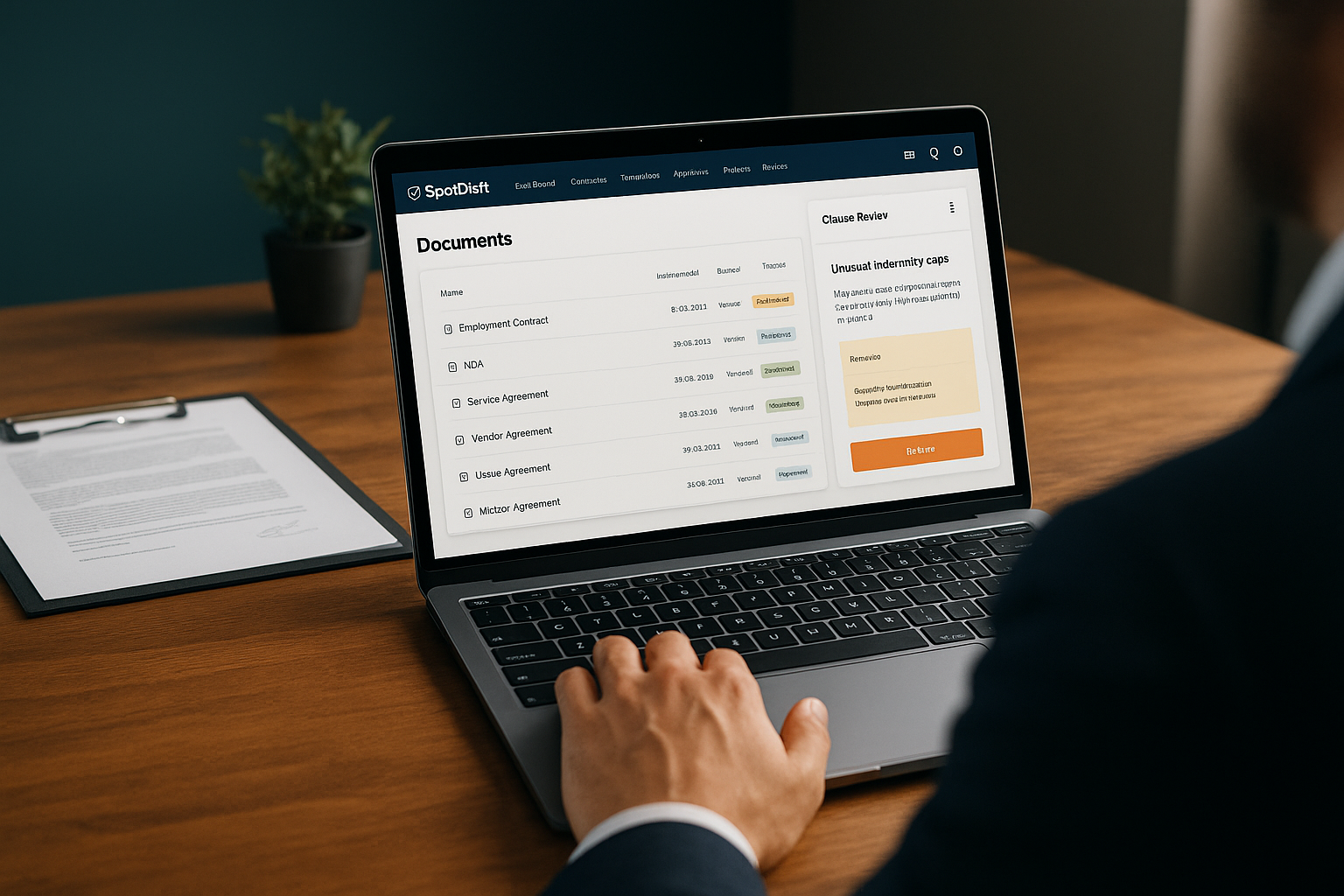
Built around a centralized contract repository, SpotDraft lets legal teams draft from pre-approved templates, route documents for internal approval, and track redlines during negotiation without endless email threads. Its AI layer reviews clauses against a playbook you configure, flagging deviations like unusual indemnity caps or missing termination provisions before a document goes out for signature. Core capabilities include:
- Clause-level risk flagging against a defined playbook
- Centralized repository with searchable metadata across all executed contracts
- Automated renewal and obligation tracking with reminders before deadlines
- Integrations with common e-signature and CRM tools
A contract platform earns its keep by catching the clause you would have missed at 11 PM before a signing deadline.
Who it is for
Corporate legal teams and startups with recurring contract volume, vendor agreements, NDAs, employment contracts, get the clearest value from SpotDraft, since the platform is built around repeatable contract types rather than one-off litigation drafting. In-house counsel managing approvals across departments benefit from the routing and tracking features more than solo litigators would. Law firms handling transactional work for multiple corporate clients also use it to standardize templates across matters.
Pricing
SpotDraft does not publish flat public pricing, and like most CLM software pricing, plans are quoted based on team size, contract volume, and which modules (drafting, repository, e-signature integration) a company needs. Enterprises with heavier contract loads typically negotiate custom annual contracts rather than a self-serve monthly rate. Anyone comparing costs should request a demo directly through SpotDraft's website and get a quote against their actual contract volume before committing to a plan.
5. Legistify: AI-powered legal operations for enterprises
Legistify runs as a legal operations platform built for enterprises managing large volumes of litigation, notices, and compliance work across multiple locations, not a single-lawyer research or drafting tool. It centralizes case tracking, legal notice management, and vendor coordination for companies that route work out to external counsel across cities. Among legal ai companies india, Legistify targets the operational side of legal work rather than the substantive drafting or research side that most competitors chase.
How it works
Legistify gives in-house teams a dashboard to track litigation status, legal notices, and compliance deadlines across every external law firm or advocate they engage. Its AI layer flags upcoming hearing dates, tracks document submissions, and generates status reports without a paralegal manually chasing external counsel for updates. Core functions include:
- Centralized case and notice tracking across multiple external law firms
- Automated deadline and hearing-date reminders pulled from case filings
- Vendor and empanelled-counsel management with performance tracking
- Compliance calendar management across regulatory filings
Enterprises lose more time chasing status updates from external counsel than they lose in the courtroom itself.
Who it is for
Large enterprises and companies with distributed litigation across multiple states get the clearest benefit, since Legistify solves a coordination problem that a single research or drafting tool cannot touch. In-house legal teams managing dozens of external law firms use it to replace spreadsheets and email chains with a single tracking system, much as firms do when they weigh legal practice management software options. It suits companies with high notice and litigation volume, banks, NBFCs, insurance companies, rather than solo practitioners or small firms without a distributed caseload to manage.
Pricing
Legistify prices its platform through enterprise contracts rather than published self-serve plans, since costs depend on case volume, number of empanelled firms, and which modules a company activates. Companies typically go through a sales consultation and demo before receiving a quote tied to their actual litigation and compliance load. Smaller legal teams without distributed litigation across cities generally find better value in a narrower research or contract tool instead of a full operations platform built for enterprise scale.
6. CaseMine: AI-powered legal research and citations
CaseMine runs as one of the AI legal research tools for Indian lawyers, built around case law discovery and citation analysis, covering Indian, US, and UK jurisdictions rather than Indian law alone. Its core product, CaseIQ, uses AI to map how judgments cite and rely on each other, which helps lawyers understand not just what a case says but how much weight it carries across later rulings. Among legal ai companies india, CaseMine has built its name mainly on citation network analysis rather than drafting or contract work.
How it works
CaseMine indexes millions of judgments and lets a lawyer search using natural language rather than exact keyword matches, then surfaces related cases through its citation graph. The platform highlights how frequently a judgment has been cited, whether later courts affirmed or distinguished it, and which paragraphs of a ruling carry the actual legal reasoning a lawyer needs to quote. Key features include:
- Natural language case search across Indian, US, and UK judgment databases
- Citation network mapping showing how precedents relate to each other
- Paragraph-level highlighting of relevant legal reasoning within long judgments
- Case law alerts for tracking developments on a specific legal issue
A citation without context tells you a case exists, a citation network tells you whether it still matters.
Who it is for
Litigators building arguments around precedent value get the most direct use out of CaseMine, since the citation graph shows whether a favorable judgment still holds up against later rulings. Law firms handling cross-border matters benefit from the multi-jurisdiction coverage, particularly firms advising clients with US or UK exposure alongside Indian litigation. Academic researchers and law students studying how case law evolves over time also use it, though its pricing and depth target practicing lawyers more than casual research.
Pricing
CaseMine offers subscription plans for individual lawyers and firms, with tiered access based on search volume and database coverage across jurisdictions. Institutional and firm-wide licenses require a direct quote through the company's sales team, since bulk seat pricing is not published openly. Lawyers comparing options should request a trial to test citation depth on their specific practice area before committing to an annual plan.
7. LegitQuest: an AI-powered case law search engine
LegitQuest runs as a case law search engine built around Indian judgments, statutes, and legal commentary, with an AI layer that ranks results by relevance rather than just keyword match. It competes directly with the big legacy databases, but positions itself as faster and more affordable for smaller practices. Among legal ai companies india, LegitQuest has carved out space by focusing tightly on search speed and citation accuracy rather than expanding into contracts or drafting.
How it works
Queries run through LegitQuest's search engine in natural language, and the AI layer surfaces judgments ranked by relevance to the fact pattern rather than raw keyword frequency. It also maps citations between cases, so a lawyer can see how a precedent has been treated by later benches before relying on it in a filing. Core features include:
- Natural language search across Supreme Court and High Court judgments
- Citation mapping showing how later courts treated a precedent
- Statute-linked search connecting bare acts to relevant case law
- Bookmarking and note-taking tools for building a research file over time
Search speed only matters if the top result is the one you would have cited anyway.
Who it is for
Litigators and solo practitioners researching on a tight budget get the clearest value from LegitQuest, since it offers a database experience close to the established players at a lower price point. Small firms without a dedicated research team use it as their primary case law tool rather than juggling multiple subscriptions. Corporate legal teams occasionally use it for quick precedent checks, though its design leans toward litigation research over transactional work.
Pricing
LegitQuest offers subscription plans priced for individual lawyers and small firms, generally cheaper than the older legacy databases it competes against. Firm-wide or multi-seat access requires contacting the company directly for a custom quote, since bulk pricing is not listed publicly. Anyone evaluating it against pricier alternatives should run a trial search on cases from their own practice area first, since coverage depth can vary by subject matter and jurisdiction level.
8. SCC Online: an AI research assistant for lawyers
SCC Online has been the default legal database for Indian lawyers for decades, and it has now layered an AI research assistant on top of its existing case law and commentary archive. Rather than launching as a new entrant, SCC Online brings AI search to a database most Indian litigators already trust, which is why it appears in most shortlists of legal research tools in India. Among legal ai companies india, SCC Online holds an advantage that newer startups cannot match: decades of curated headnotes, statutory annotations, and commentary that the AI layer draws on directly.
How it works
Lawyers type a query in plain language, and the AI assistant returns relevant judgments, statutory provisions, and commentary drawn from SCC Online's existing archive rather than the open internet. It also summarizes long judgments into shorter briefs and links directly to the full text and related citations within the same database. Typical uses include:
- Natural language search across Supreme Court, High Court, and tribunal judgments
- AI-generated case summaries linked back to the original judgment text
- Statute-to-case cross-referencing using SCC's existing annotations
- Integration with SCC's existing citation and headnote system
Decades of curated legal commentary make an AI research layer more reliable than one trained on scraped, unverified sources.
Who it is for
Law firms and litigators who already subscribe to SCC Online get the most immediate benefit, since the AI assistant sits inside a tool they already use daily rather than requiring a switch to a new platform. Senior advocates who trust SCC's established annotations over newer, unproven databases lean on this option specifically for that institutional credibility. Corporate legal departments researching statutory questions also rely on it, particularly where existing SCC subscriptions already cover their compliance and litigation teams.
Pricing
SCC Online prices its AI research features as part of its existing subscription tiers, with costs varying by database access level, number of users, and whether a firm already holds a legacy subscription. Firms upgrading from a standard plan typically pay an incremental fee for AI-assisted search rather than a separate standalone charge. Anyone evaluating it should check with their existing SCC Online account manager, since bundled pricing for existing subscribers usually beats a fresh signup.
9. Presolv360: AI-enabled online dispute resolution
Presolv360 runs an online dispute resolution platform built for mediation and arbitration of commercial disputes, rather than litigation research or contract drafting. It targets the disputes that never need a courtroom at all, low to mid-value commercial claims, consumer complaints, and debt recovery matters, and resolves them entirely online through a structured, AI-assisted process. Among legal ai companies india, Presolv360 is one of the few that focuses on resolving disputes rather than preparing lawyers to fight them.

How it works
Parties file a dispute through Presolv360's platform, and the system assigns a neutral, an arbitrator or mediator, based on the dispute type and value. AI tools within the platform assist with case scheduling, document management, and drafting settlement terms, while the actual hearings happen over video or written submissions rather than in person. Core elements include:
- Automated neutral assignment based on dispute category and claim value
- Digital case management with document sharing and deadline tracking
- AI-assisted drafting of settlement agreements and award orders
- End-to-end online hearings, avoiding physical court appearances entirely
A dispute resolved online in weeks beats a decree won in court after three years.
Who it is for
Banks, NBFCs, and e-commerce companies handling high-volume, low-value disputes get the clearest use out of Presolv360, since the platform is built to process consumer complaints and recovery claims at scale rather than one complex commercial suit at a time. Corporate legal teams embed Presolv360's dispute resolution clauses directly into their customer or vendor contracts, so any future dispute routes automatically to the platform instead of a civil court. Independent lawyers occasionally appear before Presolv360 panels as counsel, though the platform's primary customers are businesses managing dispute volume, not solo practitioners.
Pricing
Presolv360 charges fees based on the value of the dispute and the type of resolution process chosen, mediation, conciliation, or arbitration, rather than a flat subscription. Enterprises embedding Presolv360 clauses into standard contracts typically negotiate bulk rates tied to expected dispute volume over a year. Businesses considering it should request a fee schedule directly from Presolv360, since costs scale with claim value rather than following a single published rate card.
10. Leegality: AI-assisted e-signing for legal teams
Leegality runs a digital signature and document execution platform built for Indian legal and compliance teams, layering AI-assisted checks on top of e-stamping and e-signing workflows rather than competing on research or drafting. It solves a narrow but constant problem: getting signed, stamped, and legally valid documents executed without printing, courier delays, or physical notarization. Among legal ai companies india, Leegality stands apart by focusing entirely on the execution stage of a document's life, after drafting ends and before enforcement begins.
How it works
Documents move through Leegality's workflow engine, where the AI layer verifies signer identity, checks stamp duty compliance by state, and flags missing fields or unsigned pages before a document counts as complete. Teams configure approval sequences so a contract routes automatically through the right internal signatories and external parties in order. Core capabilities include:
- Aadhaar-based and digital signature certificate (DSC) verification for signers
- Automated e-stamping calculated by state-specific stamp duty rules
- Bulk document dispatch for high-volume execution, such as loan agreements
- Audit trails documenting every signature event for legal enforceability
A contract sitting unsigned in someone's inbox costs a business more than the legal fees spent drafting it.
Who it is for
Banks, NBFCs, and insurance companies executing thousands of agreements monthly get the clearest value, since Leegality replaces physical signing rooms with a compliant digital process at scale. Corporate legal teams closing vendor contracts, employment agreements, and NDAs use it to cut execution time from days to minutes. Law firms handling high-volume transactional closings, real estate, lending, insurance, also adopt it, though its scope stops at execution rather than extending into drafting or research work.
Pricing
Leegality prices access through tiered plans based on document volume, signer verification method, and whether e-stamping is bundled in. Enterprises with recurring high-volume execution typically negotiate custom annual contracts rather than pay per-document rates. Anyone comparing costs should request a demo and volume-based quote directly from Leegality before committing to a plan.
11. Aalap: an AI assistant for drafting and research
Aalap runs as an AI drafting and research assistant built specifically for Indian lawyers, positioned as an open, accessible tool rather than a locked-down enterprise product. It grew out of research into large language models trained on Indian legal text, and it carries that academic origin into a practical assistant for drafting notices, agreements, and research memos. Among legal ai companies india, Aalap stands out for being one of the few built with an explicit focus on Indian legal language patterns rather than adapting a Western model after the fact.
How it works
Aalap takes a plain-language prompt describing a legal task, drafting a reply to a legal notice, summarizing a judgment, explaining a statutory provision, and generates a first draft or answer trained on Indian legal text. It works conversationally, so a lawyer can refine an output through follow-up prompts rather than starting a fresh query each time. Typical uses include:
- Drafting legal notices, replies, and basic agreements from a fact summary
- Summarizing judgments and lengthy case files into shorter notes
- Explaining statutory provisions and legal concepts in plain language
- Answering research queries with references to relevant law
A drafting assistant only earns trust once a lawyer checks its first ten outputs against the actual statute and finds no gaps.
Who it is for
Independent lawyers and small firms without a large support staff get the most direct use out of Aalap, since it substitutes for the drafting help they cannot always afford to hire. Law students and junior associates use it to practice legal drafting techniques and understand statutory language before handling real filings under supervision. Litigators on tight deadlines lean on it for a fast first draft of a notice or reply, though senior counsel should still review anything before it goes out under a firm's name.
Pricing
Aalap has offered free or low-cost access during its earlier development phases, aimed at building adoption among individual lawyers and students rather than enterprise clients. Pricing details change as the product matures, so lawyers should check directly through Aalap's current channels for the latest plans before assuming continued free access.
Finding the right legal AI fit for your practice
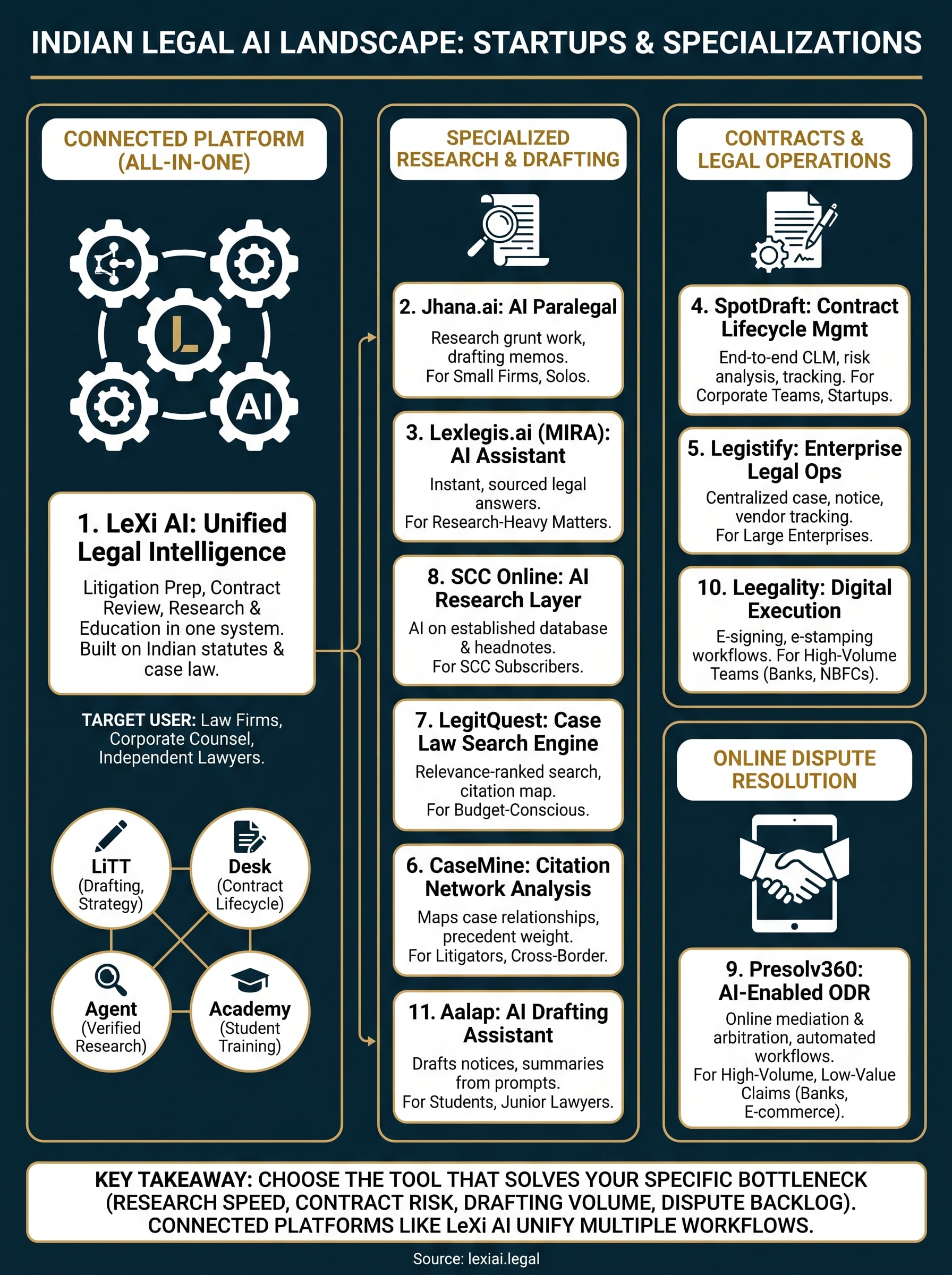
Eleven tools, eleven different jobs. A solo litigator chasing citations needs something different from an in-house team executing loan agreements at scale, and no single legal AI startup in India covers every use case equally well. Match the tool to the actual bottleneck in your practice, research speed, contract risk, drafting volume, or dispute backlog, rather than picking whatever ranks highest in a search result.
If your bottleneck spans more than one of these, litigation prep, contract review, and legal research all at once, a connected platform saves you from stitching together three subscriptions and three logins. That is the gap LeXi AI was built to close, with modules covering each workflow under one system trained on Indian law. Rather than take that claim at face value, test it against your own case files and contracts. Try LeXi AI free and see how it handles the work sitting on your desk right now.