

Lease Deed Format: Sample and How to Draft One
A lease deed format is simply the standard structure that a lease deed follows, covering the parties, property description, rent terms, duration, and rights and obligations of the lessor and lessee. Under the Transfer of Property Act, 1882, Section 105 defines a lease and sets the baseline for what such a document must establish. If you are drafting one for the first time, the format matters as much as the content, since courts and registrars expect certain clauses in a specific order.
Most readers searching for this want two things: a working sample they can adapt, and a clear breakdown of each mandatory clause, such as the recital, rent schedule, security deposit terms, and termination conditions. Getting the sequence wrong or omitting a clause can create disputes later, especially around renewal or eviction.
This article walks through a full sample lease deed, clause by clause, and explains how to draft one for residential, commercial, or agricultural property in India. Where relevant, we also point out where AI drafting tools like LeXi Desk, and other AI legal assistants used by Indian lawyers, can speed up clause generation and flag risky terms before you finalize the deed.
Why the lease deed format matters
A lease deed is a legal instrument, not just a rental agreement between two parties who trust each other, and it is drafted differently from a leave and license agreement. Courts, sub-registrars, and even banks reviewing a loan application read the deed clause by clause, and they expect the standard lease deed format to appear in a recognizable order. When a clause is missing or placed out of sequence, the document can lose its legal weight exactly when you need it most, during a dispute over rent, possession, or renewal.
Section 107 of the Transfer of Property Act, 1882 requires that a lease of immovable property for a term exceeding one year be made only by a registered instrument. If your deed skips the formalities that registration demands, such as proper execution, witness attestation, and a clear description of the demised property, a court can treat the arrangement as a mere tenancy at will rather than a lease. That downgrade strips away protections both the lessor and lessee assumed they had.
A lease deed that skips a clause is not a shorter deed, it is an incomplete legal instrument.
The format determines whether a court will enforce it
Disputes over commercial and residential leases in India often turn on whether a specific term was actually part of the deed or just a verbal understanding. A properly sequenced lease deed puts the recital, property description, rent schedule, and termination clause in a logical order that leaves no room for a party to argue a term was implied rather than agreed. Tribunals and civil courts, including under the Rent Control Acts in several states, look first at whether the deed follows the expected structure before they even examine the substance of a claim.
Registration and stamp duty depend on the format
Every state calculates stamp duty differently, but almost all of them base the calculation on how the deed presents rent, deposit, and tenure figures. If your rent escalation clause sits buried inside a general clause instead of appearing as its own numbered section, the sub-registrar may miscalculate duty or send the deed back for correction. Getting the format right the first time saves you a second trip to the registrar's office and avoids penalty interest on underpaid duty.
What a weak format actually costs you
The table below shows what tends to go wrong when lease deeds skip standard formatting, based on disputes that regularly show up in Indian civil courts.
| Aspect | Well-structured deed | Poorly structured deed |
|---|---|---|
| Enforceability | Recognized as valid lease under Section 105 | Risk of being read as tenancy at will |
| Registration | Processed without delay | Returned for missing clauses or misclassification |
| Stamp duty | Calculated correctly on first submission | Recalculated, sometimes with penalty |
| Dispute resolution | Terms are unambiguous, faster court outcomes | Terms contested, longer litigation |
| Renewal or eviction | Notice periods and grounds are clear | Ambiguity invites litigation |
Getting this right from the first draft is far cheaper than fixing it after a tenant stops paying rent or a landlord tries to evict without notice. Tools like LeXi Desk are built around this exact problem, since they generate clauses in the order registrars and courts expect and flag missing terms before you file the deed.
How to draft a lease deed step by step
Drafting a lease deed is not about writing prose, it is about applying the same core drafting skills for precise legal documents to fill a fixed sequence with accurate facts. Start by collecting every detail you need before you open a blank document, because going back to gather information mid-draft is where most errors creep in. Once you have the facts, the lease deed drafting process becomes a matter of placing them in the order registrars and courts expect.
Gather the essential details before you draft
Before writing a single clause, confirm these details in writing with both parties:
- Full legal names and addresses of the lessor and lessee
- Complete property description, including survey number, boundaries, and built-up area
- Agreed monthly or annual rent, and whether it escalates
- Security deposit amount and refund terms
- Lease tenure, start date, and renewal option
- Permitted use of the property, residential, commercial, or agricultural
Follow the sequence courts expect
Once you have these facts, draft the deed in this order:
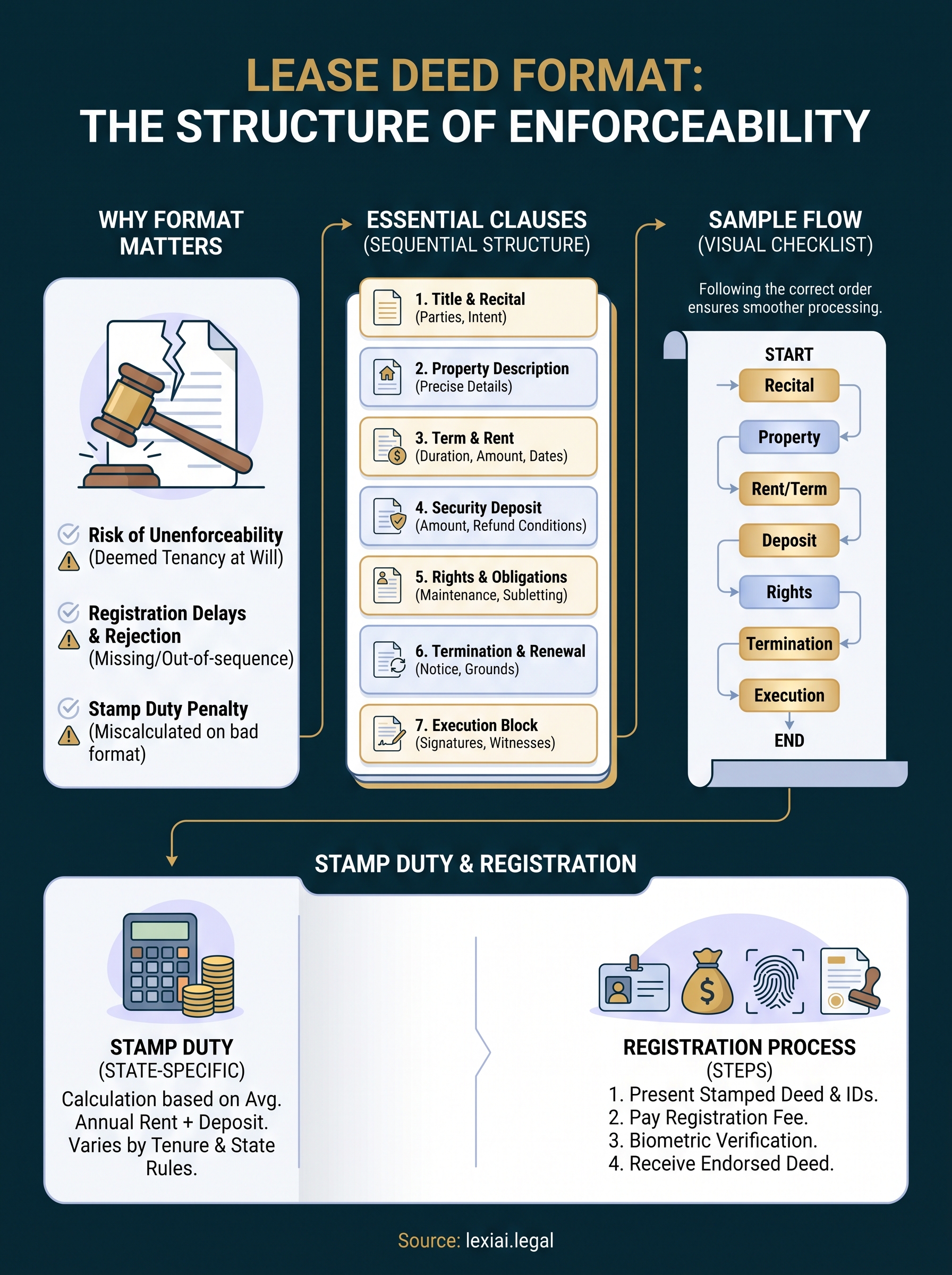
- Title and recital, naming the parties and stating the intent to lease.
- Property description, identifying the demised premises precisely.
- Term and rent schedule, stating tenure, rent amount, and due dates.
- Security deposit clause, covering amount, interest if any, and refund conditions.
- Rights and obligations, covering maintenance, subletting, and alterations.
- Termination and renewal, stating notice periods and grounds for eviction.
- Execution block, with signatures, witnesses, and date.
Draft in this order every time, and the deed practically checks itself.
Holding to this sequence matters more than the exact wording of any single clause, because a sequential lease drafting format is what a sub-registrar scans for first. If a clause is missing or out of place, the deed gets flagged before anyone even reads the substance. Many lawyers now speed this stage up with drafting tools like LeXi Desk, which generates each clause in the expected order and flags a missing security deposit or termination clause before you submit the deed for registration.
A sample lease deed format to reference
Seeing an actual sample lease deed helps more than reading a list of clause names, because you can see how each section flows into the next. Below is a simplified skeleton you can adapt for a residential or commercial lease in India, keeping the exact numbering and headings that registrars are used to seeing. Treat this as a starting structure only, since your state's stamp act and the specific property type will demand additional clauses.
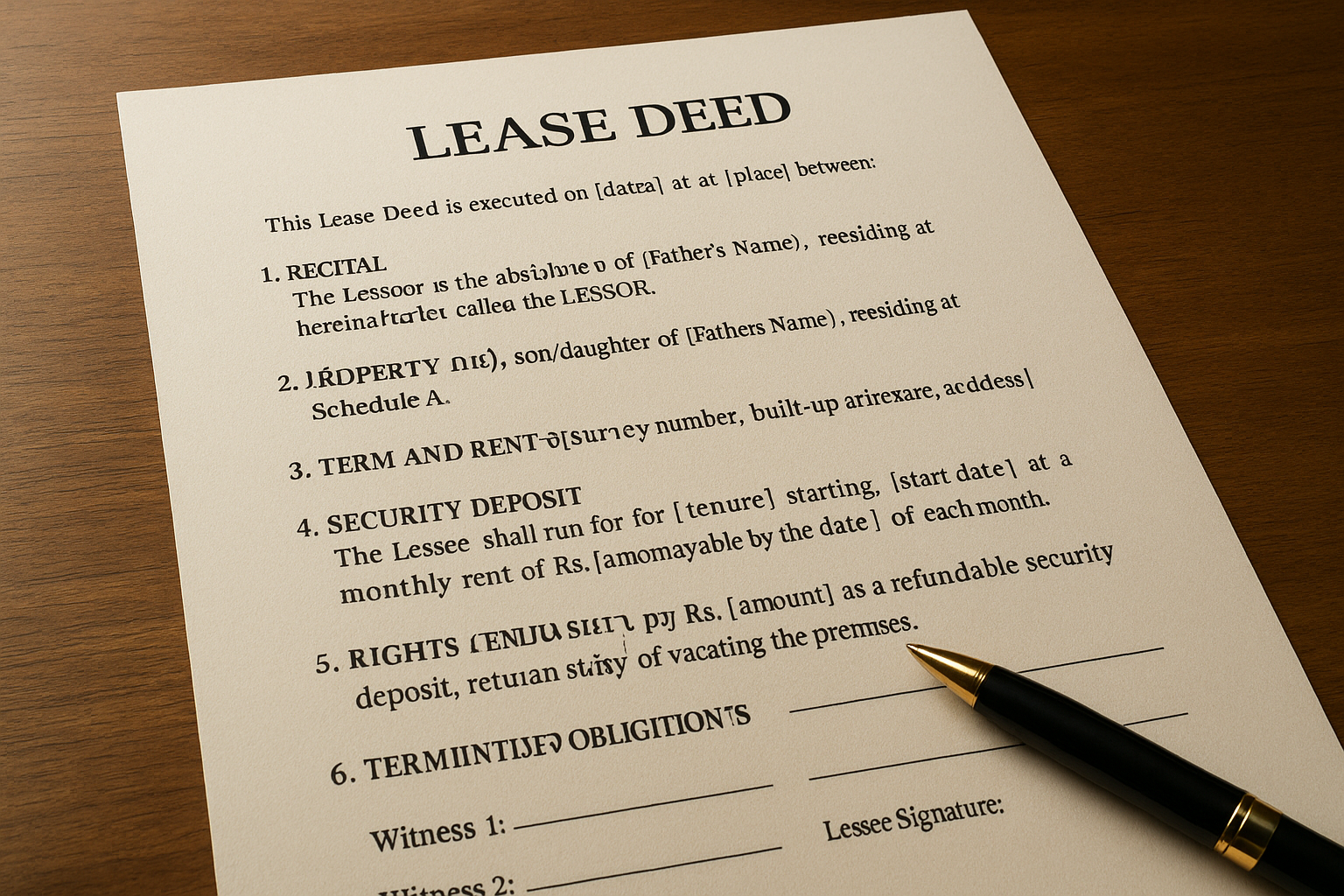
A sample only helps you if you keep the sequence intact when you fill in your own facts.
Here is a bare-bones lease deed template you can use as a reference point:
LEASE DEED

This Lease Deed is executed on [date] at [place] between:

[Lessor Name], son/daughter of [Father's Name], residing at
[Address], hereinafter called the LESSOR,

AND

[Lessee Name], son/daughter of [Father's Name], residing at
[Address], hereinafter called the LESSEE.

1. RECITAL
The Lessor is the absolute owner of the property described in
Schedule A and has agreed to lease it to the Lessee on the terms
below.

2. PROPERTY DESCRIPTION
Schedule A: [Survey number, boundaries, built-up area, address]

3. TERM AND RENT
The lease shall run for [tenure] starting [start date] at a
monthly rent of Rs. [amount], payable by the [date] of each month.

4. SECURITY DEPOSIT
The Lessee shall pay Rs. [amount] as a refundable security
deposit, returnable within [days] of vacating the premises.

5. RIGHTS AND OBLIGATIONS
[Maintenance, subletting, alteration terms]

6. TERMINATION AND RENEWAL
[Notice period, grounds for eviction, renewal terms]

7. EXECUTION
Signed by both parties in the presence of the following witnesses.

Witness 1: ___________ Witness 2: ___________
Lessor Signature: ___________ Lessee Signature: ___________
Notice how the schedule of the property sits separately from the rent clause, and how the execution block comes last, after every substantive term. Reproducing this order matters more than the exact wording, since a sub-registrar checks the sequence before reading the content. Platforms like LeXi Desk generate a version of this format automatically, filling in party details and flagging any clause you have left blank before you print the final deed for signature.
Essential clauses every lease deed should include
Every lease deed needs a fixed set of clauses regardless of whether the property is residential, commercial, or agricultural. Skipping any one of these mandatory lease clauses is what turns a routine tenancy into a courtroom dispute two years later. Below is the list every drafter should treat as non-negotiable.
- Parties and recital: full legal names, addresses, and a statement of intent to lease.
- Property description: survey number, boundaries, and built-up area, matching revenue records exactly.
- Rent and payment schedule: amount, due date, mode of payment, and any escalation clause.
- Security deposit terms: amount, interest if applicable, and refund conditions on vacating.
- Permitted use: whether the lessee can use the property for residential, commercial, or mixed purposes.
- Maintenance and alteration rights: who pays for repairs, and whether structural changes need prior consent.
- Subletting restrictions: whether the lessee can sublet, and under what conditions.
- Termination and renewal: notice period, grounds for eviction, and renewal terms if any.
- Dispute resolution: arbitration clause or jurisdiction of courts in case of conflict.
Formatting these clauses in a legally sound lease deed means giving each one its own numbered section rather than folding two or three terms into a single paragraph. Registrars in most states, and civil courts hearing eviction suits under local Rent Control Acts, read the deed clause by clause and expect this separation.
A lease deed missing even one of these clauses is not incomplete on paper only, it is incomplete in law.
Going beyond the minimum list, a comprehensive clause checklist should also address who bears property tax, whether utilities are included in rent, and what happens if the property is sold mid-tenure under a sale deed. Commercial leases often need an additional clause on signage rights and exclusivity, while agricultural leases need clauses on crop-sharing or irrigation access. Drafting tools like LeXi Desk flag these gaps automatically, comparing your draft against clause libraries built for Indian property types before you finalize the document for signature.
Stamp duty and registration rules for lease deeds
Stamp duty on a lease deed depends on the state, the tenure, and whether the property is residential, commercial, or agricultural. Most states calculate duty as a percentage of the average annual rent plus the security deposit, so an incorrectly formatted rent clause can throw off the entire calculation. Under Section 17 of the Registration Act, 1908, any lease of immovable property for a term exceeding one year must be registered, and an unregistered deed cannot be used as evidence of the lease terms in most disputes.
An unstamped or unregistered lease deed is not a shortcut, it is a document courts will not fully rely on.
How stamp duty varies by state
Rates differ sharply across India, and the lease deed stamp duty rules in one state rarely match another. The table below gives a general sense of how tenure and property type affect the calculation, though you should always confirm current rates with your local sub-registrar before filing.
| State | Basis of calculation | Typical range |
|---|---|---|
| Maharashtra | Percentage of average annual rent plus deposit | Varies by tenure |
| Delhi | Percentage of average annual rent | Varies by tenure |
| Karnataka | Percentage of average annual rent plus deposit | Varies by tenure |
| Tamil Nadu | Percentage of average annual rent plus deposit | Varies by tenure |
Registration steps that follow the format
Once the deed is stamped correctly, registration follows a fixed sequence at the sub-registrar's office:
- Present the stamped deed along with identity proof of both parties.
- Pay the applicable registration fee, separate from stamp duty.
- Both parties and witnesses appear before the sub-registrar for biometric verification.
- The registrar endorses and returns the registered copy.
Skipping any step, or presenting a deed where the rent and deposit clauses are unclear, usually means a return trip. Drafting the deed correctly the first time, with clearly separated clauses, is what keeps this process to a single visit.
Getting your lease deed right
A lease deed is only as strong as its weakest clause, and the format is what keeps every clause enforceable. Getting the sequence right, from recital through execution, protects both the lessor and lessee when a dispute over rent, possession, or renewal eventually surfaces. Stamp duty and registration only go smoothly when the rent and deposit clauses are clearly separated and easy for a sub-registrar to read.
Before you finalize any lease deed, run through the sample and clause checklist above one more time, and confirm your state's stamp duty rules with the local sub-registrar. Drafting from scratch every time is slow and error-prone, which is exactly why more lawyers and property owners now draft, check, and finalize their lease deeds on the LeXi AI legal drafting platform, rather than starting from a blank page each time.