

Kesavananda Bharati Case Summary: Facts, Judgment, and Impact
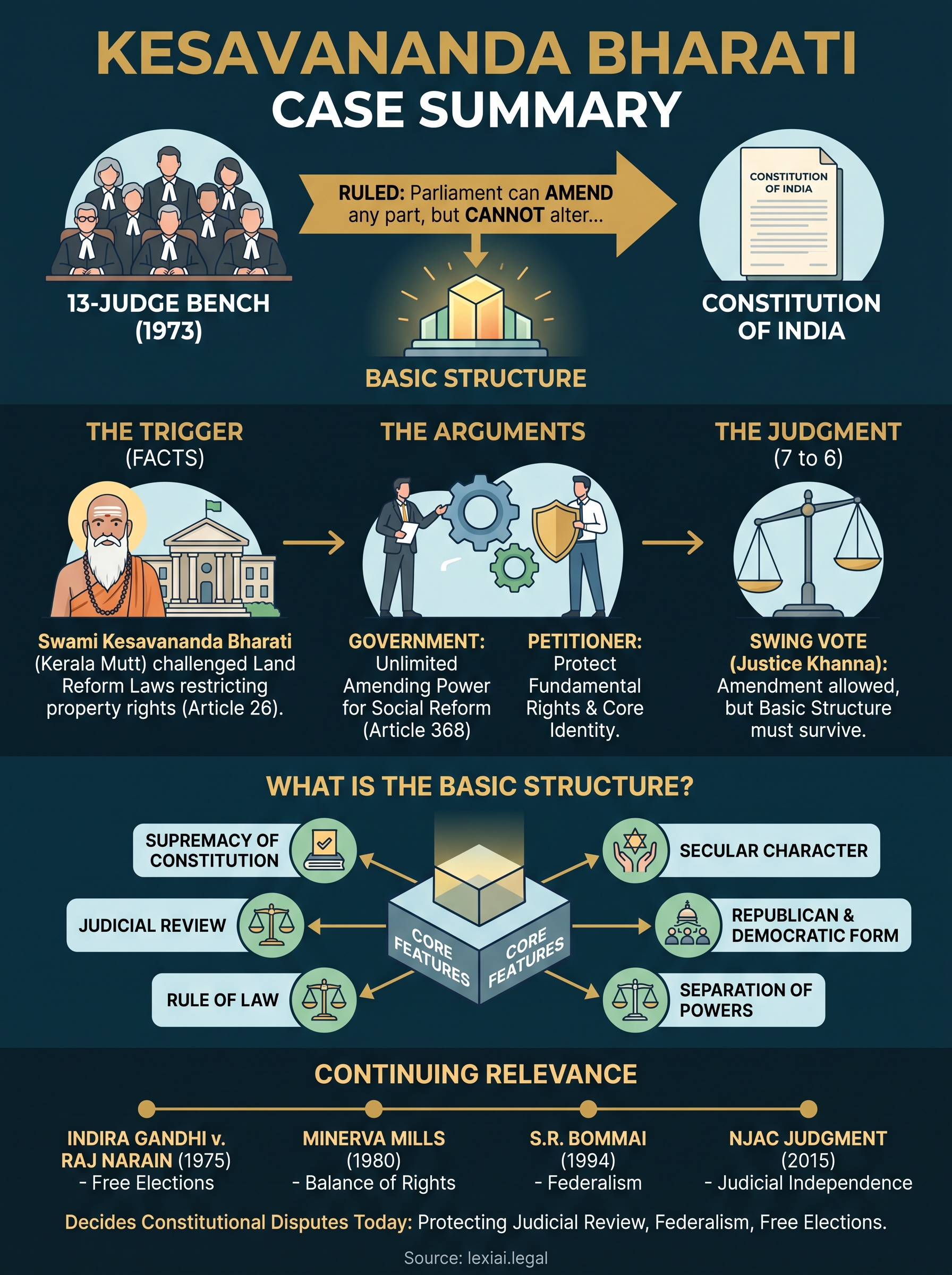
The kesavananda bharati case summary most students and lawyers need comes down to this: a 13 judge bench of the Supreme Court, the largest ever assembled, ruled in 1973 that Parliament can amend any part of the Constitution under Article 368, but cannot alter its basic structure. That single line has shaped every major constitutional dispute in India since, from the NJAC judgment to challenges against the 99th Amendment.
If you are searching for what actually happened in this case, here is the direct answer. Swami Kesavananda Bharati, head of a Kerala mutt, challenged land reform laws that restricted his religious institution's property rights. The case grew far beyond property disputes and became the forum where the Court decided whether Parliament's amending power under Article 368 was unlimited, overturning the earlier position taken in Golaknath v. State of Punjab.
This article walks through the facts, the arguments before the bench, the 7 to 6 judgment, and why the basic structure doctrine still controls constitutional interpretation today. If you are preparing for exams, drafting a constitutional law brief, or arguing a case that touches on amendment powers, tools like LeXi AI can help you pull the exact paragraphs and cross referenced judgments quickly.
Why the Kesavananda Bharati case matters
The Kesavananda Bharati case matters because it drew a line that no Parliament, however large its majority, can cross. Before 1973, the ruling government could theoretically amend the Constitution into something unrecognizable, including stripping away fundamental rights or abolishing judicial review. The 13 judge bench closed that door by holding that certain features form the basic structure of the Constitution and sit beyond the reach of Article 368.
Setting limits on Parliament's amending power
Ratan Tata could not have predicted it, but this case affects every Indian citizen far beyond land reform disputes in Kerala. The judgment established that Parliament holds wide amending power, yet that power is not unlimited. This distinction between amendment and destruction became the analytical tool every later bench would reach for.
Parliament can change the Constitution, but it cannot change what makes the Constitution the Constitution.
Protecting core constitutional features
Subsequent benches have used the basic structure doctrine to protect several identifiable features. These typically include:
- Supremacy of the Constitution
- Republican and democratic form of government
- Secular character of the Constitution
- Separation of powers between the legislature, executive, and judiciary
- Federal character of the Constitution
- Judicial review and access to constitutional remedies
- Rule of law
These are not exhaustive categories fixed in one judgment. Courts have added to this list case by case, which is exactly why the kesavananda bharati case summary you read in one textbook may list slightly different features than another.
A framework still cited in landmark cases
Every major constitutional dispute since 1973 has tested itself against this framework. The NJAC judgment in 2015 struck down the National Judicial Appointments Commission Act precisely because it threatened judicial independence, a recognized basic structure feature. Similarly, challenges to the 99th Amendment relied heavily on the reasoning first laid out in this case.
For law students and practicing advocates alike, understanding this case is not optional background reading. It is the foundation on which arguments about constitutional amendments, judicial independence, and federalism are built even today. Lawyers researching amendment challenges often use AI-powered case law research platforms like LeXi Agent to trace how the basic structure doctrine has been applied across five decades of case law, rather than manually searching through hundreds of judgments to find the relevant threads.
How the Supreme Court arrived at its judgment
Hearing this case took the Supreme Court nearly seven months of continuous arguments, the longest in its history at that point. The 13 judge bench, led by Chief Justice S.M. Sikri, sat from October 1972 to March 1973 before delivering the judgment on April 24, 1973. Eleven separate opinions ran to over 700 pages, making this one of the most fragmented rulings the Court has ever produced.
Deciding the outcome required the judges to first resolve whether Golaknath v. State of Punjab had correctly held that fundamental rights could never be amended. Six judges wanted to preserve that rigid position, while six others argued Parliament needed broader amending power to implement social and economic reform. Justice H.R. Khanna cast the deciding vote, agreeing that fundamental rights could be amended, but only if the amendment did not destroy the basic structure of the Constitution.
One judge's swing vote turned a deadlocked bench into a doctrine that still governs Indian constitutional law.
Reaching this compromise meant the majority accepted a middle path: Article 368 permits amendment of any provision, including fundamental rights, but Parliament cannot use that power to alter the Constitution's identity.
| Position | Number of judges | Core view |
|---|---|---|
| Unlimited amending power | 6 | Parliament can amend any provision without restriction |
| No amendment of fundamental rights | 6 | Golaknath position, fundamental rights are unamendable |
| Swing vote (Justice Khanna) | 1 | Amendment allowed, but basic structure must survive |
Summarizing the vote count this way explains why so many kesavananda bharati case summary write-ups describe the ruling as 7 to 6 rather than a clean majority, since Khanna's separate reasoning effectively created the deciding formula that later benches would apply.
Facts and arguments behind the case
Facts in this case began far from any Article 368 debate. Swami Kesavananda Bharati, head of the Edneer Mutt in Kerala, filed a writ petition after the Kerala Land Reforms (Amendment) Act, 1969 restricted the mutt's ability to manage and sell its property. He argued this violated his fundamental rights under Article 26 (freedom to manage religious affairs) and Article 25 (freedom of religion). What started as a property dispute widened quickly once the 24th, 25th, and 29th Constitutional Amendments came under challenge alongside the land reform law itself.
The land dispute that widened into a constitutional question
Nani Palkhivala, appearing for Kesavananda Bharati, expanded the petition to challenge whether Parliament could amend fundamental rights at all, drawing directly on the reasoning from Golaknath v. State of Punjab. He argued that if Article 368 gave Parliament unchecked amending power, no right guaranteed under Part III would ever be safe from a hostile legislative majority.
A dispute over a mutt's land ended up deciding how far Parliament could ever go in rewriting the Constitution.
What each side argued before the bench
Attorney General Niren De, representing the Union government, argued the opposite position:
- Parliament represents the will of the people and needs unrestricted power to amend the Constitution for social and economic reform.
- Article 368 places no express limitation on which provisions can be amended, including fundamental rights.
- Courts should not read implied restrictions into a power the framers deliberately left broad.
Judges weighing these arguments understood that ruling either way carried consequences far beyond the Edneer Mutt's property, which is why any accurate kesavananda bharati case summary treats the underlying facts as almost secondary to the constitutional question they ultimately triggered.
Basic structure doctrine in later court rulings
Judges did not stop applying this doctrine once the 1973 ink dried. Over the next five decades, the Supreme Court leaned on the basic structure doctrine every time Parliament tried to insulate its own actions from judicial scrutiny, and each new ruling added texture to what counts as unamendable.
Indira Nehru Gandhi v. Raj Narain (1975)
Parliament passed the 39th Amendment to place the Prime Minister's election beyond the reach of ordinary courts, right after the Allahabad High Court found Indira Gandhi guilty of electoral malpractice. The Supreme Court struck down that clause, holding that free and fair elections and judicial review were part of the basic structure and could not be removed by any amendment, however urgent the political motive.
A doctrine born from a land dispute ended up protecting the outcome of a national election.
Minerva Mills v. Union of India (1980)
Here the Court confronted the 42nd Amendment, which tried to give directive principles automatic priority over fundamental rights and place amendments themselves beyond judicial challenge. Justices ruled that the balance between Part III and Part IV was itself part of the basic structure, and that limited amending power was a feature the Constitution could not do without.
Later benches expanding the list
Subsequent rulings kept adding to the doctrine rather than narrowing it:
- S.R. Bommai v. Union of India (1994) confirmed federalism and secularism as basic features.
- I.R. Coelho v. State of Tamil Nadu (2007) subjected Ninth Schedule laws to basic structure review.
- NJAC judgment (2015) protected judicial independence from a constitutional amendment itself.
Lawyers tracing this chain across judgments often turn to LeXi Agent or other AI research tools for Indian lawyers rather than searching each ruling separately.
Kesavananda Bharati case versus the Golaknath case
Comparing these two rulings answers a question every constitutional law student eventually asks: why did the Court reverse itself within six years? Golaknath v. State of Punjab (1967) held that Parliament had no power whatsoever to amend fundamental rights, treating Article 368 as a procedural provision rather than a source of substantive amending power. That rigid stance created a practical problem, since land reform and social welfare legislation kept running into fundamental rights challenges that Parliament could never cure through amendment.
What Golaknath decided
Eleven judges in Golaknath ruled by a narrow 6 to 5 margin that Article 13(2), which bars laws abridging fundamental rights, applied equally to constitutional amendments. Effectively, this froze Part III of the Constitution, leaving no route for future amendment even where Parliament had legitimate reform goals.
Golaknath protected fundamental rights absolutely, but left no room for a Constitution that could grow with the country.
What changed with Kesavananda Bharati
Directly overruling that position, the 13 judge bench in Kesavananda Bharati restored Parliament's power to amend fundamental rights while adding the basic structure limitation as a safeguard. This shift replaced an all-or-nothing rule with a workable test that courts still apply.
| Feature | Golaknath (1967) | Kesavananda Bharati (1973) |
|---|---|---|
| Fundamental rights amendment | Not permitted at all | Permitted, subject to basic structure |
| Bench size | 11 judges | 13 judges |
| Vote margin | 6 to 5 | 7 to 6 |
| Governing test | Article 13(2) applies to amendments | Basic structure doctrine |
Examining both judgments side by side, using a tool like LeXi Agent and sound doctrinal legal research methods, makes it easier to see exactly how the reasoning shifted between 1967 and 1973 rather than relying on secondhand summaries.
The doctrine's continuing relevance
Fifty years on, the basic structure doctrine still decides which amendments survive and which do not. Any kesavananda bharati case summary worth remembering should leave you with one core idea: Parliament can change the Constitution, but it cannot erase what makes it the Constitution. That single distinction has protected judicial review, federalism, and free elections through decades of political pressure.
Students preparing for exams and lawyers building arguments around amendment powers both return to the same seven judgments discussed above, tracing how each bench refined the doctrine, and many now do it with the help of an AI legal assistant built for Indian law. Rather than rereading hundreds of pages every time a new case cites Kesavananda Bharati, you can start a free trial of LeXi AI and pull the relevant paragraphs and cross-referenced rulings directly, with this entire chain of case law organized in one place. That saves the kind of research time this doctrine, ironically, took the Court seven months to work out.