

Contract Lifecycle Management: What It Is and How CLM Works
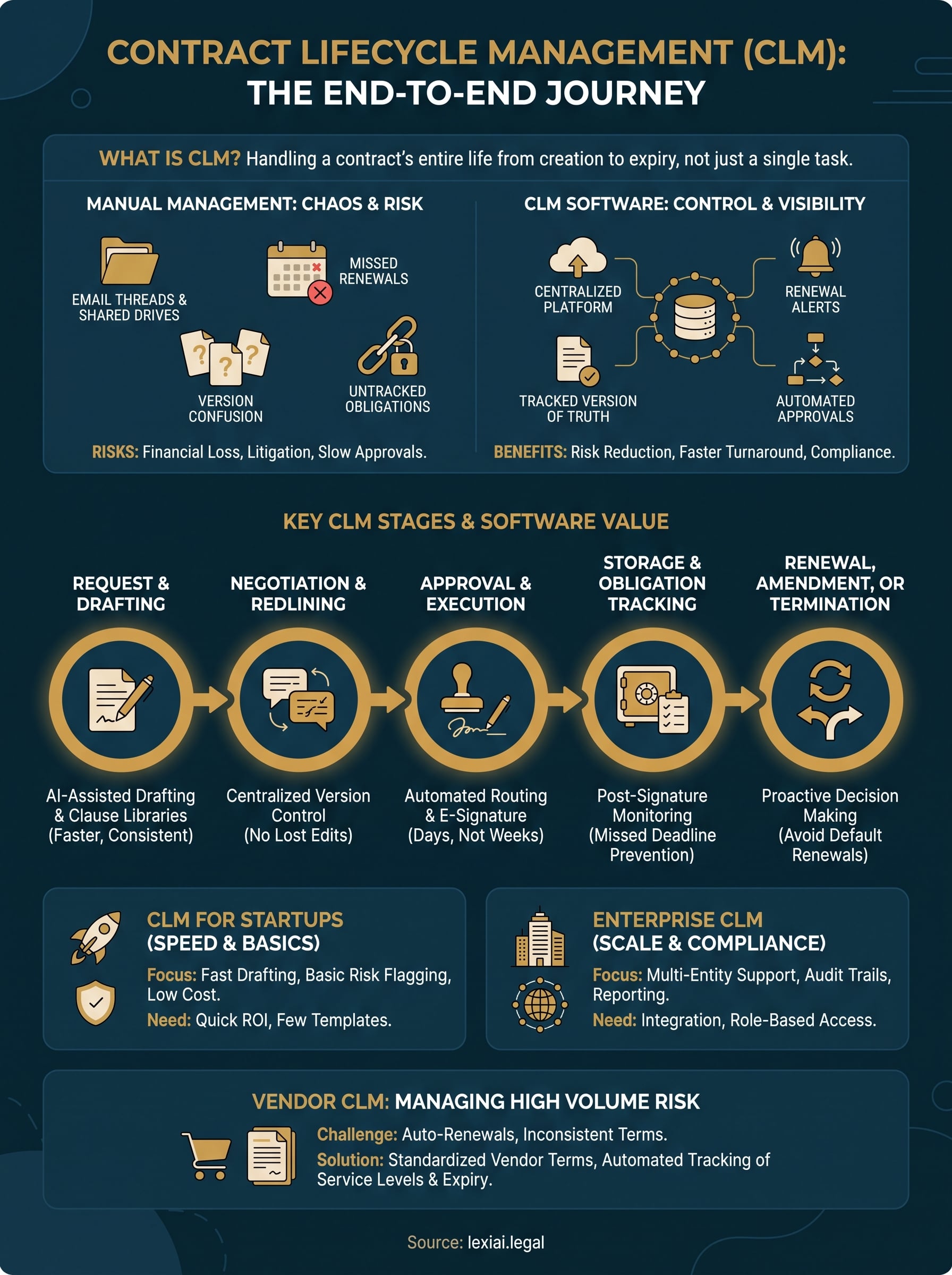
Every contract your organization signs goes through the same journey: someone drafts it, someone negotiates it, someone signs it, and someone has to remember when it expires. Contract lifecycle management is the process of handling that entire journey, from the first draft to renewal or termination, instead of treating each stage as a separate task. In plain terms, CLM means you control a contract's life from creation through execution to expiry, rather than losing track of it in someone's inbox.
Most Indian law firms, in house teams, and startups still manage this manually across email threads and shared drives, which is exactly why contract lifecycle management clm software exists. Good contract lifecycle management tools cover drafting, clause negotiation, approval routing, e-signature, obligation tracking, and renewal alerts in one place. Whether you are handling vendor contract lifecycle management for a single business unit or running enterprise contract lifecycle management across dozens of teams, the goal stays the same: fewer missed deadlines and faster turnaround.
This article breaks down what CLM actually involves, the stages every contract passes through, and the core contract lifecycle management requirements you should check before choosing software, including options built for clm for startups india and larger legal teams alike. Platforms like LeXi Desk, part of LeXi AI's legal AI built for Indian law, show how these stages work together in practice for contract lifecycle management india.
Why contract lifecycle management matters for legal teams
Most legal teams do not lose disputes because of bad arguments. They lose money because of a clause nobody flagged, a renewal date nobody tracked, or an approval that took six weeks instead of six days. Contract lifecycle management matters because contracts are not static documents. They are live obligations that carry deadlines, penalties, and risk exposure long after signature, and someone has to own that ongoing responsibility.
What happens without a CLM system in place
Consider a mid-sized Indian company with 400 active vendor agreements spread across procurement, HR, and IT. Without a central system, each department stores its own copies in local drives or email chains. Nobody notices when a vendor's indemnity clause auto-renews on unfavorable terms, or when a non-compete expires quietly. This is precisely where contract lifecycle management requirements get overlooked, and where the gaps show up years later during a dispute or audit.
Here is what typically breaks down without a structured process:
- Missed renewal windows: contracts auto-renew on old pricing or unfavorable terms because nobody set a reminder.
- Untracked obligations: service level commitments or payment milestones slip past their due dates.
- Version confusion: three people negotiate three different drafts of the same agreement over email.
- Inconsistent clauses: indemnity, liability caps, and termination language vary from contract to contract with no standard template.
- Slow approvals: a contract sits with legal for two weeks because nobody knows whose desk it is on.
A contract you cannot track is a risk you cannot manage.
The financial and legal cost of poor tracking
Each of these gaps has a rupee value attached to it. A missed termination window can lock a company into another 12 months of an unfavorable vendor rate. An unflagged indemnity clause can expose a business to liability far beyond what the deal was worth. Reviewing this manually, contract by contract, is slow and inconsistent even for experienced counsel, since fatigue and volume work against thoroughness. This is why enterprise contract lifecycle management has become a standing requirement for legal departments handling hundreds of active agreements rather than a nice-to-have.
Why growing legal teams cannot rely on spreadsheets alone
Spreadsheets and shared drives work fine when a legal team handles twenty contracts a year. They fall apart at scale. A growing in-house team or a busy litigation chamber managing vendor contract lifecycle management across multiple business units needs a system that flags obligations automatically, routes approvals to the right person, and keeps one verified version of every clause. Manual tracking also makes it nearly impossible to answer basic questions quickly, such as which vendor contracts expire in the next 90 days or which agreements still carry an outdated liability clause.
Law students and junior associates often assume contract work ends at drafting and signature. In practice, drafting is the easy part. The harder, ongoing work is monitoring obligations, tracking amendments, and catching renewal deadlines months in advance, which is exactly the discipline that separates a well-run legal team from one that is constantly firefighting.
How this connects to litigation and cost control
Poorly managed contracts do not just create administrative headaches, they generate disputes. A missed notice period, an ambiguous termination clause, or an untracked penalty provision often becomes the root cause of litigation that could have been avoided with earlier visibility. Firms and in-house teams that treat contract management as a continuous process, rather than a one-time drafting exercise, tend to spend far less time in court defending avoidable claims. Tools such as LeXi Desk build this continuous tracking directly into the drafting and clause management workflow, so risk flags and renewal alerts sit alongside the contract itself instead of living in a separate spreadsheet nobody checks. That connection between drafting, tracking, and dispute prevention is the real reason contract lifecycle management has moved from a back-office concern to a priority for legal leadership across Indian firms and enterprises.
How contract lifecycle management works: the key stages
Every contract moves through a predictable set of stages, whether it is a two-page NDA or a fifty-page vendor master agreement. Understanding these stages is the real answer to contract lifecycle management requirements, because each stage carries its own risks and its own checkpoints. Skip a stage or handle it carelessly, and the whole agreement becomes harder to enforce later.
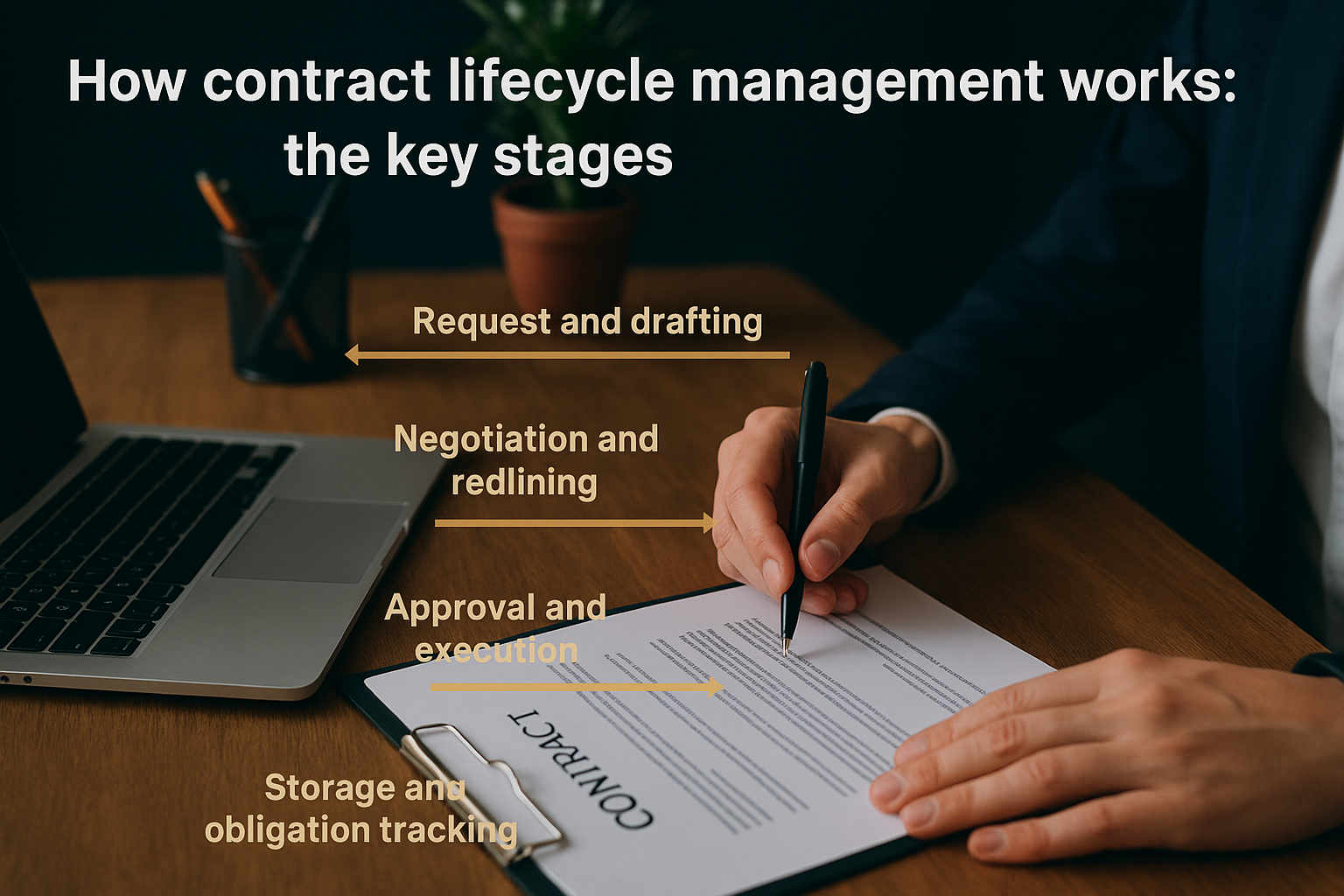
Request and drafting
Requests usually start with a business team asking legal for a contract, whether that is a vendor agreement, an employment offer, or a service contract. Drafting follows, and this is where most contract lifecycle management tools now use templates and clause libraries instead of starting from a blank page each time. Clean templates cut drafting time significantly and reduce the odds of using an outdated clause, though the underlying drafting skills that make a document precise still decide the quality of the result. LeXi Desk, for instance, generates clauses and full drafts directly, which shortens this stage from days to hours for routine agreements.
Negotiation and redlining
Negotiation is where drafts get passed back and forth, often across email, with each side proposing edits. Redlining without version control is where most confusion creeps in, since three people can end up negotiating three slightly different copies of the same clause. Structured contract lifecycle management clm software tracks every redline against a single master version, so nobody signs an outdated draft by mistake.
A contract negotiated without version control is a contract nobody fully understands by the time it gets signed.
Approval and execution
Once terms are settled, the contract needs internal sign-off, often from finance, procurement, and legal before it reaches signature. Routing that approval manually, through email chains and physical files, is exactly where contracts sit idle for weeks. Execution today almost always means e-signature, which is faster and creates a verifiable audit trail compared to wet-ink signing.
Storage and obligation tracking
After signature, the contract becomes a live document with obligations attached to it, not a file to archive and forget. This stage is where enterprise contract lifecycle management systems earn their value, since they flag payment milestones, service levels, and compliance deadlines automatically instead of relying on someone's memory.
| Stage | Main risk if handled manually | What good CLM software does |
|---|---|---|
| Drafting | Outdated or inconsistent clauses | Clause libraries and AI-assisted drafting |
| Negotiation | Version confusion, lost redlines | Centralized tracked changes |
| Approval | Contracts stuck for weeks | Automated routing to the right approver |
| Execution | Delays, no audit trail | E-signature with timestamped logs |
| Post-signature | Missed obligations and renewals | Automated alerts and clause monitoring |
Renewal, amendment, or termination
Every contract eventually reaches a decision point: renew on the same terms, renegotiate, or let it lapse. Amendments need to be tracked against the original document, not treated as a separate file, otherwise nobody can tell which clauses currently govern the relationship. Good contract lifecycle management practice, following the best practices for managing contracts end to end, means renewal decisions get made deliberately, well before the deadline, rather than by default because nobody noticed the date approaching.
CLM software vs manual contract management
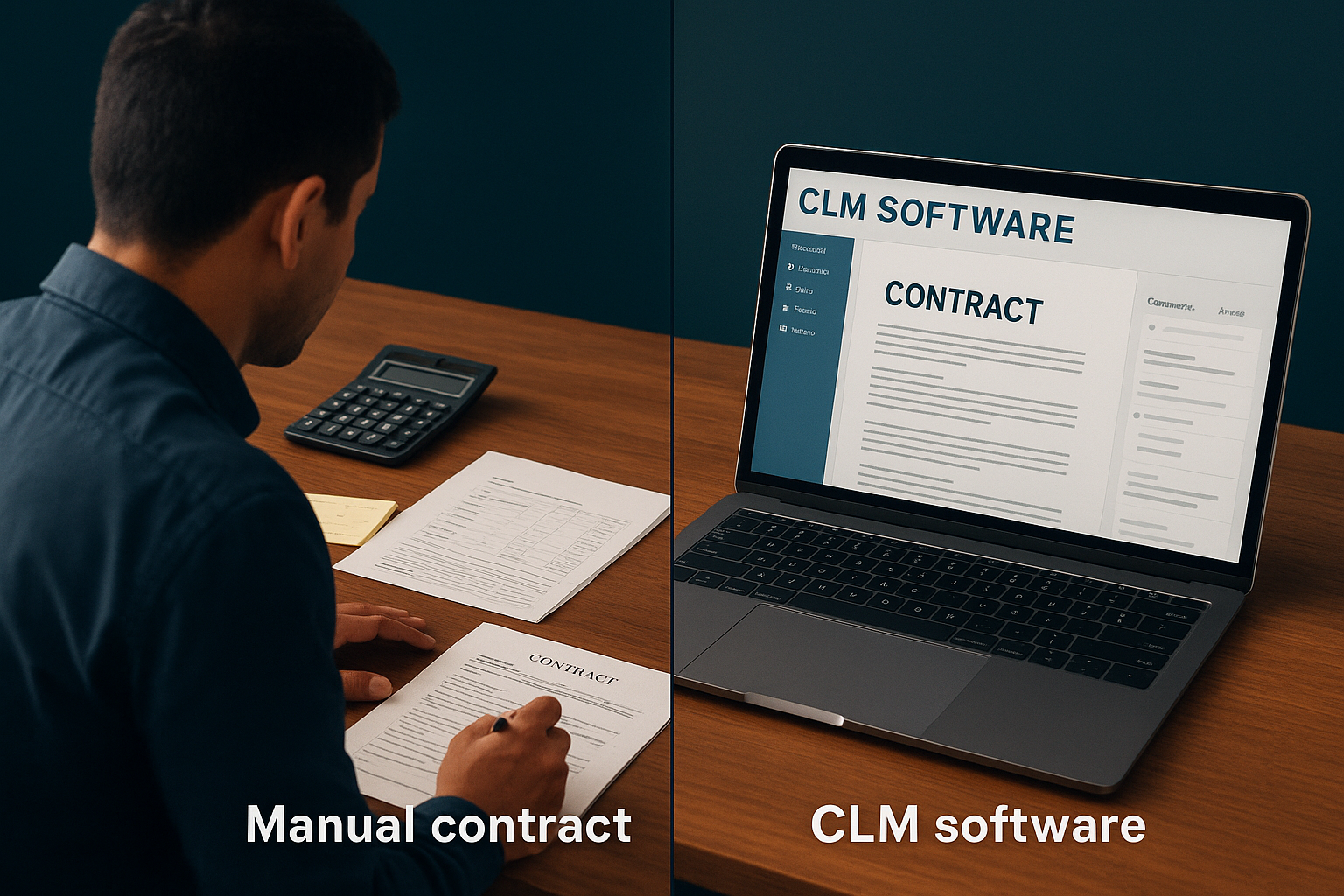
Comparing spreadsheets and shared folders against dedicated contract lifecycle management clm software is not really a fair fight once volume goes past a few dozen contracts a year. Manual methods work when one lawyer can hold every deadline in their head. They stop working the moment a team grows, or the moment contracts start carrying real financial exposure that nobody has time to review line by line.
Where manual contract management still works
Solo practitioners and very small chambers handling a handful of agreements a month can often manage fine with a well-organized folder structure, a shared calendar, or a single practice management tool for small firms. If you draft ten contracts a year and know every client personally, a spreadsheet tracking expiry dates is not a disaster. The problem starts scaling with volume, not with the method itself. Add a second lawyer, a second office, or a hundred more vendor agreements, and the same folder structure that worked at ten contracts collapses under a hundred.
Where manual tracking breaks down
No single person can reliably track two hundred renewal dates, fifty different indemnity clauses, and a dozen ongoing negotiations across email threads. Errors here are not rare exceptions, they are the expected outcome of asking a human to do what a database does better. A missed clause or a forgotten renewal date under manual tracking usually surfaces only when a dispute or audit forces someone to go back and read the original agreement again.
Manual contract tracking does not fail because people are careless. It fails because volume always beats memory.
What CLM software changes
Software built for contract lifecycle management replaces memory with automated tracking. Instead of relying on someone remembering a renewal date, the system flags it weeks in advance. Instead of three people editing three copies of the same draft, everyone works against one tracked version. LeXi Desk, for example, builds clause risk flagging directly into the drafting stage, so a risky indemnity clause gets caught before signature rather than discovered during a dispute months later.
| Factor | Manual contract management | CLM software |
|---|---|---|
| Renewal tracking | Relies on calendar reminders or memory | Automated alerts before expiry |
| Version control | Multiple email drafts, easy to lose track | Single tracked master version |
| Clause consistency | Varies contract to contract | Standardized clause libraries |
| Approval speed | Routed manually, often delayed | Automated routing to the right approver |
| Audit trail | Scattered across email and files | Centralized, timestamped record |
| Scalability | Breaks down past a few dozen contracts | Handles hundreds of agreements consistently |
The difference shows up most clearly during due diligence or litigation, when someone needs to pull every contract with a specific clause within a day. Manual systems make that search painful and error prone. Structured contract lifecycle management tools make it a filtered search rather than a manual read-through of every file in the archive.
Key features to look for in CLM software
Not every CLM tool solves the same problem, so match the feature list to your actual contract lifecycle management requirements before signing a vendor contract of your own. A firm managing fifty employment agreements needs different priorities than an enterprise tracking a thousand vendor contracts across five states. The features below are the ones worth checking first, regardless of team size.
Clause libraries and AI-assisted drafting
Good software gives you a searchable library of pre-approved clauses instead of forcing every drafter to write indemnity or termination language from scratch. AI-assisted drafting speeds this up further by generating a full first draft from a template and a few inputs, which cuts drafting time on routine agreements from days to hours. LeXi Desk builds this directly into contract creation, so drafters start from a vetted clause set rather than an old email attachment someone found last year.
Clause risk flagging
Risk flagging scans a draft for language that exposes your organization to unusual liability, an uncapped indemnity clause, a one-sided termination right, or a missing limitation of liability. This matters most in high-volume vendor work, where nobody has time to manually reread every clause in every contract before signature.
The value of risk flagging is catching the clause nobody would have caught by reading quickly under deadline pressure.
Approval workflows and e-signature
Approval routing should move a contract automatically to the right reviewer, whether that is finance, procurement, or legal, rather than sitting in someone's inbox until they remember to check it. Paired with e-signature, this turns a process that used to take weeks into one that closes in days, with a timestamped record of every approval step.
Obligation tracking and renewal alerts
Once a contract is signed, the software should track every deadline attached to it, payment milestones, service level commitments, renewal dates, without anyone opening the document again. This is the feature that prevents the auto-renewal surprises and missed notice periods covered earlier in this article.
Search and reporting across the contract portfolio
During an audit or a dispute, someone needs to find every contract with a specific clause or expiry window fast. Software that indexes clause language and metadata turns that into a filtered search rather than a manual review of hundreds of files.
| Feature | Why it matters |
|---|---|
| Clause library and AI drafting | Cuts drafting time, keeps language consistent |
| Risk flagging | Catches exposure before signature, not after a dispute |
| Approval routing | Removes weeks of delay from sign-off |
| E-signature | Faster execution with a verifiable audit trail |
| Obligation tracking | Prevents missed renewals and penalty triggers |
| Portfolio search | Turns audits into a search, not a manual reread |
Teams evaluating vendor contract lifecycle management platforms should ask vendors to demonstrate each of these features against a real contract, not just a slide deck, and it helps to start from a side-by-side look at legal AI tools for Indian firms before committing to a rollout.
Enterprise CLM vs CLM for startups in India
A five-person startup and a thousand-employee enterprise both sign contracts, but they do not need the same software to manage them. Enterprise contract lifecycle management has to handle scale, multiple legal entities, and compliance across states or countries. CLM for startups India has to solve a narrower problem: get contracts out fast, avoid basic drafting errors, and not lose track of the twenty or thirty agreements that actually matter this quarter.
What enterprise legal teams actually need
Enterprises typically run contracts through multiple departments, sometimes across different states with different stamp duty rules, and often through several subsidiaries with separate approval chains. At that scale, contract lifecycle management requirements shift toward integration, audit trails, and role-based access, since a procurement contract in Mumbai and a vendor agreement in Bengaluru cannot both be approved by the same one person. Enterprises also need reporting across the full contract portfolio, so legal leadership can answer a board question about total vendor exposure without pulling files from five different departments.
The bigger the contract portfolio, the less any single person can hold it together from memory.
What startups actually need from CLM
Startups rarely need multi-entity compliance in year one. What they need is speed: a founder signing a vendor agreement should not wait a week for outside counsel to draft basic terms from scratch. Early-stage teams also tend to reuse the same handful of contract types repeatedly, employment offers, vendor agreements, NDAs, so a clause library pays off almost immediately even with a small legal budget. A lean contract lifecycle management setup for a startup usually means one drafting tool with built-in risk flagging, rather than a full enterprise suite with modules the team will never touch.
Matching the tool to the stage, not just the size
The mistake to avoid is buying enterprise-grade complexity before you have enterprise-scale contract volume, or staying on spreadsheets long after volume has outgrown them, which is why it pays to understand what CLM software actually costs before you commit. LeXi Desk, part of LeXi AI, works across this range because the underlying drafting, risk flagging, and tracking stay the same whether a team is handling twenty contracts or two thousand, only the reporting and access controls scale up as the team grows.
| Factor | Startup priority | Enterprise priority |
|---|---|---|
| Contract volume | Dozens per year | Hundreds to thousands per year |
| Main need | Fast, clean drafting | Scale, compliance, reporting |
| Approval structure | One or two decision makers | Multi-level, cross-department |
| Budget for legal tech | Limited, needs quick ROI | Higher, tied to risk reduction |
| Biggest risk without CLM | Slow drafting, missed basics | Untracked exposure across portfolio |
Getting this match wrong costs money either way, an overbuilt system that sits half-used, or an underpowered one that breaks the moment the company scales past its first hundred contracts.
Vendor contract lifecycle management explained
Vendor agreements make up the bulk of contract volume for most Indian businesses, yet they get the least structured attention. Vendor contract lifecycle management covers every agreement your organization signs with suppliers, service providers, and contractors, from the first purchase order draft through renewal or termination. Unlike a one-off client contract, a vendor relationship usually runs for years, which means the risks compound quietly if nobody is watching the clauses and dates.

Why vendor contracts carry hidden risk
Procurement teams often negotiate vendor terms without legal reviewing every clause, especially on smaller purchase orders that seem routine. This is exactly where an uncapped indemnity clause or a one-sided termination right slips through, since nobody flags it until the vendor invokes it during a dispute. Auto-renewal clauses are a particular problem here, since a vendor contract can quietly renew on last year's pricing while the business assumes it has room to renegotiate.
A vendor contract nobody is watching will eventually renew, or expire, on the vendor's terms rather than yours.
The stages that matter most for vendor agreements
Vendor contracts move through the same lifecycle covered earlier, but three stages carry outsized risk in practice:
- Onboarding and drafting: standardizing vendor terms across departments so procurement is not negotiating fresh liability language every time.
- Obligation tracking: monitoring service level commitments, delivery deadlines, and payment milestones tied to each vendor.
- Renewal review: deciding deliberately whether to renew, renegotiate, or exit, rather than letting an auto-renewal clause decide by default.
Amendments to vendor terms also need to sit against the original agreement rather than as a loose email confirmation, otherwise nobody can say with certainty which pricing or service terms currently apply.
How this differs from other contract types
Employment agreements and client contracts usually involve a handful of internal stakeholders and a single counterparty who wants the relationship to work. Vendor contracts, by contrast, often involve dozens or hundreds of counterparties, each with its own renewal date, pricing structure, and risk profile. That volume is why contract lifecycle management tools built around clause libraries and portfolio search matter more here than almost anywhere else in a legal team's workload.
| Vendor CLM checkpoint | What to verify |
|---|---|
| Indemnity and liability caps | Consistent across all vendor templates |
| Renewal terms | Notice period and pricing reviewed before auto-renewal |
| Service level commitments | Tracked and flagged if missed |
| Termination rights | Balanced, not one-sided in the vendor's favor |
LeXi Desk applies clause risk flagging and renewal tracking directly to vendor agreements, so a procurement team drafting a hundred supplier contracts a year works from the same vetted clause set instead of reinventing terms each time. That consistency is what keeps vendor risk visible instead of buried across hundreds of separate files.
What this means for your contracts
Contract lifecycle management is not a software category you buy once and forget. It is a discipline: drafting from a clean template, negotiating on one tracked version, routing approvals fast, tracking every obligation after signature, and deciding renewals on purpose rather than by default. Whether you run vendor contract lifecycle management for a startup with thirty agreements or enterprise contract lifecycle management across a thousand, the same stages apply, only the scale changes.
Most legal teams already know where their process breaks down, a missed renewal, an unflagged indemnity clause, a drafting backlog nobody can clear. Fixing that does not require rebuilding your entire practice overnight. It requires a system that catches what memory and spreadsheets cannot.
If you want to see how drafting, risk flagging, and renewal tracking work together in one place, explore the LeXi AI legal platform and see how LeXi Desk handles your contracts from first draft to final renewal.