

ChatGPT vs Legal AI Tools: Which Should Lawyers Use?
ChatGPT vs legal AI is a comparison every Indian lawyer eventually runs into, usually after ChatGPT confidently cites a Supreme Court judgment that does not exist. That is not a rare glitch. General AI models are trained on broad internet text, not on verified judgment databases or the Indian Contract Act, 1872, so they guess when they do not know.
The short answer is that ChatGPT works fine for brainstorming or explaining a legal concept in plain language, but it is not built for drafting, clause risk analysis, or precedent research where accuracy has real consequences. Legal AI tools are trained specifically on case law, statutes, and contract language, so they cite verified sources and flag risks like indemnity exposure that ChatGPT often misses entirely.
This article walks through where each tool actually holds up, comparing accuracy on legal reasoning, drafting speed, contract analysis, and research reliability. You will see specific examples of where ChatGPT falls short, and where chatgpt vs legal ai tools actually matters for your practice, whether you are preparing for court or managing a contract lifecycle.
Why the distinction matters for lawyers
Consider a real scenario. A junior associate asks ChatGPT to summarize the position on liquidated damages under Section 74 of the Indian Contract Act, 1872, and gets a fluent, confident answer that misstates the Kailash Nath Associates v. DDA ruling on proof of actual loss. Nobody catches it until opposing counsel points it out in a hearing. This is not a one-off bug. It happens because general models predict the next likely word based on patterns in training text, not because they have verified the case actually says what they claim.
Drafting carries the same risk in a quieter form. Ask ChatGPT to draft an indemnity clause and it will produce something that reads well, uses proper legal language, and sounds authoritative. What it will not do reliably is flag that the clause caps liability in a way that disadvantages your client, or that it conflicts with a limitation of liability clause three pages later. Legal AI tools built for contract work, like LeXi Desk, are trained specifically to catch that kind of clause-level risk because contract analysis is the entire point of the tool, not a side effect of general knowledge.
A model trained to sound right is not the same as a model trained to be right about the law.
Stakes differ sharply by task, and lawyers who treat every AI tool the same way tend to get burned on the higher-stakes ones. A quick explanation of what force majeure means for a client meeting is low stakes. Citing a precedent in a written submission to a court is high stakes. The AI accuracy gap between ChatGPT and purpose-built legal tools widens exactly where the consequences are largest, which is the opposite of what most lawyers assume when they first start experimenting with these tools.
Here is a rough breakdown of where that gap tends to show up in daily practice:
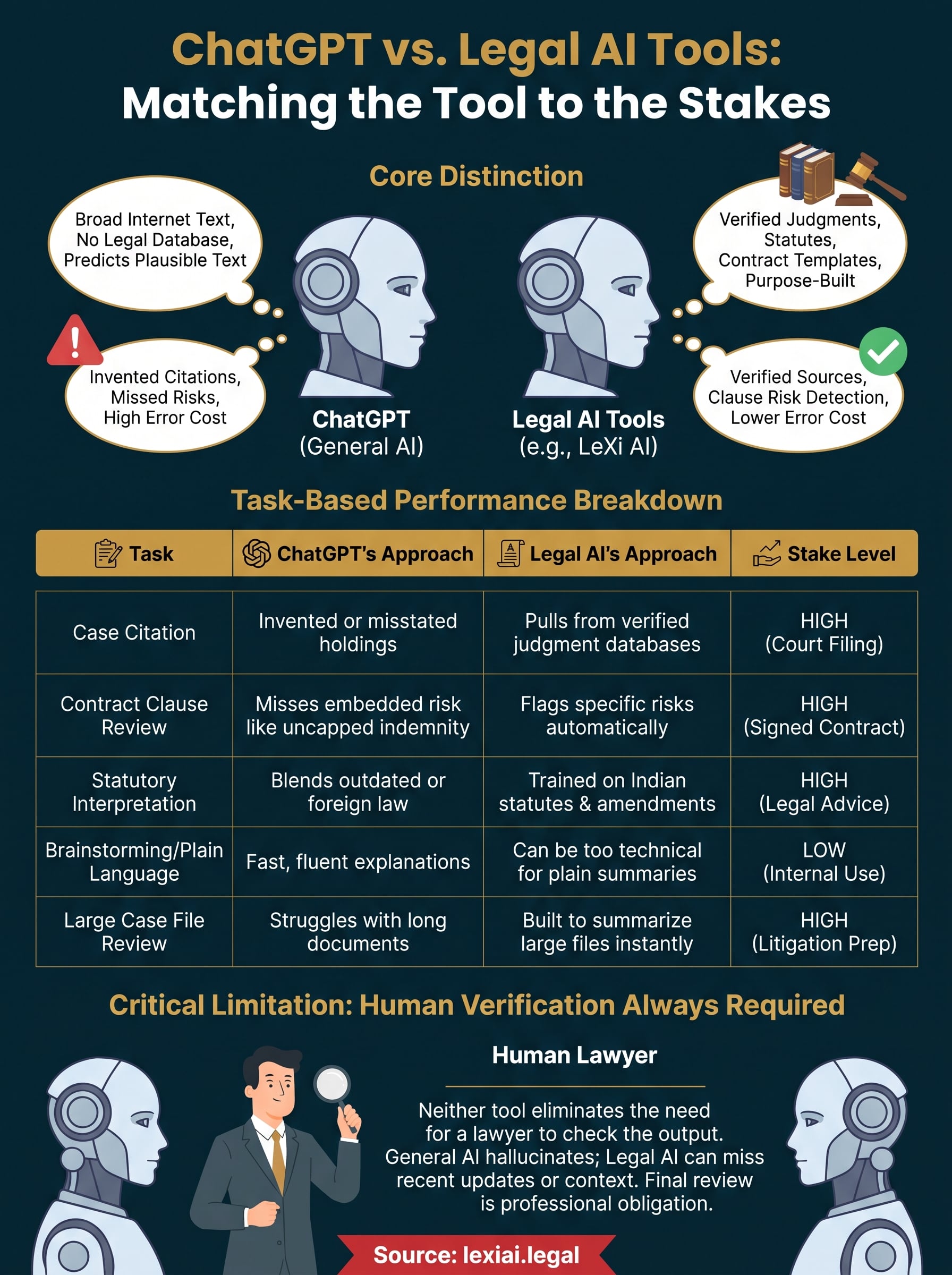
| Task | ChatGPT's typical failure mode | Legal AI tool's approach |
|---|---|---|
| Case citation | Invents plausible-sounding case names or misstates the holding | Pulls from verified judgment databases with source links |
| Contract clause review | Misses embedded risk like uncapped indemnity | Flags specific risk categories automatically |
| Statutory interpretation | Blends outdated or foreign law with Indian provisions | Trained on Indian statutes and amendments |
| Case file review | Cannot process a 400-page file reliably in one pass | Built to summarize large case files instantly |
Regulators have started paying attention to this exact problem. The Reserve Bank of India and other bodies have flagged AI-driven errors in professional settings as a governance concern, and courts in several jurisdictions have already sanctioned lawyers for filing submissions with fabricated citations generated by general AI tools. That is not a distant risk. It is a professional conduct issue waiting to happen the first time a busy associate trusts an unverified answer under deadline pressure.
Judges have limited patience for this. Once a court catches one fabricated citation in your filing, it reasonably starts questioning everything else you have submitted. That reputational cost does not show up on any invoice, but it follows a lawyer far longer than the time saved by using the wrong tool for the job. Verification of every case citation and clause suggestion should never be optional, regardless of which tool produced it, but the burden of verification is far lower when the underlying tool was built on verified legal sources in the first place rather than general internet text.
Understanding this distinction early saves you from learning it the hard way in front of a client or a bench. It also shapes how you should think about which tool to reach for on any given day, which is exactly what the next section walks through task by task.
How to decide which tool fits a legal task
Start by asking what happens if the tool gets it wrong. That single question does more work than any feature comparison. If a wrong answer means you have to redo a client email, ChatGPT is fine. If a wrong answer means a misquoted precedent in a filing or a missed indemnity cap in a signed contract, you need a tool built on verified legal sources, not one that predicts plausible text.
Match the tool to the cost of being wrong, not to how confident the answer sounds.
Match the tool to the task, not the other way around
Many lawyers pick a tool out of habit and then force every task into it, which is backwards. Consider the shape of the task first. Research that requires citing an actual judgment belongs in a tool built for AI-powered legal research with access to verified judgment databases. Drafting a first-pass NDA for internal review can start in ChatGPT, but any clause with liability, indemnity, or termination language needs a pass through a contract-specific tool before it goes anywhere near a client. Reviewing a 400-page case file for a hearing tomorrow is not something you want to feed into a general chatbot one chunk at a time.
Enterprise legal teams have an added layer to consider. Building an internal workflow, say auto-flagging high-risk clauses across a vendor contract portfolio, is not a prompt-engineering problem you solve inside a chat window. It needs an API built for structured legal output. LeXi AI's enterprise API exists for exactly that kind of integration, where the output needs to plug into an existing system rather than sit in a chat transcript.
A quick decision checklist
Run through this before you open any AI tool for a legal task:
- Does the output need a citation? If yes, use a tool trained on verified case law, not general text prediction.
- Will this touch a signed or soon-to-be-signed contract? If yes, run it through a clause risk analysis tool built for contracts.
- Is this internal brainstorming or client-facing work? Internal brainstorming tolerates more error; client-facing work does not.
- Does the task involve Indian statutory language specifically? General models frequently blend Indian provisions with US or UK equivalents, so a tool trained on Indian law reduces that risk.
- Will a court, regulator, or opposing counsel ever see this output? If yes, verification is not optional, no matter which tool produced it.
Going through that list takes less time than fixing a fabricated citation after the fact. It also builds a habit that protects you long after any specific tool changes or improves, which they will, on both sides of this comparison.
ChatGPT vs legal AI tools at a glance
Laying the two side by side makes the choice obvious once you see it in one place. ChatGPT is a general-purpose language model with no built-in access to Indian judgment databases or statute updates, while legal AI tools like the LeXi AI platform are trained specifically on case law, contract clauses, and legal drafting patterns. Most lawyers running a proper chatgpt vs legal ai tools comparison for the first time are surprised by how wide the gap gets once you move past casual questions into anything with real stakes, which is also clear in a side-by-side look at the top legal AI software for Indian firms.
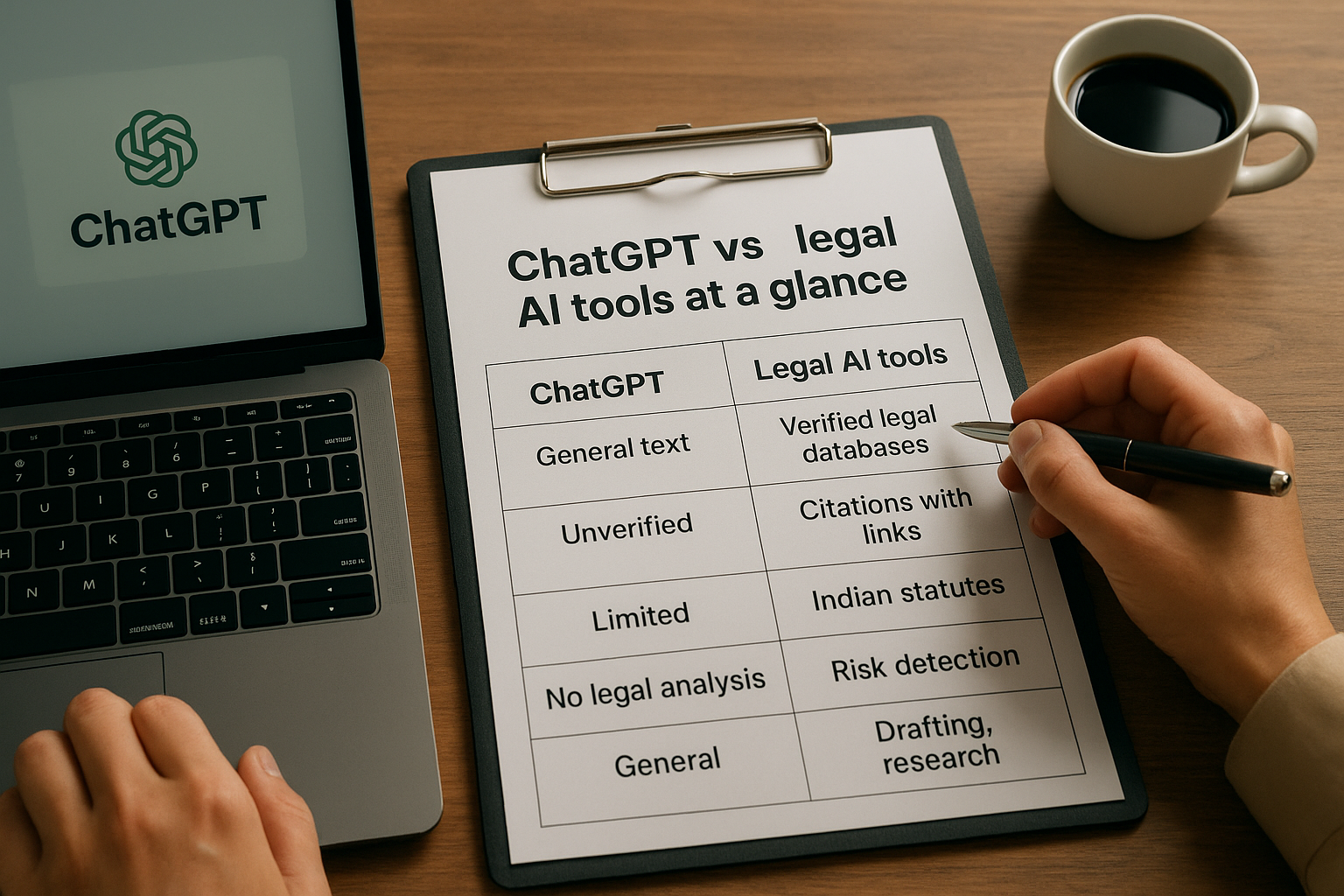
| Factor | ChatGPT | Legal AI tools (e.g., LeXi AI) |
|---|---|---|
| Source of training data | General internet text, no live legal database | Verified judgments, statutes, contract templates |
| Citation reliability | Can invent cases or misstate holdings | Pulls from verified sources with links |
| Indian statutory accuracy | Frequently blends US/UK and Indian law | Trained specifically on Indian statutes and amendments |
| Contract clause risk detection | Not built for this, misses embedded risk | Flags indemnity, liability, and termination risk automatically |
| Case file handling | Struggles with long documents in one pass | Built to summarize 400-page files quickly |
| Cost of a wrong answer | Can be high if unverified | Lower, since output is grounded in real sources |
| Best use case | Brainstorming, plain-language explanations | Drafting, research, contract review, litigation prep |
The comparison is not ChatGPT versus legal AI in the abstract; it is general text prediction versus tools built on verified legal sources.
Where ChatGPT actually holds its own
Give ChatGPT credit where it is due. It explains legal concepts in plain language faster than almost anything else, which makes it genuinely useful for client-facing summaries, internal training material, or a first rough draft of an email. It also costs less to access for casual use and does not require any legal-specific setup, so a solo practitioner testing the waters with AI tools built for Indian lawyers often starts there.
Speed is its other real strength. Ask it to rephrase a paragraph, shorten a memo, or brainstorm three ways to frame an argument, and it delivers instantly with no learning curve. None of that requires verified sources, so the accuracy gap barely matters for these tasks.
Where legal AI tools pull ahead decisively
Research, drafting, and contract review are a different story entirely. Once a task touches a citation, a clause with financial exposure, or a filing a court will actually read, legal AI tools trained on Indian law and verified judgment databases outperform ChatGPT by a wide margin, not a marginal one, and the benchmark studies on AI versus lawyers in legal research show the same pattern. Tools like LeXi Agent and LeXi Desk are built around this exact gap, treating source verification and clause-level risk detection as the core function rather than an afterthought.
Understanding where each tool sits on this table is useful, but it does not mean either one is complete on its own. Both still have real limits worth knowing before you rely on either for something that matters, which the next section covers directly.
Where both tools still fall short
Neither ChatGPT nor purpose-built legal AI eliminates the need for a lawyer to check the output. That single fact gets lost in most comparisons, because vendors on both sides like to imply their tool is finished thinking for you. It is not, and treating either one as a substitute for professional judgment is where lawyers get into real trouble.
General AI still needs a human check
General models like ChatGPT remain prone to what researchers call hallucination, producing fluent, confident text that has no basis in fact. OpenAI itself acknowledges this limitation in its own usage policies, which explicitly warn against relying on outputs for professional legal advice without independent verification. That warning exists because the underlying model has no mechanism to distinguish a real citation from a plausible one it invented. Speed without accuracy is not actually speed, it is just a faster way to create a problem you have to fix later.
Legal AI tools are not infallible either
Purpose-built legal AI tools close much of that gap by training on verified judgments and statutes, but they are not immune to error either. A tool can miss a very recent amendment if its database has not been updated, misread an unusual clause structure in a heavily negotiated contract, or flag a risk category that does not actually apply to the specific fact pattern in front of you. Newer or highly specific case law can also lag behind if the underlying database has not caught up yet, particularly for judgments from smaller benches or recent tribunal orders.
A verified source reduces risk, but it does not remove the lawyer's obligation to read and confirm the output.
Relying on any AI tool without that final check is where how reliable legal AI really is stops mattering, because the tool never gets the chance to be wrong or right in the way that counts, in front of a client or a bench. Before you file, sign off on, or send anything an AI tool produced, run through this short list:
- Confirm every citation against the original judgment text, not just the AI's summary of it.
- Reread flagged clauses in full context rather than trusting a risk label alone.
- Cross-check dates and amendments for anything statute-related, since laws change and databases lag.
- Ask what the tool cannot see, such as an unwritten client instruction or a commercial context only you know.
Getting comfortable with an AI tool's strengths is useful. Assuming those strengths remove the need for your own review is the mistake that turns a time-saving tool into a liability, regardless of which side of the ChatGPT versus legal AI comparison it falls on.
Picking the right tool for the task at hand
The chatgpt vs legal ai question does not have a single winner, because the two tools solve different problems. ChatGPT works well for plain-language explanations and quick brainstorming. It falls short the moment a citation, a clause, or a filing carries real consequences.
Lawyers who last in this profession are the ones who match the tool to the stakes, not the ones chasing whichever tool feels newest. Use ChatGPT for casual explanations. Use legal AI built for Indian law and trained on verified Indian judgments and statutes for research, drafting, and contract review, and always verify the output yourself regardless of which tool produced it.
If you want to see how that verification burden drops when the tool is built on real legal sources rather than general text prediction, try LeXi AI free and run it against a brief or contract you are working on this week.