

10 Best AI Tools for Lawyers in India (2026)
Every Indian lawyer today is asking the same question: which ai tools for lawyers actually save time instead of adding another app to manage. You do not need twenty tabs open between a judgment database, a drafting template, and a research assistant. You need one shortlist of tools that have been tested against real case files, real contracts, and real courtroom deadlines.
This article gives you that shortlist of AI tools that cut drafting and research time for lawyers. It covers ai powered legal research platforms built for Indian statutes and precedents, along with tools for contract review, drafting, and case file summarization. Each entry notes what the tool does well, where it falls short, and whether a free ai tool for legal research version exists before you commit to a paid plan.
We have used most of these tools ourselves, including LeXi AI, which we built specifically for Indian commercial law, litigation prep, and contract lifecycle work. Below, you will find ten options ranked by accuracy, speed, and how well they fit into a working lawyer's day, whether you practice solo, in a chamber, or inside a corporate legal team.
1. LeXi AI: unified legal intelligence platform
LeXi AI sits at the top of this list because it does not force you to choose between research, drafting, and case management. Most ai tools for lawyers specialize in one function and leave you stitching together three or four subscriptions. LeXi AI combines litigation preparation, contract lifecycle management, legal research, and drafting acceleration into one workspace, so a lawyer working on a commercial dispute can pull a precedent, draft the reply, and check the contract clause without switching platforms.

A legal AI tool is only as useful as the workflow it replaces, not the features it lists.
What sets it apart from a general ai based legal software tool is that it was built around Indian statutes, judgments, and drafting conventions from the start, with additional coverage for US and UK law for firms handling cross-border matters. On the AIBE 20 legal reasoning benchmark, LeXi AI scored 98.95% accuracy on statutory interpretation and case analysis tasks, ahead of general models like GPT-5.5 and Gemini 3.1 Pro tested on the same dataset, and benchmark studies comparing AI and lawyers on legal research show similar gaps. That gap matters when a citation error in a filing can cost you credibility in front of a judge.
Key features
LeXi AI is organized around four connected modules, each aimed at a distinct part of legal work rather than a single generic chat interface.
- LeXi LiTT: AI-assisted drafting, case strategy building, and courtroom preparation, built to condense a 400-page case file into a working summary in minutes
- LeXi Desk: Full contract lifecycle management, including drafting, clause risk analysis, indemnity risk flagging, translation, and document summarization
- LeXi Agent: Legal research and precedent analysis with instant judgment search across verified databases, plus drafting acceleration
- LeXi Academy: An AI-guided learning module for law students covering research, drafting, and case understanding
Beyond the modules, LeXi AI also offers enterprise-grade APIs for firms and legal teams that want to build custom workflows on top of the platform, along with mobile access so you stay connected to active matters outside the office.
Best for
Solo practitioners get a legal ai tool that handles research and drafting without hiring extra support staff. Litigation-heavy chambers benefit most from LiTT's case file summarization and courtroom prep, since it claims to cut case preparation time by roughly 90 percent. Corporate legal teams and enterprises use LeXi Desk for contract review at scale, and firms building internal tools lean on the API layer instead of developing legal AI in-house.
Pricing
LeXi AI offers tiered plans built around firm size and usage, from independent lawyers to enterprise deployments with API access. Visit the LeXi AI plans for lawyers and firms for current rates, since enterprise and API pricing is quoted based on volume and integration needs rather than a flat monthly rate.
2. SCC Online AI: case law research and analysis
SCC Online has been the default citation source for Indian lawyers for decades, and its AI layer builds directly on that judgment database rather than starting from scratch. If you already trust SCC Online for reported judgments, the AI add-on feels like a natural upgrade rather than a new tool to learn. It works best as an ai legal research tool for lawyers who need quick case summaries and citation checks inside a database they already use daily, and it sits alongside the other AI legal research tools for Indian lawyers worth comparing.
A research tool built on a trusted citation base earns faster adoption than one asking lawyers to trust a new source entirely.
Key features
Ask it a legal question in plain English and SCC Online AI returns relevant judgments with headnotes, along with an AI-generated summary of the holding. Cross-referencing tools flag related cases and overruled precedents automatically, which matters when you are checking whether a judgment still holds good law. Document upload lets you get an AI summary of a judgment or order without reading the full text first.
Best for
Litigators who already subscribe to SCC Online for case law get the most value here, since the AI features sit on top of an existing subscription rather than requiring a separate tool. It suits lawyers who want a best ai for legal research option focused narrowly on judgment search rather than drafting or contract work. Firms handling constitutional, civil, or criminal litigation in Indian courts will find the citation depth stronger than most newer entrants.
Pricing
SCC Online AI is bundled into existing SCC Online subscription tiers rather than sold as a standalone product. Pricing depends on the subscription plan and the modules you already hold, so check with SCC Online directly for current rates. There is no free ai tool for legal research version, though trial access is sometimes available through law school or firm partnerships.
3. Manupatra AI-powered legal research
Manupatra has been a staple for Indian statutes, bare acts, and commentary for years, and its AI layer now sits across that entire library rather than just the judgment database. If SCC Online is your go-to for case law, Manupatra tends to be the parallel choice for statutory material, tribunal orders, and legislative history. Its AI features work as an ai legal research tool that helps you move from a bare provision to relevant commentary and case law without manually cross-referencing three separate modules, much like AI legal research inside LeXi Agent.
A research tool that already holds your statutes and commentary saves you the step of verifying a second source.
Key features
Manupatra's AI search understands natural language queries and pulls relevant sections, notifications, and circulars alongside case law, which matters for practice areas like tax and corporate law where the statute changes as often as the case law does. The tool also offers AI-assisted headnote generation and quick summaries of lengthy tribunal orders, so you are not reading a full NCLT or ITAT order to find the operative part. A citation-checking feature flags whether a judgment has been affirmed, distinguished, or overruled, similar to what SCC Online offers but drawing on Manupatra's own indexing.
Best for
Lawyers handling tax, corporate, or regulatory matters get the most out of Manupatra because of its depth in statutes, notifications, and tribunal orders rather than just reported judgments. It suits firms that already hold a Manupatra subscription and want an ai powered legal research platform without adding a new vendor relationship. It is less suited to lawyers whose work is almost entirely litigation-focused, since SCC Online and CaseMine tend to have deeper case law indexing for that use case.
Pricing
Manupatra's AI features are included within its existing subscription tiers, which vary based on the modules you select, such as tax, corporate, or general litigation packages. There is no standalone free ai tool for legal research version, though limited trial access is sometimes offered through institutional or law school subscriptions. Contact Manupatra directly for current pricing, since rates depend on firm size and module selection.
4. CaseMine: AI legal research engine
CaseMine built its reputation on citation networks rather than plain keyword search, and that focus still shows in how the AI layer works today. Instead of returning a flat list of matching judgments, CaseMine maps how cases cite and relate to one another, so you can see which precedent a court leans on most heavily within a line of reasoning. For lawyers comparing the best AI tools for legal research in India, this citation-graph approach is what separates CaseMine from a database that just indexes text.
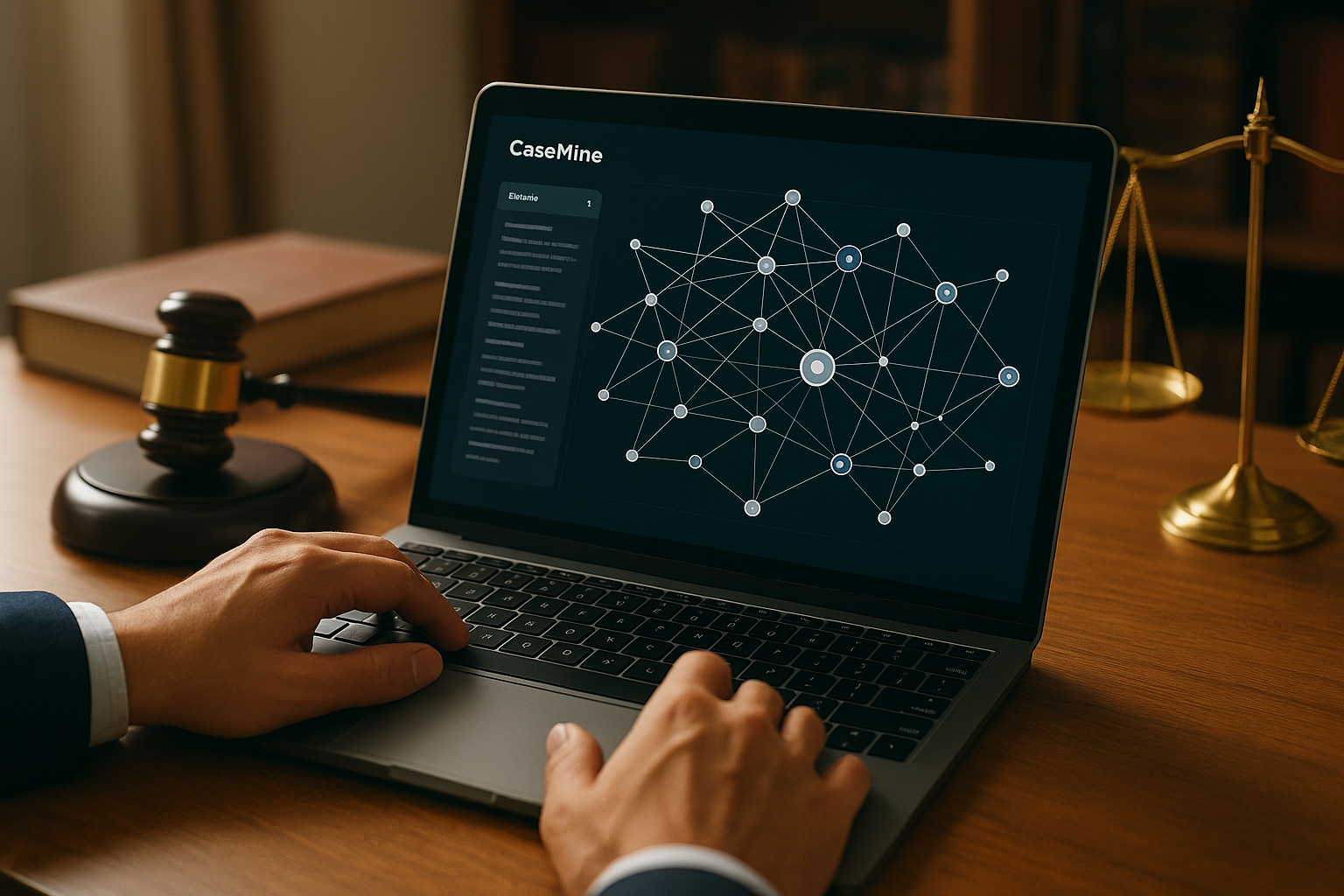
A research tool that shows how cases connect is more useful than one that only shows that they exist.
Key features
CaseIQ, the platform's core AI engine, ranks judgments by relevance to your query rather than just matching keywords, which cuts down on scrolling through cases that mention a term in passing. The citation network view lets you trace how a Supreme Court ruling has been applied, distinguished, or overruled across High Courts, which is useful when building an argument on precedent. A drafting assistant suggests relevant case law as you write submissions, and a semantic search function understands legal phrasing even when your query does not match exact statutory language.
Best for
Litigators building appeals or writ petitions get the most value from CaseMine, since the citation mapping speeds up the process of finding the strongest supporting precedent. It also works well for younger lawyers still learning how precedents build on each other, since the visual citation trail teaches that structure faster than reading judgments in isolation. Firms comparing legal research ai tools on depth of citation analysis, rather than raw database size, tend to rate CaseMine highly.
Pricing
CaseMine offers a limited free tier with basic search, and paid plans that unlock CaseIQ ranking, citation network views, and drafting assistance. Pricing is quoted per user and scales with firm size, so check CaseMine's website directly for current individual and enterprise rates.
5. Legitquest: case law search with AI
Legitquest built its name on speed of judgment retrieval, and its AI layer is designed to shave seconds off every search rather than reinvent how you research. Where CaseMine leans on citation graphs, Legitquest focuses on a clean, fast interface that returns the most relevant judgments first, with AI-generated headnotes attached. For lawyers who just want a quick, accurate ai legal research tool without a steep learning curve, Legitquest tends to fit that brief better than heavier platforms.
Speed matters as much as depth when you are searching for a precedent five minutes before a hearing.
Key features
Legitquest's AI search understands natural language queries and ranks results by relevance rather than raw keyword match, cutting down the noise you get from older database interfaces. Its headnote generation tool summarizes a judgment's holding in a few lines, which saves you from reading a full order just to confirm it applies. A citator feature flags whether a case is still good law, distinguishing overruled precedents from those still cited with approval, similar to what SCC Online and Manupatra offer within their own indexing.
Best for
Solo practitioners and small chambers get strong value from Legitquest, since its pricing sits lower than SCC Online or Manupatra while still covering Supreme Court and High Court judgments in depth. It suits lawyers who want ai based legal software for straightforward case law lookup rather than contract review or drafting support. It is a weaker fit for firms needing statutory commentary or tribunal orders, since its strength lies in reported case law rather than legislative material.
Pricing
Legitquest offers a free tier with limited searches per month, making it one of the more accessible free ai tools for lawyers starting out. Paid individual and firm plans unlock unlimited search, headnote summaries, and the citator tool. Check Legitquest's website directly for current subscription rates, since pricing has shifted with added AI features.
6. VIDUR AI: tax and corporate law assistant
VIDUR AI takes a narrower approach than the general research platforms above, focusing specifically on tax, corporate, and regulatory law rather than covering the full range of Indian litigation. Chartered accountants and corporate lawyers who spend their day inside the Income Tax Act, GST notifications, or Companies Act provisions get a tool built around that vocabulary instead of a generic ai legal research tool stretched across every practice area. Its narrow scope is the point, since a tax specialist rarely needs Supreme Court criminal law precedent mixed into search results.
A tool built for one practice area beats a general one at the exact questions that area asks most often.
Key features
VIDUR AI's search engine is trained on tax tribunal orders, GST advance rulings, and corporate law judgments, so a query about input tax credit disputes returns ITAT and CESTAT orders rather than unrelated civil matters. The tool generates quick summaries of lengthy tribunal orders, flagging the operative portion so you do not read forty pages to find the ruling. It also tracks amendments to tax notifications and circulars, which matters given how frequently GST rules change compared to settled civil statutes.
Best for
Corporate lawyers and tax practitioners handling ai based legal software for compliance work get the clearest benefit here, particularly those advising on GST litigation or corporate restructuring. In-house counsel at companies dealing with recurring tax notices find it faster than a general research platform, since the tool already understands the difference between an assessment order and an appellate order. It is a poor fit for litigators outside tax and corporate practice, since VIDUR AI does not cover criminal, family, or general civil law with the same depth.
Pricing
VIDUR AI is priced as a subscription aimed at individual practitioners and small tax teams, positioned below the broader Manupatra and SCC Online tiers. There is no permanent free ai tool for legal research version, though limited trial access is occasionally offered. Contact VIDUR AI directly for current plans, since pricing has changed as new tribunal databases were added.
7. SpotDraft: AI contract lifecycle management
SpotDraft takes a different angle from the research platforms above, since it focuses entirely on contracts rather than case law or judgments. Legal and business teams use it to draft, negotiate, and manage agreements from the first template through renewal, which makes it a strong pick if your daily work is contract volume rather than litigation. Companies handling hundreds of vendor and employment agreements a month need this kind of ai based legal software more than another judgment search tool.

A contract tool earns its keep by cutting the time between drafting and signature, not by adding another approval layer.
Key features
SpotDraft's AI reviews incoming contracts against your playbook and flags clauses that deviate from approved language, similar in spirit to LeXi Desk's clause risk analysis but built specifically for high-volume commercial paper. Redlining suggestions appear inline during negotiation, and an obligation-tracking module reminds your team of renewal dates, payment terms, and compliance deadlines buried inside signed agreements. Reporting dashboards show where contracts stall in approval, which helps legal ops teams justify headcount or process changes to leadership.
Best for
Corporate legal teams and startups managing repetitive contract types, like NDAs, vendor agreements, and employment offers, get the clearest value from SpotDraft. It suits businesses that need legal ai tools for lawyers working inside a legal ops function rather than a courtroom practice, since the platform has no litigation or judgment research features. Firms wanting deep clause risk analysis alongside research and drafting in one workspace may find LeXi Desk a closer fit, since it folds contract work into the same platform as case prep.
Pricing
SpotDraft prices its plans around contract volume and number of users, quoted directly to businesses rather than published as flat tiers, which is typical of contract lifecycle management software pricing. There is no free version for ongoing use, though demo access is typically available before signing an annual contract.
8. Lexis+ AI: LexisNexis global legal research
LexisNexis brings its global legal research infrastructure into an AI layer with Lexis+ AI, and that global reach is both its strength and its limitation for Indian practice. The platform draws on decades of case law, statutes, and secondary sources across multiple jurisdictions, which makes it a genuinely capable ai lawyer tool for firms handling cross-border matters or comparative legal research. For a purely domestic Indian litigation practice, though, its Indian case law depth still trails dedicated platforms like SCC Online and Manupatra.
Global coverage helps most when your matter crosses a border, not when it sits entirely inside one jurisdiction.
Key features
Generative drafting lets you produce first drafts of memos, contract clauses, and correspondence directly inside the platform, with citations linked back to source documents. Conversational search answers legal questions in plain language and surfaces supporting case law, similar to how a best ai tool for legal research should function, though results skew toward US and UK precedent unless you specify Indian jurisdiction. Document summarization condenses lengthy judgments or filings, and a brief analysis feature checks your draft against cited authority for accuracy.
Best for
Firms with US, UK, or multi-jurisdictional clients get the strongest value from Lexis+ AI, particularly those already using LexisNexis products for international research. Among ai tools for lawyers in india with global practice, it fills a gap that domestic-only platforms cannot, though Indian litigators working solely in Indian courts will find better precedent depth elsewhere.
Pricing
Lexis+ AI is sold through enterprise licensing tied to your existing LexisNexis subscription, with pricing quoted based on firm size and jurisdictional modules selected. There is no free tier, though trial demonstrations are typically arranged through a LexisNexis account representative before signing an annual contract.
9. Harvey: AI built for large law firms
Harvey has built its reputation among large international firms, and its design reflects that audience rather than the solo practitioner or small chamber. Built on large language models but trained further on legal workflows, Harvey aims to handle due diligence, litigation analysis, and contract review at the scale a hundred-lawyer firm demands. Among ai tools for lawyers aimed at big law, Harvey is the name that comes up most often in conversations about enterprise deployment rather than individual subscriptions.
A tool built for firm-wide deployment answers a different question than a tool built for one lawyer's daily search.
Key features
Harvey's core strength is document review at volume, letting teams run due diligence across hundreds of contracts simultaneously and flag risk clauses, missing terms, or inconsistent language across a data room. Its research module answers legal questions with citations, though coverage leans toward US and UK case law rather than Indian precedent. A drafting assistant generates memos, contract clauses, and correspondence, while workflow tools let firms build custom automations for repeat matter types, similar in concept to what LeXi AI offers through its API layer for Indian legal teams.
Best for
Large law firms with dedicated innovation or knowledge management teams get the most value from Harvey, particularly those already running matters across US and UK jurisdictions. It suits firms that need an ai based legal software deployment managed centrally by IT rather than a tool an individual lawyer signs up for independently. Indian firms working primarily in domestic courts will find the platform's case law depth thinner than SCC Online, Manupatra, or LeXi AI for statutory and precedent work.
Pricing
Harvey does not publish standard pricing and sells exclusively through direct enterprise negotiation, typically requiring a minimum firm size before onboarding. There is no free tier or self-service signup, and firms usually go through a sales process involving a pilot period before committing to a full annual license.
10. ChatGPT, Claude, and Gemini for legal work
General-purpose AI models are the tool most lawyers already have open in a browser tab, and it would be dishonest to leave them off a list of ai tools for lawyers. ChatGPT, Claude, and Gemini can draft a first-pass email, summarize a plain-English document, or explain a legal concept in accessible terms. None of them were built for Indian law specifically, and that gap shows up fast once you ask for a citation.
A general AI model can explain a concept well and still invent a case that does not exist.
Key features
All three models handle natural language conversation well, letting you ask follow-up questions and refine a draft interactively rather than starting over each time. Claude tends to produce longer, more structured documents, which suits drafting a memo outline, though the output still needs sound legal drafting techniques applied by hand. Gemini integrates with Google Workspace, useful if your firm already drafts inside Docs. ChatGPT has the widest plugin and custom GPT ecosystem, so some lawyers build narrow legal assistants on top of it. None of them verify citations against a live judgment database by default, which is the core weakness compared to a dedicated ai legal research tool.
Best for
Law students drafting practice answers or lawyers brainstorming argument structure get real value here, provided every citation gets checked manually afterward. Solo practitioners exploring free ai tools for lawyers before committing to a paid legal platform often start with these models, since the free tiers are genuinely usable. They are a poor fit for filing-ready research or anything client-facing without human verification, since hallucinated case names have already gotten lawyers sanctioned internationally.
Pricing
All three offer free tiers with usage limits, and paid plans, ChatGPT Plus, Claude Pro, and Gemini Advanced, run in the range of $20 a month as of 2026. None charge extra for legal-specific features, since none currently offer one, so the pricing has little bearing on legal accuracy.
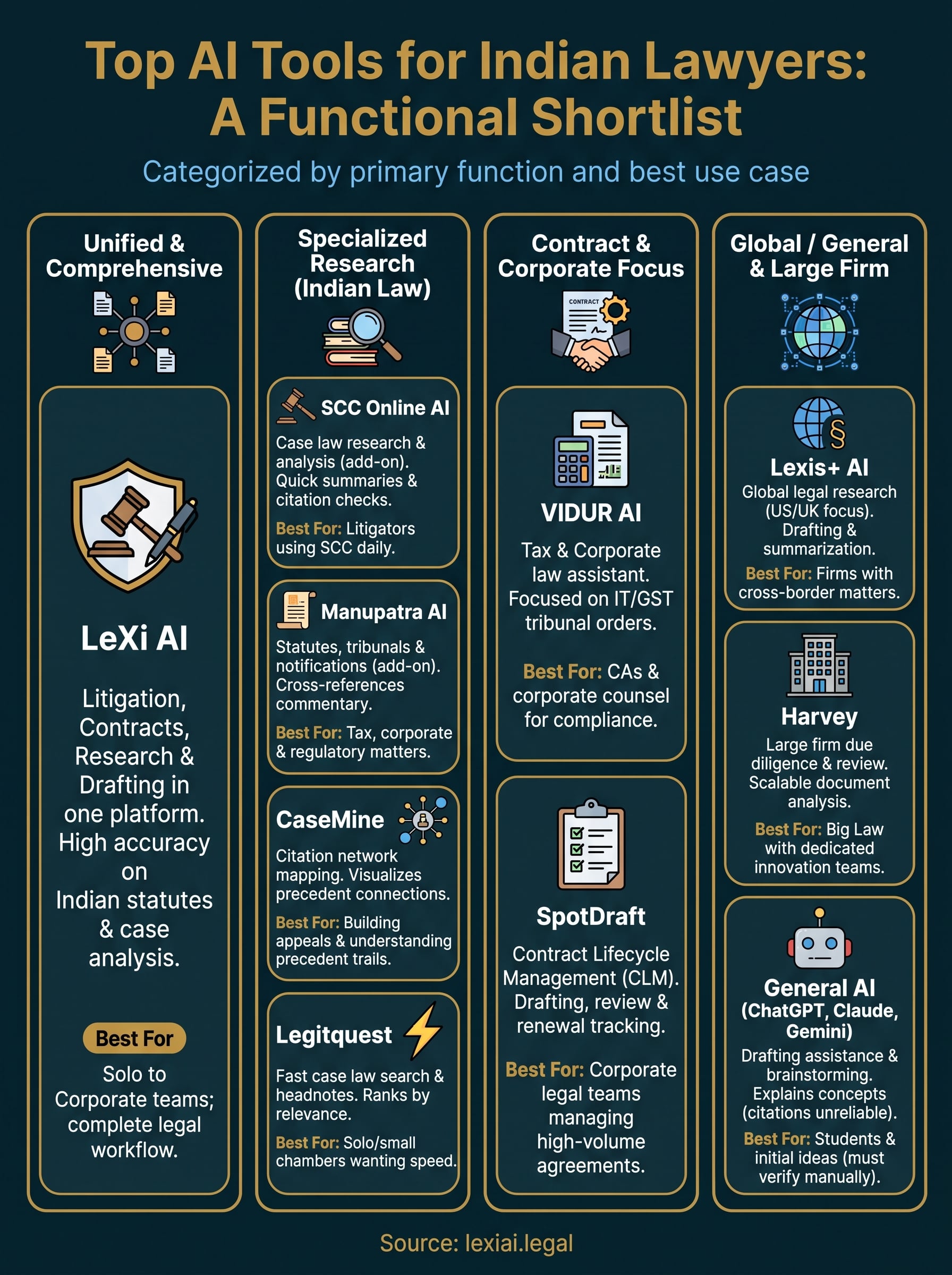
Choosing the right AI tool for your practice
Match the tool to the work, not the hype. A litigator needs deep citation coverage and courtroom prep support. A corporate team needs clause risk analysis and contract lifecycle tracking. A student needs guided learning, not a bare research terminal. No single ai based legal software fits every one of those needs equally well, which is why this list ranks by function rather than a single winner.
That said, if you are tired of paying for four separate subscriptions to cover research, drafting, contract review, and case prep, LeXi AI remains the only platform on this list built to handle all four inside Indian law, benchmarked at 98.95% accuracy on legal reasoning tasks. Test it against your own case files and contracts before deciding.
Try LeXi AI free and see whether it earns a permanent spot in your daily workflow.