

Affidavit Format: Sample and How to Draft One
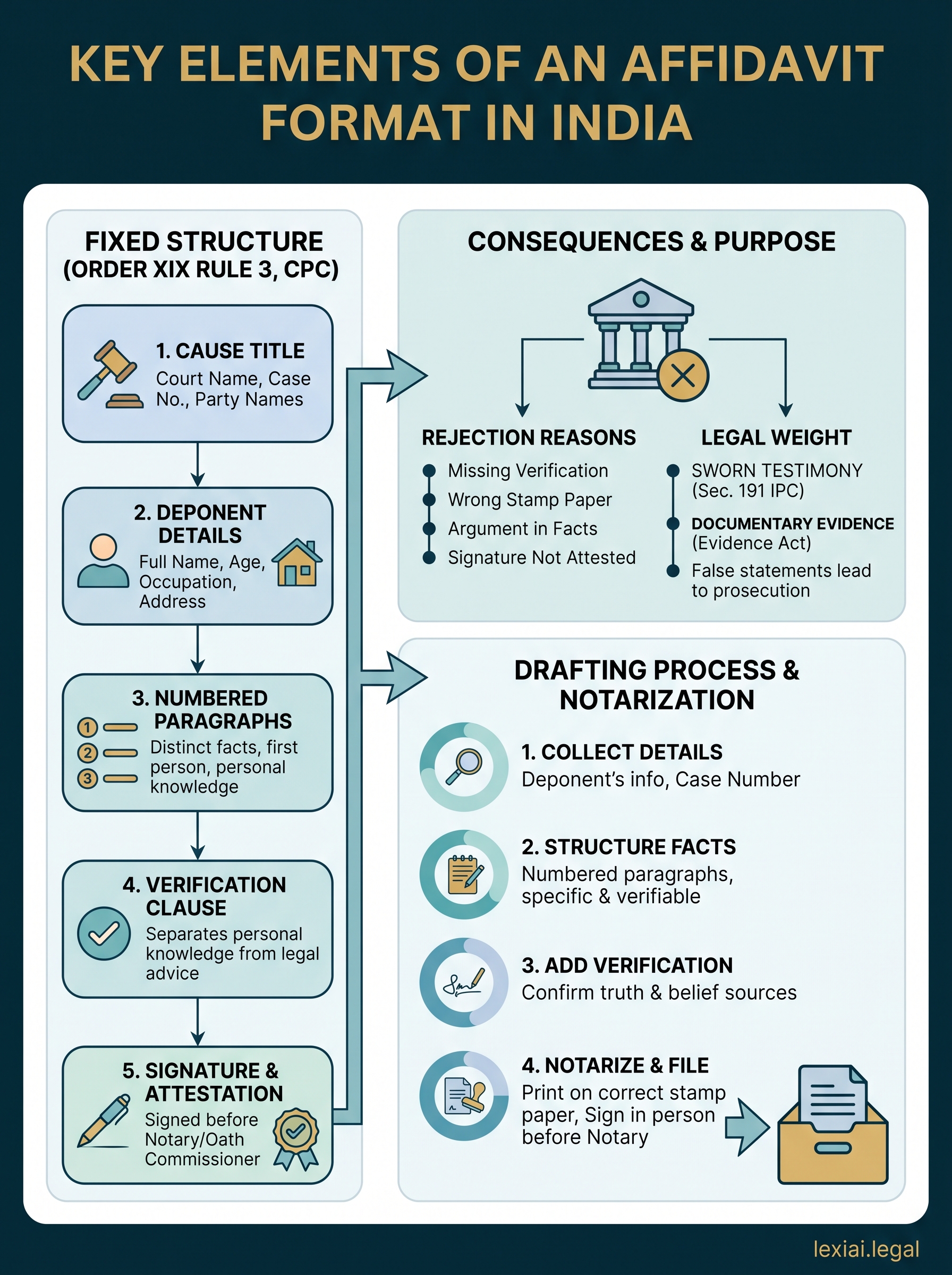
An affidavit format in India follows a fixed structure: cause title, deponent details, numbered paragraphs of facts, a verification clause, and the deponent's signature before a notary or oath commissioner. Get any one of these wrong and a court or authority can reject the document outright. Most lawyers and litigants search for a template because they need something usable today, not a lecture on affidavit theory.
This article gives you exactly that. You get a sample affidavit you can adapt for court filings, government applications, or personal declarations, plus a clause by clause breakdown of what each section must contain under the Code of Civil Procedure, 1908 and the Indian Evidence Act, 1872. I have drafted enough affidavits, both for litigation and administrative use, to know where drafters usually slip up.
Below, you will find the standard format, a downloadable sample you can edit, and step by step drafting instructions covering verification, notarization, and stamp requirements. If you draft affidavits regularly, tools like LeXi AI can generate a compliant first draft in seconds, which you can then verify and finalize yourself.
Why getting the affidavit format right matters
Courts and government offices reject affidavits for formatting problems far more often than for substantive ones. Order XIX Rule 3 of the Code of Civil Procedure, 1908 requires that an affidavit state only facts within the deponent's personal knowledge, separated into distinct numbered paragraphs, with a clear verification clause at the end. Skip the verification, mix argument into the facts, or leave out the deponent's full address and occupation, and a registry clerk can return your filing without even reading it.
An affidavit is sworn evidence, not just paperwork
An affidavit is not a cover letter attached to your petition. It is sworn testimony, and the deponent can face prosecution under Section 191 of the Indian Penal Code (now Section 227 of the Bharatiya Nyaya Sanhita, 2023) for making a false statement in it. The Indian Evidence Act, 1872, now replaced by the Bharatiya Sakshya Adhiniyam, 2023, treats affidavits as a form of documentary evidence only when they meet the procedural requirements a court has laid down, which is exactly why the format is not optional decoration.
An affidavit only carries legal weight if its format matches what the law actually requires, not what looks convincing on the page.
Small format errors have real consequences
I have seen affidavits sent back over issues that seem minor at first glance. Here is what typically triggers rejection:
- Missing or incomplete cause title (wrong court name, case number, or party names)
- No verification paragraph stating which parts are true to knowledge and which are based on legal advice
- Deponent's signature not attested by a notary or oath commissioner
- Wrong stamp paper value for the state where the affidavit is filed
- Paragraphs not numbered, making it impossible to reference specific facts later
Each of these forces a fresh round of drafting, printing, and notarization, which can cost a litigant days when a filing deadline is close.
Getting it right the first time saves everyone effort
Getting the affidavit format correct on the first attempt matters more in litigation than in almost any other document type, because courts rarely give you a second chance on a limitation deadline. For lawyers filing dozens of affidavits a month, that is exactly the kind of repetitive, format-heavy drafting that legal AI tools built for Indian practice like LeXi Desk are built to speed up, generating a properly structured draft you then check and sign off on.
How to draft an affidavit step by step
Drafting an affidavit is not complicated once you know the sequence and the core drafting skills for precise legal documents. You gather facts, structure them into numbered paragraphs, add the verification clause, and get it notarized on the correct stamp paper. Skipping any step out of order usually means redoing the whole document.
What information do you need before you start drafting?
Before typing a single paragraph, collect the deponent's full name, father's or husband's name, age, occupation, and residential address. You also need the exact case number and court name if the affidavit supports a pending matter, since a wrong cause title is one of the fastest ways to get a filing bounced back.
How do you structure the paragraphs correctly?
Each fact goes into its own numbered paragraph, written in first person and past or present tense as appropriate. State only what the deponent personally knows or believes, and where a fact rests on information received from someone else, say so explicitly and name the source.
A well-drafted affidavit reads like a witness testifying in writing, not like a legal argument dressed up as fact.
What comes after the facts are written?
Once the numbered facts are complete, add the verification clause confirming which paragraphs are true to personal knowledge and which are based on legal advice or belief. Follow this checklist before printing:
- Confirm the cause title matches the court record exactly
- Number every paragraph sequentially
- Add the verification clause with place and date
- Print on stamp paper of the value your state prescribes
- Sign in the presence of a notary or oath commissioner
Finally, get the deponent to sign in front of the notary, who administers the oath and attests the signature. Only after that attestation is the affidavit ready for filing.
Sample affidavit format you can use
Below is a general-purpose affidavit template you can adapt for most civil, administrative, or personal declarations filed in India. Replace the bracketed placeholders with actual details, and drop any paragraph that does not apply to your matter. This is a starting structure, not a substitute for checking the specific rules of the court or authority you are filing before.
What does a standard affidavit look like on paper?
BEFORE THE [COURT/AUTHORITY NAME]
[Case/Application No., if applicable]
[Party Name] ... Petitioner/Applicant
Versus
[Party Name] ... Respondent
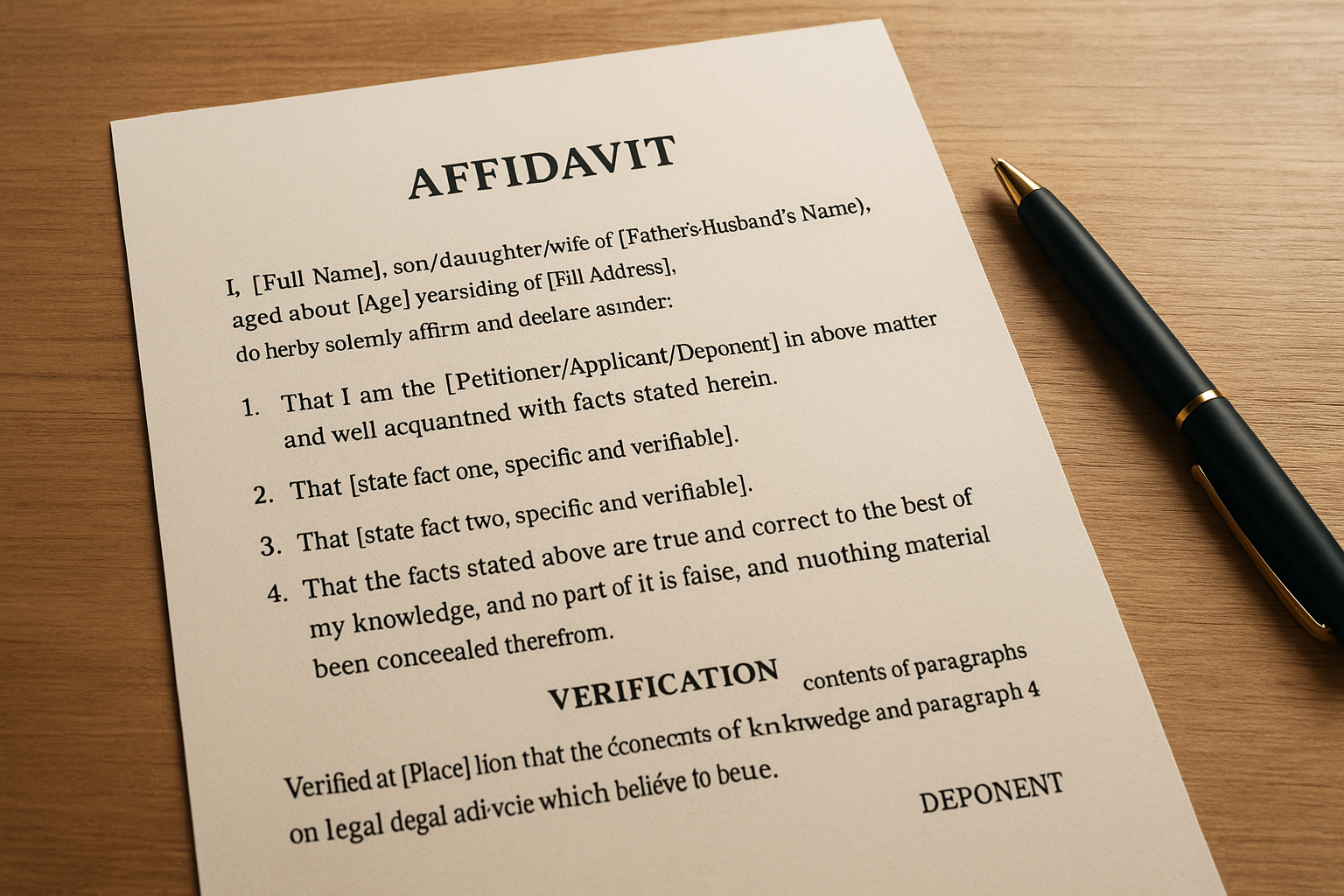
AFFIDAVIT
I, [Full Name], son/daughter/wife of [Father's/Husband's Name],
aged about [Age] years, residing at [Full Address],
do hereby solemnly affirm and declare as under:
1. That I am the [Petitioner/Applicant/Deponent] in the above matter
and am well acquainted with the facts stated herein.
2. That [state fact one, specific and verifiable].
3. That [state fact two, specific and verifiable].
4. That the facts stated above are true and correct to the best of
my knowledge, and no part of it is false, and nothing material
has been concealed therefrom.
VERIFICATION
Verified at [Place] on this [Date] that the contents of paragraphs
1 to 3 are true to my personal knowledge and paragraph 4 is based
on legal advice which I believe to be true.
DEPONENT
How do you adapt this template for your own matter?
Notice that every factual claim sits in its own numbered paragraph, and the verification splits knowledge from belief exactly as Order XIX Rule 3 requires. If you are filing a personal declaration rather than a court affidavit, drop the cause title and case number, but keep the deponent's details, numbered facts, and verification intact.
The strength of an affidavit lies less in its wording and more in whether each fact sits where the format demands it sit.
Common types of affidavits and how the format changes
The skeleton stays the same across every affidavit, cause title, numbered facts, verification, and attestation, but the content and supporting documents shift depending on why you are filing it. A name change affidavit needs proof of the old and new names attached, while a litigation affidavit needs to track the pleadings it supports paragraph by paragraph. Knowing which type you are drafting tells you what to attach, not just what to write.
The affidavit format is fixed, but what counts as a complete affidavit changes with its purpose.
Which affidavit types come up most often in Indian practice?
Below are the ones lawyers and litigants draft repeatedly, along with what makes each one different in practice.
| Affidavit type | Typical use | Format difference to note |
|---|---|---|
| Affidavit in support of a petition | Court filings, interim applications | Must reference the specific case number and pleading paragraph it supports |
| Name change affidavit | Gazette publication, document correction | Requires attached proof of both old and new names |
| Address proof affidavit | Bank, passport, or government applications | Needs a witness in many states, not just a notary |
| Affidavit of no objection | Property transactions, NOCs | States the deponent's relationship to the property explicitly |
| Income or asset affidavit | Court disclosures, loan applications | Figures must match supporting financial documents exactly |
Does the state or authority change the format too?
Beyond the type, the filing authority can add its own requirements. Some High Courts insist on specific font sizes or margin widths for court affidavits, while certain state registrars demand a particular stamp paper denomination regardless of the affidavit's content. Always check the specific rules of the forum before finalizing, since the base structure covered earlier is necessary but sometimes not sufficient on its own.
Mistakes that get affidavits rejected by notaries or courts
Rejections rarely come from one dramatic error. They come from small inconsistencies a notary or court clerk spots in seconds, so it helps to know exactly what they check before you walk in.
What do notaries actually check before attesting?
Notaries verify identity, stamp paper validity, and whether the document was signed in their presence, not after. A notary who sees a signature already on the page will refuse to attest it, since the oath must be administered before signing, not confirmed afterward. Overwriting, cutting, or pasting corrections into the text after printing is another common reason a notary sends someone back to redraft.
A notary is not there to check your grammar. A notary is there to confirm the deponent swore the oath in person, on that document, on that date.
What do courts flag that notaries usually miss?
Courts look deeper into content than notaries do. A registry clerk or judge will reject an affidavit where the verification clause does not clearly separate facts known personally from facts based on legal advice, since Order XIX Rule 3 treats that distinction as mandatory, not optional. Judges also reject affidavits where numbered paragraphs contain arguments or legal conclusions instead of facts, since that blurs the line between evidence and submission.
Here is a quick list of the mistakes that come up again and again in Indian practice:
- Signing before the notary administers the oath
- Using an expired or mismatched stamp paper date
- Mixing legal argument into factual paragraphs
- Leaving the deponent's occupation or address blank
- Filing an affidavit format that does not match the specific court's local rules
Getting your affidavit ready for notarization
Once your draft matches the sample format, read it one more time before you print. Check that the cause title matches the court record, every paragraph is numbered, and the verification clause separates personal knowledge from legal advice exactly as Order XIX Rule 3 demands. Print on the correct stamp paper for your state, and do not sign until you are physically in front of the notary or oath commissioner.
Getting the affidavit format right is mostly about discipline, not legal complexity. The structure rarely changes, but skipping a step or misjudging a state's stamp requirement is what sends people back to redraft under deadline pressure. If you draft affidavits often enough to feel that pressure regularly, a structured drafting tool removes most of the guesswork on formatting. See how the LeXi AI drafting platform generates a compliant first draft, which you then verify and finalize yourself before you head to the notary.